


What Is Modern Judaica Wall Art vs. Traditional Jewish Decor
What Is Modern Judaica Wall Art vs. Traditional Jewish Decor
Quick answer, what is modern Judaica wall art? It is original and printed artwork that draws on Jewish heritage, sacred sites, and spiritual themes while using the visual language of contemporary fine art: abstraction, expressive brushwork, layered color, and non-literal composition. It differs from traditional Jewish decor primarily in what it leaves out. Where traditional pieces spell out symbols and text, modern Judaica lets form and atmosphere carry the meaning. If you are trying to decide which direction suits your home, the distinction is real, practical, and worth understanding before you buy.
The category has grown significantly as a new generation of Israeli and diaspora artists began applying the rigor of contemporary studio practice to subjects that earlier generations treated more literally. The result is a body of work that can hold its own in a modern interior without reading as purely decorative, and without losing its connection to Jewish identity and faith.
A Working Definition
At its core, modern Judaica wall art is artwork made with Jewish themes as the subject or inspiration, executed through a contemporary artistic lens. That lens might be abstract expressionism, color-field painting, impressionist layering, or minimalist composition. The subject matter stays rooted in Jewish experience: sacred sites like the Kotel, Jerusalem's skyline, prayer and memory, the Hebrew calendar, the Land of Israel. The treatment, however, is not illustrative.
The practical test: if you could read every symbol and passage of text at a glance without any art training, it is probably traditional Judaica. If the piece asks something of you visually, if you find yourself reading light and texture before you identify the subject, that is modern Judaica.
For collectors and buyers, the distinction also maps onto materials and format. Much of the modern Judaica produced by serious Israeli artists today arrives as high-resolution prints on acrylic, a format that gives depth and luminosity that paper or canvas alone cannot match. Artists like Avigdor Ben Ari and Yossi Bitton, whose work anchors the original kotel paintings and Judaica wall art at Ben Ari Art Gallery, have worked specifically in acrylic print format to capture the quality of light that defines Jerusalem in paint.
Understanding how this category developed means looking briefly at what came before it.

How Traditional Jewish Decor Established the Visual Language
Traditional Jewish decorative art emerged from centuries of communal need. Homes needed mezuzot, Shabbat candlesticks, haggadahs, ketubot, and mizrach plaques, the decorative panels hung on an east-facing wall to mark the direction of prayer, a practice rooted in the domestic sphere rather than the synagogue, whose mizrach orientation is established architecturally. The visual vocabulary that grew up around these objects was largely symbolic and textual: menorahs, Stars of David, Hebrew script, pomegranates, the hamsa, and stylized Jerusalem cityscapes rendered with topographic fidelity.
This tradition produced genuinely beautiful work. Illustrated ketubot from 18th-century Italy are masterpieces of decorative art. Paper-cut mizrach plaques from Eastern Europe show extraordinary technical skill. The point is not that traditional Judaica lacks artistic merit. The point is that its visual grammar was built for legibility and communal recognition, not for formal artistic innovation.
That grammar became fixed partly because of function, and partly because Jewish communities historically had limited access to the broader art market and academy. The ornamental repertoire that carried identity across generations was precious and was not easily discarded. Even today, the category of traditional Jewish wall decor, which includes printed blessings, decorative hamsa hangings, stylized Jerusalem panoramas, and Hebrew text pieces, serves a real purpose. It communicates Jewish identity clearly and immediately to anyone who walks into the room.
Modern Judaica does not replace that. It extends it.
Key Differences in Style, Technique, and Artistic Intent
The most useful way to compare the two approaches is across four dimensions: representation, color, material, and intent.
| Dimension | Traditional Jewish Decor | Modern Judaica Wall Art |
|---|---|---|
| Representation | Literal, symbolic, legible at first glance | Interpretive, abstract, requires looking |
| Color palette | Rich, saturated, often gold-accented | Atmospheric, restrained, or deliberately bold through abstraction |
| Primary material | Ceramic, brass, paper, wood, textile | Acrylic print, canvas, archival paper, mixed media |
| Artistic intent | Devotional and decorative; clarity of message | Experiential; the viewer completes the meaning |
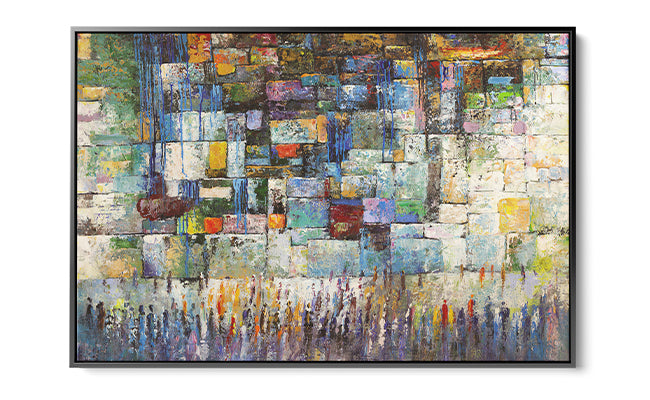
Technique matters too. A traditional Jerusalem cityscape is painted to be recognizable: the Dome of the Rock, the Old City walls, the Tower of David all appear in their correct spatial relationships. An abstract Kotel painting by a contemporary artist might reduce the Western Wall to planes of texture and warm gray-gold stone tones, letting the emotional weight of the site arrive through atmosphere rather than architecture. Both are depicting the same place. The experience of looking at them is entirely different.
Curator's note: When you are choosing between the two approaches, ask yourself whether you want the art to announce its meaning immediately or to reveal it over time. A piece that reveals itself slowly is almost always a better long-term investment in terms of how you will live with it.

Abstract Judaica also gives artists more room to grapple honestly with complex subjects. A literal painting of Jews praying at the Kotel carries one emotional register. An abstract interpretation by an artist who prays there themselves, who has embedded the texture of the stone and the quality of the light into non-literal mark-making, can carry something harder to name: grief, continuity, hope, the weight of generations. That is what abstract Judaica art means when it is working at its best.
How Modern Judaica Treats Sacred Subjects Like the Kotel and Jerusalem
The Western Wall is the most painted Jewish subject in contemporary Israeli art, and for good reason. It concentrates everything that makes sacred subjects challenging for an artist: the site is specific and universally recognized, yet the experience of standing at it is almost entirely interior. A painting that just shows the stones is, in a sense, showing the least important part.
Modern Kotel art for the home solves this by prioritizing feeling over topography. Look at how Avigdor Ben Ari approaches the subject in his acrylic series: the stone courses are present but they blur at the edges, and the palette moves between warm ochre and cool gray in a way that evokes the shift of light on Jerusalem limestone from morning to afternoon. The wall is not a monument in these paintings. It is a presence. That is a distinctly modern approach to a sacred site, and it is why these pieces fit naturally in contemporary interiors that would reject a more literal treatment.
Yossi Bitton takes a related but different path. His Kotel compositions often play with the tension between mass and light, using impasto-like surface effects (even in print form) to suggest the physical weight of the stones against the openness of the sky above them. His piece "Moriah, Jerusalem" is a good example: the color is warmer and the composition quieter than Ben Ari's work, which makes it well-suited for rooms that need a contemplative rather than dramatic focal point.
For buyers new to contemporary Jerusalem wall art, the meaningful distinction is this: the subject gives you the connection to place and faith, and the artistic treatment determines how that connection lives in your home day to day.
If you want to understand how these approaches fit into a broader design context, the article on using Kotel art as the anchor of a gallery wall covers that practically and specifically.

Which Style Fits Your Home and Your Jewish Identity
This is the question most buyers are really asking, and it deserves a direct answer. The right choice is not about how observant you are. It is about how you think about space and how you want Jewish identity to appear in your home.
A simple three-step framework helps here.
First, consider the emotional register of the room. A dining room used for Shabbat and holidays often benefits from art that is immediately recognizable as Jewish, because guests will encounter it and it becomes part of the ritual environment. A study or a bedroom, where you live with the piece privately, is where abstract Judaica often performs best: the work deepens with daily proximity rather than needing to announce itself.
Second, look at the dominant colors and materials already in the space. Traditional Judaica, with its gold accents, deep blues, and graphic black-and-white text, tends to suit warmer or more richly furnished rooms: dark wood, velvet, brass. Modern Judaica in the acrylic print format, especially pieces that work in a cool stone-and-linen palette, sit naturally in modern, minimalist, or Japandi-influenced interiors where the goal is calm visual weight without visual noise.
Third, scale to the wall, not to the object. A 12-inch decorative hamsa is a traditional Judaica object, not wall art in the architectural sense. If your wall is 8 to 10 feet wide, you need a piece sized between 36 and 60 inches on its longest dimension to anchor it properly. Many of the acrylic Kotel prints in Ben Ari Art Gallery's collection scale to that range and beyond, which is part of what makes them function as genuine room anchors rather than decorative accents.
Styling note: Hang large-format Judaica wall art so the visual center of the piece sits approximately 57 to 60 inches from the floor. That is standard gallery hang height and keeps the art in comfortable eye-line whether you are standing or seated.
On the question of Jewish identity: modern Judaica is not more or less Jewish than traditional decor. It simply makes different choices about how that identity is expressed. A family with strong roots in the Eastern European craft tradition may feel that a hand-painted ketubot or a carved wooden mizrach plaque connects them more viscerally to their heritage. A family that grew up with Israeli modernism, or that simply wants their home to feel coherent with a contemporary design sensibility, will find modern Judaica carries equal weight with more formal visual means.
You can also explore how contemporary Jewish artists have developed these visual strategies across mediums and periods in this overview of how contemporary Judaica has evolved as an artistic discipline.

Mistakes to Avoid When Choosing Modern Judaica Wall Art
Buying any significant piece of wall art involves a few decisions that are easy to get wrong. These come up specifically often with modern Judaica.
- Buying too small for the wall. Abstract art reads very differently at 12 inches than at 40 inches. The color relationships, the sense of texture, and the compositional impact all require a certain scale to land. If the wall is large, err toward the larger format option.
- Assuming abstract means religion-free. A number of buyers hesitate over abstract Kotel paintings because they are not sure the piece reads as Jewish. It does. The subject, the artist's intention, and the way the piece will function in a Jewish home all carry that meaning. Abstract treatment does not secularize sacred subject matter.
- Matching art to furniture color instead of wall tone. Acrylic prints have a luminous quality that interacts with wall color more than furniture color. Test the palette of the piece against your wall, not your sofa.
- Hanging a large piece without proper anchoring. Acrylic prints have real weight. Follow the manufacturer's hanging instructions precisely, use appropriate wall anchors for the surface type, and do not rely on adhesive strips for anything over 5 pounds.
- Buying from a screen without checking the actual dimensions in your space. Cut a piece of kraft paper to the exact size of the artwork and tape it to your wall for a day before you order. This one step eliminates most size regrets.
Where to Find Original Modern Judaica Wall Art Worth Buying
Translating the ideas in this article into an actual purchase means knowing what to look for in a specific piece. A few editorial pointers based on the collection at Ben Ari Art Gallery, where the work is made specifically by Israeli artists with serious studio practices.
Avigdor Ben Ari's Kotel series, including "Eternal Stones of the Kotel" and his primary Western Wall print, exemplifies what was discussed earlier about prioritizing presence over topography. These are the pieces to consider if you want a work that functions as a daily meditation as much as a piece of decor. They suit living rooms in a modern or transitional style, particularly where the wall is uncluttered and can hold a large format without competition.
Yossi Bitton's work in the same collection takes a warmer, more intimate approach. His "Moriah, Jerusalem" and "Gathered at the Kotel" compositions have a quality of quiet reverence that makes them natural in dining rooms, studies, and master bedrooms. If the room calls for contemplation rather than drama, his palette is the one to consider.
For buyers who want to go deeper into each artist's full range before deciding, the Avigdor Ben Ari Judaica collection and the Yossi Bitton collection are organized by artist and give a clearer sense of each one's recurring themes and color sensibilities.
If the Kotel is not the right subject for your space but you want the same contemporary approach applied to Jerusalem more broadly, the Jerusalem modern Jewish art collection includes cityscape and architectural work by several artists across different compositional moods.

On format: acrylic prints in this category are typically printed on archival-quality material and mounted on a rigid substrate. The surface has a slight depth and luminosity that a standard canvas or paper print cannot replicate. For rooms with natural light, that surface quality makes the piece feel alive in changing light conditions in a way that significantly adds to the long-term satisfaction of living with it.
Best for: Buyers who want a single large statement piece above a sofa, credenza, or dining table. In that placement, a 40-by-60-inch or larger acrylic Kotel print will anchor the room architecturally in a way that a grouping of smaller traditional pieces rarely achieves.
Caring for and Displaying Modern Judaica Art in Your Space
Acrylic prints are durable, but they need specific handling to stay that way. The surface should be cleaned only with a soft, lint-free microfiber cloth and water. Avoid ammonia-based glass cleaners: they cloud acrylic over time. If the piece has a protective film on delivery, remove it carefully and only once the piece is hung.
Placement relative to light sources matters more than most buyers expect. Direct sunlight causes fading in any pigment-based print over time, including archival-grade acrylic work. Position the piece so it receives indirect natural light or is lit by a dedicated picture light or track spot. A warm-temperature LED (around 2700 to 3000 Kelvin) enhances the ochre and warm stone tones in most Kotel compositions without color-casting the cooler grays.
In terms of display context, modern Judaica works best when it has space to breathe. A large-format Kotel print does not need a gallery wall around it; the subject carries enough gravity to command a wall alone. If you want to extend the theme into a fuller display, the principles in this guide to displaying sacred art with intention are directly applicable to contemporary Judaica in a home setting.
For rooms beyond the living room, abstract Kotel prints work in entry halls as a way of establishing the character of the home immediately. Keep the piece at least 12 inches from any adjacent door frame to avoid a crowded look. In a dining room, center the piece on the wall behind the head of the table rather than over a sideboard, which puts it too low when guests are seated.

Storage, if you ever need to move the piece: keep the original packaging, store the print vertically rather than flat, and do not stack anything against the surface. Acrylic does not crack under normal conditions but is vulnerable to pressure marks if stored improperly.
Frequently Asked Questions
What is modern Judaica wall art and how is it defined?
Modern Judaica wall art applies contemporary fine-art techniques, including abstraction, expressionism, and color-field composition, to Jewish subjects: sacred sites, spiritual themes, and cultural memory. The defining characteristic is that the artistic treatment is primary and the symbolic legibility that defines traditional Judaica is secondary or absent. A piece qualifies as modern Judaica when its Jewish identity comes through atmosphere and artistic choice rather than through recognizable symbols or Hebrew text alone.
How does abstract Judaica art differ from traditional Jewish wall decor?
The core difference is in how meaning is delivered. Traditional Jewish wall decor makes its meaning immediately readable: a hamsa, a menorah, a blessing in Hebrew script communicate clearly without any artistic interpretation required. Abstract Judaica asks you to bring your own understanding of the subject. A painting of the Kotel that abstracts the stones into planes of texture and light will mean more, not less, to someone who has stood at the Wall. The art is not less Jewish; it is differently Jewish.
Can modern Judaica art still carry religious meaning even if it looks abstract?
Yes, and arguably more effectively for some viewers. Religious meaning in visual art is not confined to literal depiction. A non-objective color-field painting made by an artist whose intent is the Shekhinah, or the spiritual weight of a sacred site, carries that meaning in its making, its title, and the relationship between viewer and object. The abstraction does not dilute the intention; it invites the viewer into an active, personal encounter with the subject rather than a passive reception of a fixed message.
Is modern Judaica wall art appropriate for non-Orthodox Jewish homes?
Yes, across the full spectrum. Modern Judaica is particularly well-suited to homes where Jewish identity is strongly felt but where the visual environment skews contemporary, minimalist, or design-forward. Because the art does not rely on overt ritual symbolism, it connects to Jewish experience through cultural and spiritual depth rather than observance-specific iconography. That makes it a natural fit in Reform, Conservative, Masorti, secular Zionist, and culturally Jewish homes where traditional decor might feel misaligned with how Jewish identity is actually lived.
What makes a piece of Jerusalem or Kotel art count as modern Judaica?
Subject matter alone is not enough. A photograph of the Western Wall sold at a tourist kiosk is not modern Judaica in any meaningful artistic sense. A piece counts as modern Judaica when an artist has made intentional formal choices, about composition, color, texture, and scale, that communicate something about the Jewish relationship to that site, not just its physical appearance. Artist background and intent matter: work by Israeli artists like Avigdor Ben Ari and Yossi Bitton carries the weight of lived connection to the places they depict, which is part of what distinguishes it from decorative illustration.
How do I know if modern or traditional Judaica art is the right choice for my space?
Check the room against three criteria. First, who uses the space and when: rooms used for communal ritual benefit from immediate visual legibility, which favors traditional decor. Second, the finish level of other objects in the room: if your fixtures and furniture are high-design, traditional Judaica objects may look mismatched regardless of their intrinsic quality. Third, how often you redecorate: modern Judaica in a restrained palette has a longer design lifespan in changing interiors than trend-sensitive traditional pieces because abstraction ages better than ornament.
If you are ready to see how these distinctions look in practice, the Western Wall art and modern Judaica collection brings together original acrylic works by Avigdor Ben Ari, Yossi Bitton, and other Israeli artists, spanning a range of scales, palettes, and compositional approaches suited to serious contemporary interiors. Each piece there represents a considered artistic interpretation of subjects that matter most in a Jewish home.
Read more
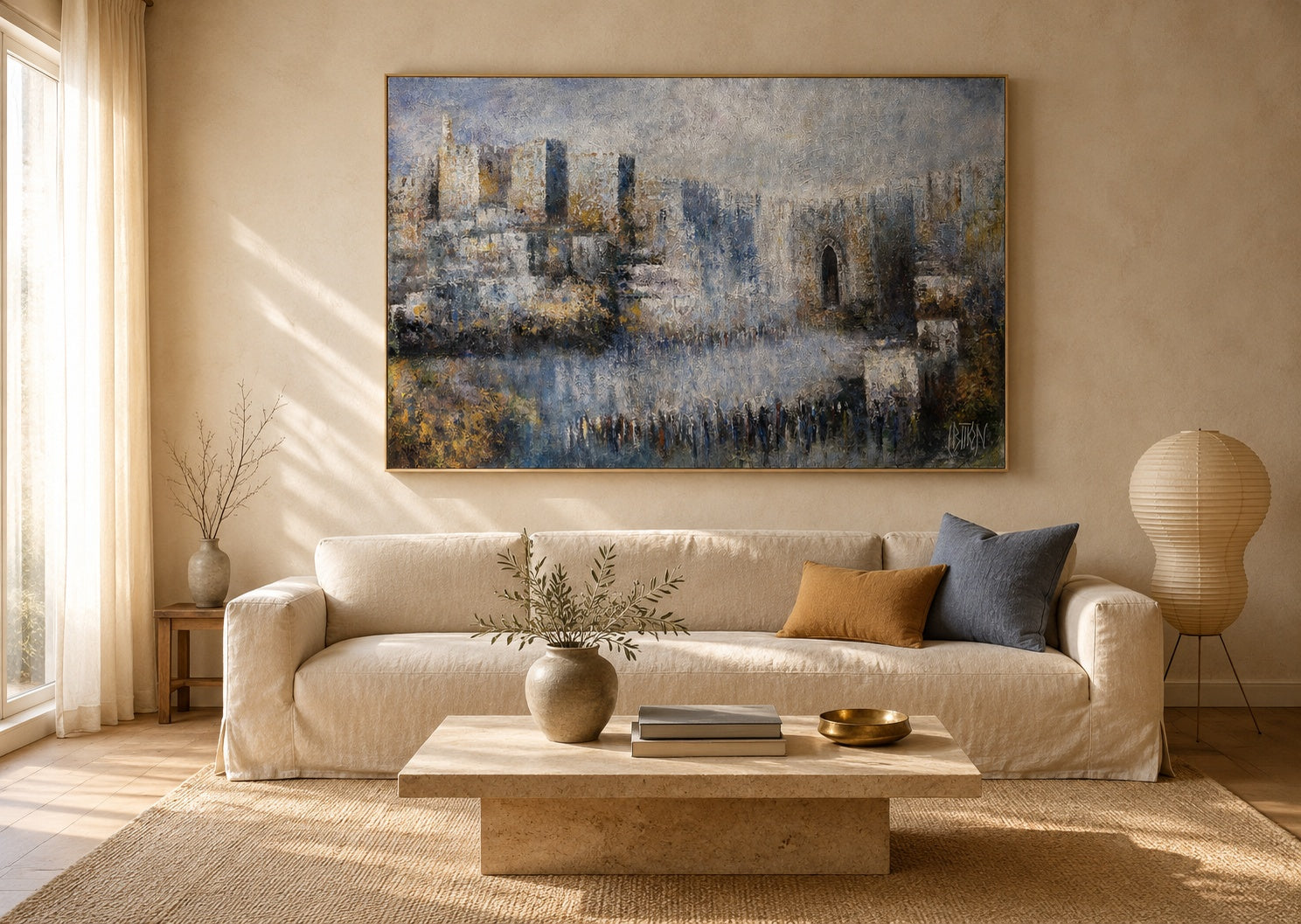
Jerusalem Inspired Israeli Wall Art: How Artists Capture the City
A practical guide to Jerusalem-inspired Israeli wall art, how Israeli artists approach the city, what separates great work from decorative filler, and how to choose the right piece for your interior.
Read more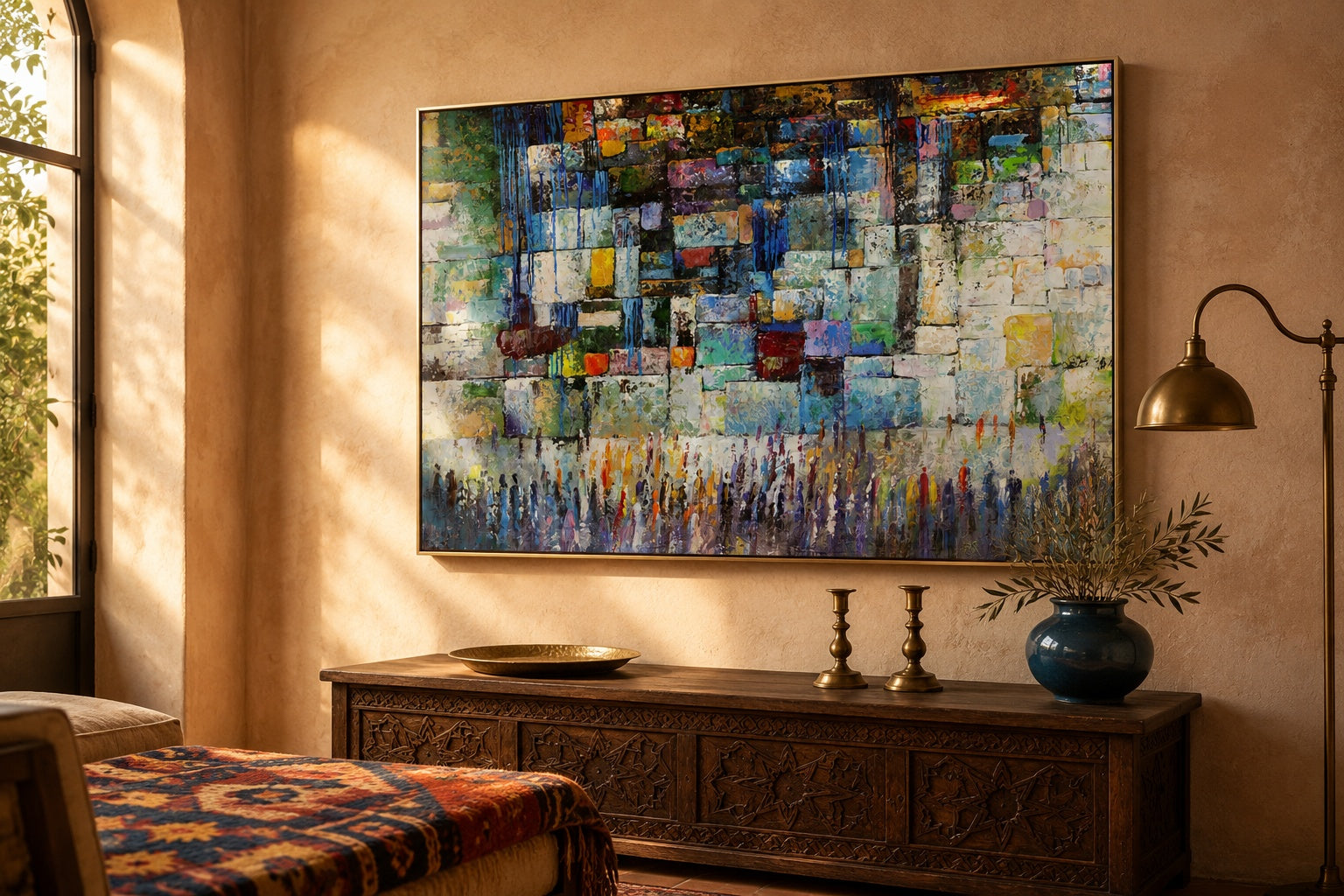
What Is Contemporary Judaica and How Has It Evolved
A practical and historical guide to contemporary Judaica, what defines it, how it evolved from traditional craft, and how to choose pieces that work in a sophisticated modern home.
Read more