


What Is Contemporary Judaica and How Has It Evolved
What Is Contemporary Judaica and How Has It Evolved
What Is Contemporary Judaica: A Working Definition
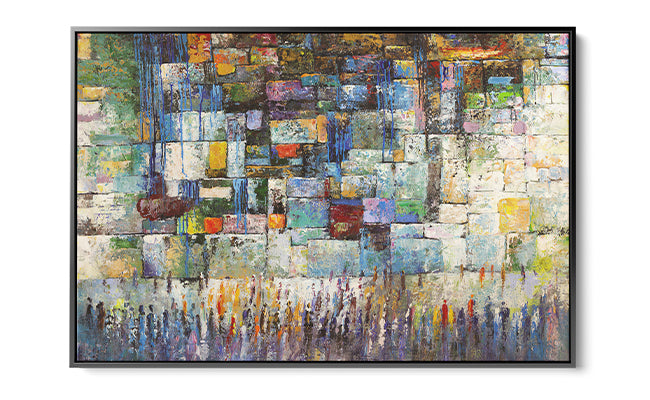
Contemporary Judaica is Jewish ceremonial, cultural, and artistic work made in modern idioms, using current materials, visual languages, and design sensibilities, while remaining rooted in Jewish identity, tradition, or spiritual life. The term covers a wide range: from a hand-thrown ceramic Kiddush cup to a large-format acrylic painting of the Western Wall. What unifies these objects is not a single style but a shared intention: to engage meaningfully with Jewish experience through a contemporary creative lens.
The field has expanded dramatically over the past several decades. Artists working today draw on abstract expressionism, minimalism, photography, digital printing, and mixed media, applying those tools to subjects that have occupied Jewish artists for centuries: Shabbat light, sacred texts, holy sites, and the rhythms of Jewish communal life. Understanding what contemporary Judaica is, and how it got here, helps you make sharper choices when you are furnishing a home or selecting a meaningful gift.

How Traditional Judaica Laid the Foundation
To understand where contemporary Judaica stands, it helps to know what it is departing from. For most of recorded Jewish history, Judaica meant ritual objects: Torah mantles, Hanukkah menorahs (Hanukkiot), Kiddush cups, Havdalah sets, Mezuzot, and Passover Seder plates. These were made to a functional specification, usually in silver, brass, or hand-painted ceramics, decorated with biblical motifs, Hebrew lettering, and iconographic symbols like the Magen David, the menorah, or the hamsa.
Craftsmanship was paramount. A silversmith in 18th-century Frankfurt applied the same formal vocabulary as a craftsman in Warsaw or Baghdad, because the objects served a halakhic purpose and had to communicate their sanctity legibly to any Jewish community. Regional styles existed, but the visual grammar was shared and conservative by design.
That conservatism was not a failure of imagination. It reflected a coherent theology: objects made for mitzvot deserve the best craft, and continuity of form across generations reinforces continuity of practice. That principle, known in Jewish law as hiddur mitzvah (beautifying the commandment), is still the philosophical backbone of Judaica today, even when the visual form looks nothing like an 18th-century silver menorah.
The history of Judaica art also reflects the places Jewish communities lived. Moroccan Jewry brought geometric tile-work patterns into their ceremonial objects. Italian Jews absorbed Renaissance motifs. Ashkenazi artisans in Central Europe favored filigree metalwork. These regional inflections are the first evidence that Jewish artistic identity was never monolithic, a fact contemporary artists have leaned into fully.

The Turning Points: How Contemporary Judaica Evolved Through the 20th Century
The most significant shift in how Judaica art evolved came in the early-to-mid 20th century, through two intersecting forces: the rise of the Bezalel Academy of Arts and Design in Jerusalem (founded 1906) and the upheaval of the Holocaust and subsequent founding of the State of Israel.
Bezalel's founders set out to create a distinctly Jewish visual art by fusing European academicism with Near Eastern ornament and Zionist idealism. The results were sometimes overwrought, but the institution permanently changed the conversation. Jewish art was no longer only craft in service of ritual; it could be fine art in its own right, with Jewish identity as subject matter rather than decoration.
After 1948, Israeli statehood gave that conversation urgency and geographic grounding. Artists now had to define what Israeli-Jewish visual culture looked like, independent of the Diaspora experience. Abstract painters, sculptors, and printmakers tackled the landscape of the Land of Israel, the meaning of return, and the psychological weight of collective memory. Much of this work was not Judaica in the traditional sense, but it seeded the visual vocabulary that later generations would bring back into ceremonial and decorative contexts.
In the United States and Europe, the 1970s and 1980s saw a parallel Jewish renewal movement that created demand for Judaica reflecting a modern sensibility. Craft artists, many trained in fine-arts programs, began making Seder plates in blown glass, Mezuzot in anodized aluminum, and Shabbat candlesticks with sculptural abstracted forms. The boundary between art object and ritual object started to blur deliberately.
By the 1990s, that boundary had largely dissolved. A ceramic Kiddush cup made by a studio artist who happens to be Jewish, a limited-edition print of a Jerusalem streetscape, and a large canvas painting of Chassidic figures in motion could all, credibly, be called contemporary Judaica. If you want to go deeper on which artists have driven this shift most visibly, this guide to significant contemporary Jewish artists covers the landscape in detail.

What Makes Judaica Contemporary: Materials, Styles, and Themes
Contemporary Judaica is most easily identified by three characteristics: material innovation, stylistic pluralism, and thematic breadth.
Materials
Traditional Judaica relied on silver, brass, ceramic, and wood. Contemporary practitioners add acrylic, cast resin, aluminum, archival canvas, UV-cured inks, hand-pulled screen print on museum stock, and mixed-media assemblage. The shift to acrylic art, in particular, has had a large impact on wall Judaica. High-gloss acrylic panels printed or painted with vivid color fields read differently in light than canvas, catching and moving with natural and artificial light across the day. For a decorating decision, that material behavior matters: acrylic pieces feel more dynamic in rooms that receive changing light; canvas has a softer, warmer presence.
Styles
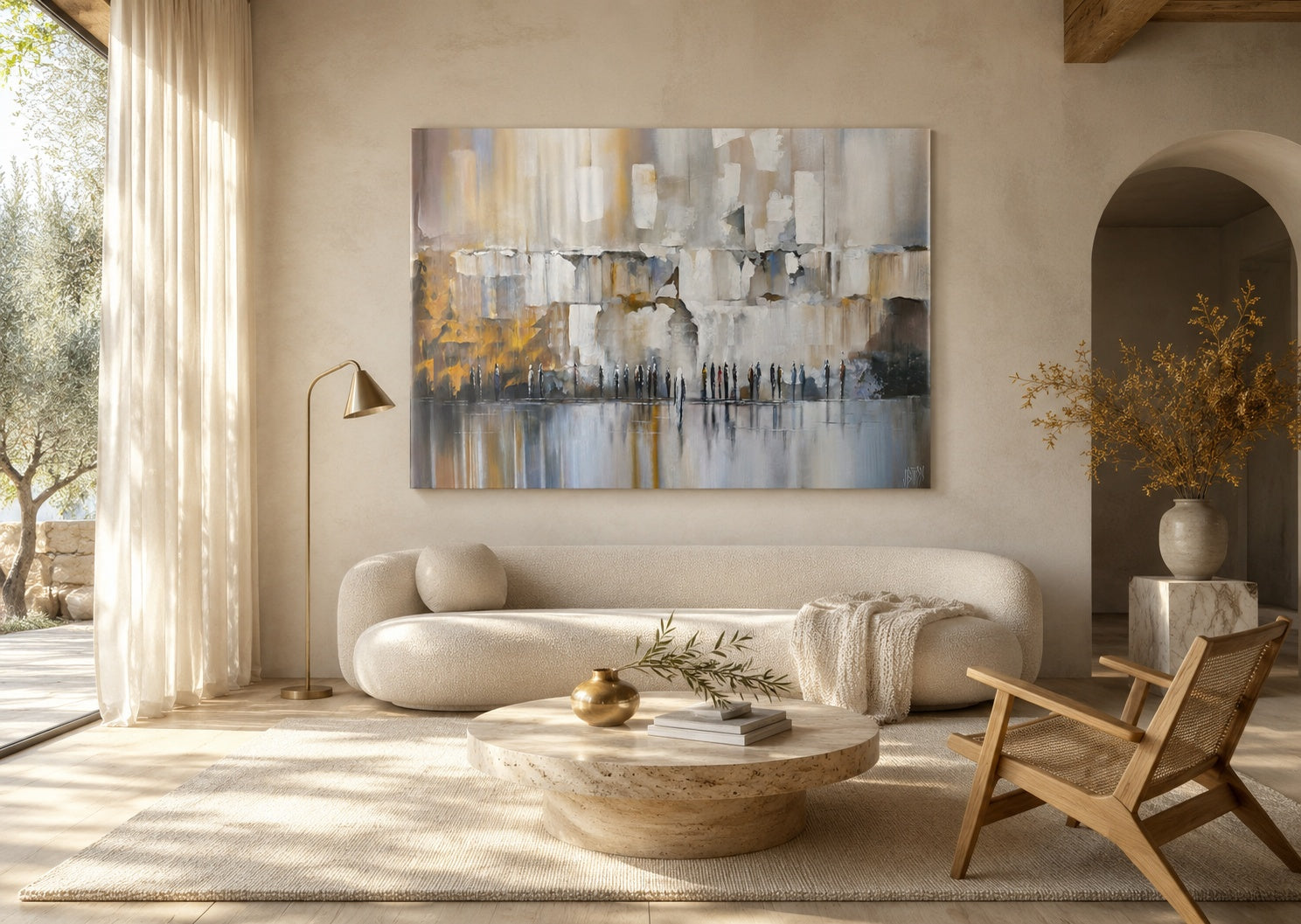
Contemporary Judaica spans abstract expressionism, graphic minimalism, painterly realism, and everything between. An artist like Avigdor Ben Ari approaches the Western Wall through layered, light-saturated abstraction; the stones are present but dissolved into planes of gold and ochre. A more figurative artist might render the same site with architectural precision. Neither approach is more authentically Jewish than the other. What matters is intentionality: the work is engaging with something real in Jewish spiritual or cultural life.
Themes
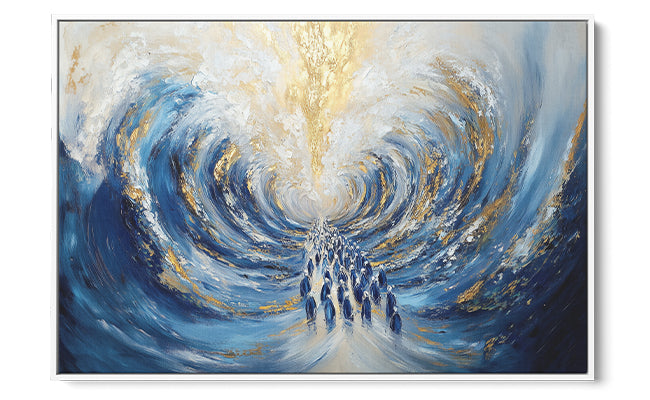
The subject range has expanded well beyond ritual calendars. Contemporary Judaica addresses: holy sites and landscape (Jerusalem, the Kotel, the Galilee); lifecycle moments (Shabbat candlelighting, weddings, bar and bat mitzvahs); communal celebration (Simchat Torah dancing, Chassidic joy); mystical and kabbalistic imagery; and the texture of everyday Jewish identity. Some of the strongest work sits at the intersection of the personal and the communal, capturing a felt experience rather than illustrating a concept.
Curator's note: When evaluating whether a piece qualifies as genuine contemporary Judaica, ask whether the Jewish reference is structural to the work or simply decorative. A Magen David placed on an otherwise generic print is decoration. A composition built around the movement of Shabbat light entering a room is Judaica.
Contemporary Judaica and the Jewish Home: From Ritual Objects to Wall Art
That design thinking connects directly to how contemporary Judaica lives in an actual home, which is where most buyers encounter this shift most personally.
Functional Judaica (candlesticks, Kiddush cups, mezuzot) still anchors the Jewish home. But over the past two decades, wall art has become as central to Jewish domestic identity as any ritual object. A large painting of the Kotel in a foyer carries the same spiritual and cultural weight as a mezuzah on the doorpost, just in a different register. And unlike a silver Kiddush cup, wall art works in every room.
The practical question for homeowners is how to integrate Jewish art with a contemporary interior that may be minimalist, modern, or Scandinavian in character. The answer almost always comes down to palette and scale rather than subject matter. A large-format abstract work with a warm, limited color field reads first as sophisticated wall art and reveals its Jewish subject as you move closer. That layered reveal is one of the defining qualities of the best contemporary Judaica for the home.
For concrete placement strategy, this guide on displaying sacred art with intention covers room-by-room sizing and hanging-height decisions in detail. But the core principle is this: hang the center of a piece at eye level, typically 57 to 60 inches from the floor, and size the art to cover roughly two-thirds of the furniture width it anchors. A sofa that is 84 inches wide calls for a piece or arrangement spanning roughly 55 to 56 inches.
Styling note: In rooms with warm wood tones and natural textiles (linen, jute, raw plaster walls), look for Judaica with gold, ochre, or amber in the palette. Cooler interiors, concrete or painted white walls, brushed metal hardware, respond better to pieces with blue, teal, or silver-gray fields.

How to Recognize Quality Contemporary Judaica and Find Pieces Worth Owning
The field has grown large enough that quality varies considerably. Here is a practical framework for evaluating any piece before you commit.
Step 1: Read the composition before the subject
Cover the Hebrew text or the recognizable Jewish symbol with your hand. Does the remaining composition still hold together as a work of visual art? Is there a sense of light, movement, or spatial depth? If the answer is no, the Jewish content is doing all the structural work, and the result is illustration rather than art. The strongest contemporary Judaica is artistically coherent on its own terms, and additionally meaningful in its subject.
Step 2: Assess the material honestly
For wall art specifically, ask about the substrate, print technology, and finish. Archival-grade acrylic or canvas with UV-resistant inks does not fade the way dye-based consumer prints do. Museum-quality acrylic panels have a surface depth that flat paper prints cannot replicate. These distinctions have real consequences for a piece you intend to hang in a main living space for decades.
Step 3: Verify the artist's relationship to the subject
Contemporary Judaica made by artists who live inside the tradition tends to carry a different quality of specificity. It is not that non-Jewish artists cannot engage seriously with Jewish themes, but there is a difference between illustrative reference and embodied experience. Look for an artist's statement or biography that speaks to how they came to the subject.
Common mistakes to avoid:
- Buying on Hebrew text alone. Calligraphic pieces with popular verses are widely available; most are printed on low-grade stock. If the Hebrew is the primary visual element rather than part of a larger composition, apply extra scrutiny to the material quality.
- Ignoring scale. A piece intended for a main wall that is only 16 by 20 inches will feel lost. Pull out a tape measure before ordering.
- Choosing a piece that matches your current furniture exactly. The best art anchors a room and guides future decisions; it should lead the palette slightly, not merely confirm it.
- Overlooking the frame or mount. A strong contemporary piece in a poorly made frame is a contradiction. On acrylic panels, the depth and finish of the mount matters as much as the image.
For a broader look at how different Jewish art styles sit in specific rooms, the room-by-room guide to Jewish art styles is a useful complement to this framework.

Where Contemporary Judaica Is Headed: Trends Shaping the Next Generation
Several forces are actively reshaping the field, and knowing them helps you buy with more confidence.
Abstraction is deepening. Artists are moving further from literal representation of Jewish iconography toward works that capture emotional or spiritual states. The Western Wall rendered as pure light and stone texture rather than architectural record; Shabbat evoked through a field of warm amber rather than a set of candles. This demands more from the viewer but results in pieces that live comfortably in sophisticated interiors without announcing themselves as explicitly religious art.
Material hybrids are proliferating. Acrylic over handmade paper, digital printing on brushed aluminum, resin layers over traditional gold leaf: the material vocabulary keeps expanding. For buyers, this creates opportunity and noise in equal measure, which is why step two of the framework above (assess the material honestly) matters more than ever.
Female artists are increasingly central. For most of Jewish history, the craft and artistic traditions that produced Judaica were male-dominated guild structures. That has shifted substantially. Artists like Menucha Yankelevitch bring a distinct perspective to subjects like Simchat Torah celebration or the warmth of Shabbat preparation, compositions where the emotional interior of the moment is the subject, not its external pageantry.
Diaspora and Israeli voices are converging. With digital platforms, an artist working in Tel Aviv and one working in New York are in the same conversation. The result is a richer cross-pollination between Israeli landscape sensibility and Diaspora community experience, producing work that is neither purely Israeli nor purely Diaspora but genuinely both.
Designer's tip: If you are furnishing a home with a long horizon, prioritize artists with a coherent body of work over individual striking pieces. A home that holds three or four works by the same artist develops a through-line that individual acquisitions cannot create, and contemporary Judaica lends itself well to this kind of intentional collecting.

Finding Pieces That Reflect What You Have Just Read
The ideas above come together clearly when you look at specific works. Abstract Western Wall paintings, like Avigdor Ben Ari's acrylic series, apply the principle discussed in the style section: the Kotel is present through light, texture, and implied mass rather than literal stone-by-stone rendering. His pieces work in minimalist and modern interiors precisely because the composition reads as serious abstract painting first. The full range of Ben Ari's work demonstrates how a single artist can approach the same subject, Jerusalem's sacred sites, through multiple compositional strategies without repetition.
Menucha Yankelevitch's figurative work illustrates the point about embodied experience. Her "Dance of Joy" piece, with its expressive Chassidic figures in motion, and "Embrace of the Torah," a Simchat Torah composition, both derive their energy from the artist's firsthand knowledge of what these celebrations feel like from inside the community. These are not illustrations of events; they are records of atmosphere. Works in this register suit warm, layered interiors: natural wood, textile-rich spaces, homes where the art should feel lived-in rather than gallery-cool. Browse the Menucha Yankelevitch collection to see the full breadth of her figurative approach.
Yossi Bitton's menorah wall art takes a different route: the Mishkan-inspired composition uses architectural light to connect the ancient with the contemporary, a piece that suits a more formal entry hall or dining room where you want presence without narrative density. The Yossi Bitton collection shows how his formally rigorous approach extends across multiple ritual and architectural subjects.
All of these artists represent what the history section described as the post-Bezalel generation: trained in fine art, fluent in contemporary visual language, and working with clear intentionality from within Jewish tradition. The Jewish life and home decor collection brings together a wider range of subjects, including everyday Jewish moments that sit alongside the holy-site paintings and give a home's art program more tonal variety.
Frequently Asked Questions
What is the difference between traditional Judaica and contemporary Judaica?
Traditional Judaica centers on ritual objects made to established forms, primarily in silver, brass, or ceramic, with iconography drawn from a shared Jewish visual canon. Contemporary Judaica expands that definition to include fine art, wall art, and mixed-media objects that engage with Jewish identity, spirituality, or history through modern visual languages. The functional distinction matters too: traditional Judaica is often made to fulfill a specific mitzvah; contemporary Judaica may serve a devotional, aesthetic, cultural, or commemorative purpose without a specific halakhic function.
Does contemporary Judaica have to be religiously observant in style or subject?
No. Some of the most compelling contemporary Judaica deals with secular Jewish identity, historical memory, Israeli landscape, or the cultural texture of Jewish communal life rather than religious observance. The thread connecting all of it is intentional engagement with Jewish experience, not adherence to a religious framework. A painting of the Galilee that evokes a specifically Israeli-Jewish relationship to land is as legitimately Judaica as a painting of Shabbat candlelighting.
What kinds of items are considered contemporary Judaica today?
The category now includes: wall art (acrylic, canvas, fine art prints, mixed media), sculptural ritual objects (menorahs, Kiddush cups, Seder plates, Havdalah sets), textiles (challah covers, matzah covers, Shabbat tablecloths), jewelry with Jewish iconographic or textual references, and architectural elements like artistic mezuzah cases. Within wall art specifically, large-format abstract and figurative pieces depicting holy sites, Jewish celebration, and spiritual moments have become a distinct and rapidly growing segment.
Who are some of the artists shaping contemporary Judaica right now?
Avigdor Ben Ari works in light-saturated acrylic abstraction centered on Jerusalem's sacred sites, with a palette that ranges from warm gold to deep blue. Menucha Yankelevitch brings expressive figuration to Jewish communal celebration, particularly Chassidic themes. Yossi Bitton focuses on architectural and ritual subjects with a formally rigorous compositional approach. These are three artists whose work exemplifies the range of the field without exhausting it. Newer voices are emerging constantly, particularly among Israeli women artists and those working at the intersection of digital and traditional media.
Can contemporary Judaica wall art work in a non-religious Jewish home?
Consistently, yes, provided the pieces are chosen for compositional strength first. A large abstract acrylic anchored in warm amber and gold, whose subject happens to be the Western Wall, reads in an agnostic interior as a serious, architecturally confident work of art. The Jewish resonance is there for those who know it and entirely optional for those who don't. The key selection criterion for a non-religious home is the same as for any home: does the work hold together visually on its own terms, independent of the label?
How do I know if a piece of contemporary Judaica is authentic and well made?
Ask four specific questions: Is the artist's background and training documented? Is the substrate archival quality (UV-resistant inks, museum-grade acrylic or canvas)? Does the piece carry edition information if it is a print (open editions and unlabeled prints are a quality warning sign)? And does the gallery or retailer stand behind the work with a clear returns policy? Price is an imperfect signal but useful at the margins: serious studio-quality acrylic work on gallery-grade panels starts well above mass-produced print territory. A piece that seems underpriced for its described materials warrants closer inspection.
To see a focused collection of pieces that meet these criteria, browse the contemporary Judaica holy sites collection, abstract Western Wall art, Shabbat compositions, and figurative Jewish celebrations, all produced on archival acrylic by artists with a clear, documented relationship to their subjects.
Read more
What Is Modern Judaica Wall Art vs. Traditional Jewish Decor
A practical guide to what separates modern Judaica wall art from traditional Jewish decor, covering style, technique, sacred subjects, and how to choose the right piece for your home.
Read more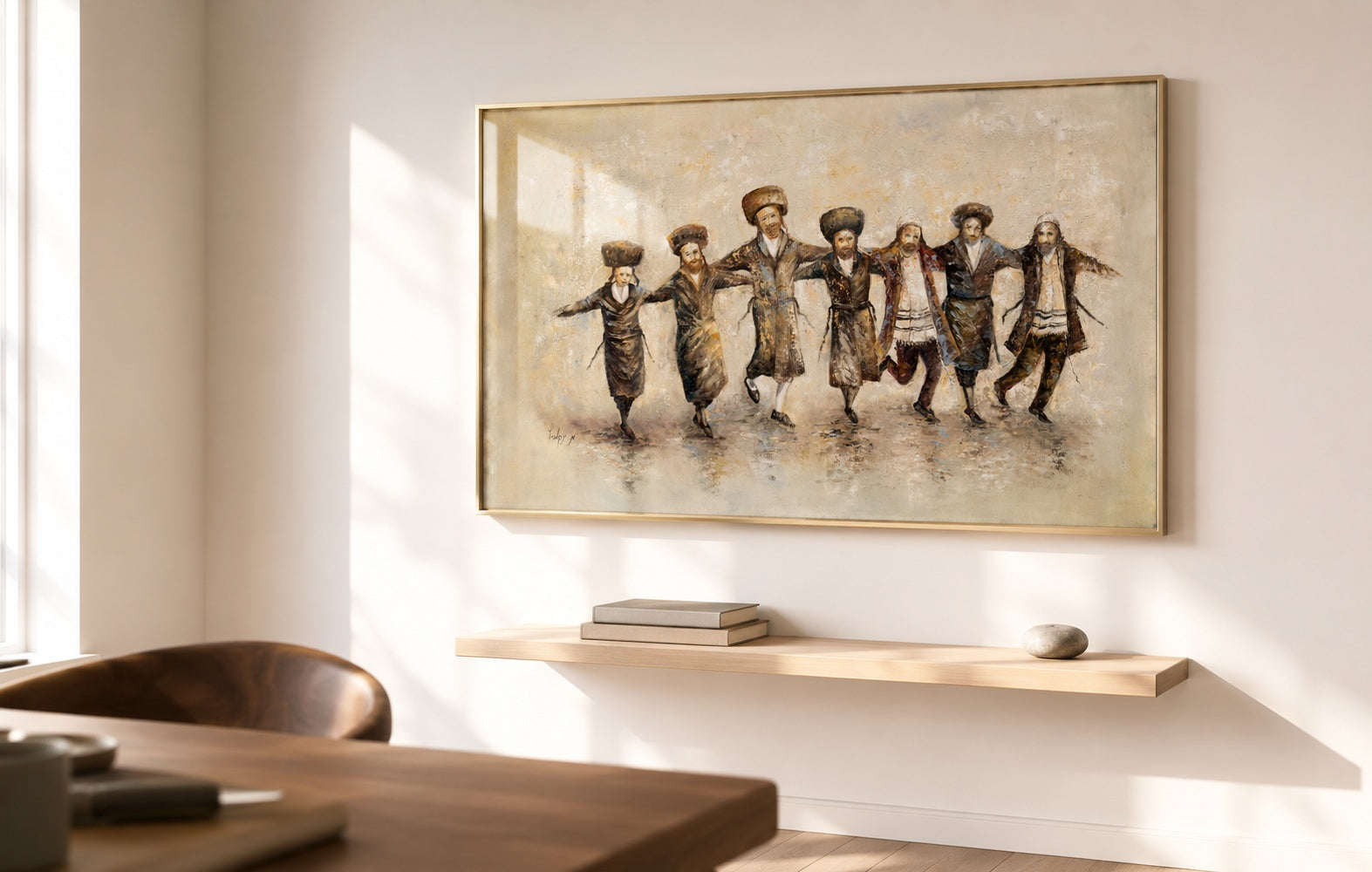
How to Choose Jewish Artwork for Your Home: Tips from a Fine Art Gallery
A practical guide to choosing Jewish artwork for your home, covering style, symbolism, scale, placement, and quality, so you can buy with confidence.
Read more