


Jerusalem Inspired Israeli Wall Art: How Artists Capture the City
Jerusalem Inspired Israeli Wall Art: How Artists Capture the City
The best jerusalem inspired israeli wall art draws from one of the longest artistic traditions in the world, yet reads as fresh and alive as anything being made today. Israeli artists approach the city not as illustrators of a postcard skyline but as interpreters of memory, faith, and geology, all at once. The result spans near-photographic realism, expressive abstraction, and everything between, united by a shared obsession with light, stone, and the weight of place.
That range is exactly what makes this category so useful for a serious interior. A Jerusalem canvas can anchor a room without reading as devotional furniture, or it can carry deep spiritual resonance without looking out of place in a modern interior. Understanding how these artists think, and what separates a great piece from a decorative placeholder, makes it far easier to choose well.
Why Jerusalem Has Captivated Israeli Artists for Generations
No other city in Israeli consciousness carries the same density of meaning. Jerusalem is simultaneously a physical place, a theological idea, a collective grief, and an ongoing argument. For Israeli artists, painting it is never neutral. The city shows up in their work the way childhood does for other painters: not as a subject chosen from a list, but as something that keeps returning.
The tradition has deep roots. Artists working in the British Mandate period were already wrestling with how to depict Jerusalem honestly, without reducing it to orientalist fantasy. By the mid-20th century, Israeli modernists had begun using the city's stone terraces and light-washed valleys as raw material for abstraction. That lineage continues directly into contemporary work.
What distinguishes this tradition from Western European religious city painting is its relationship to lived presence. Most great European religious city paintings were made by outsiders looking in. Israeli artists painting Jerusalem are often painting the view from their own window, or from a hillside they walked to that morning. That intimacy shows in the work: the scale feels human, the light is specific rather than symbolic, and the emotional register is complicated rather than reverential.
For collectors considering contemporary Jewish wall art, understanding that distinction helps calibrate expectations. A piece by a working Israeli artist is not an icon or a reproduction of sacred imagery; it is a subjective response to an extraordinary place.

The Visual Language Israeli Artists Use to Depict Jerusalem
Walk through enough of this work and certain formal choices repeat, not because artists are copying each other, but because Jerusalem imposes its own visual logic.
Stone dominates. Jerusalem limestone, the material the city is legally required to use on its facades, shifts color through the day from pale cream at noon to deep amber at dusk to something almost silver under a full moon. Artists who have spent time there know these shifts viscerally. You see it in palette choices: ochres, siennas, warm grays, the particular dusty gold that no paint manufacturer has ever quite named correctly.
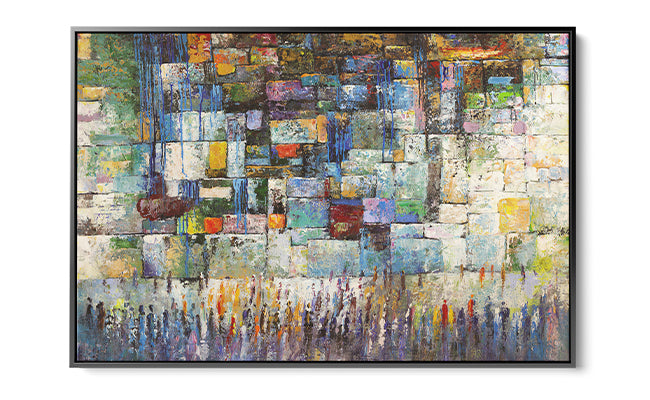
Layering is structural, not decorative. Jerusalem is literally built on itself. Earlier centuries lie beneath later ones; you can see archaeological strata in a building's wall. Artists respond to this by building up paint in visible layers, letting underpainting show through, or fragmenting a scene so that different historical moments coexist on the same canvas. In Yossi Bitton's "Jerusalem Mosaic," this structural layering becomes explicit: the composition fragments the city's surfaces the way a mosaic breaks whole forms into constituent tiles, each piece holding color and light independently.
The horizon is rarely empty. Domes, minarets, the flat rooftops of the Jewish Quarter, cypress trees: Jerusalem's skyline is dense and specific. Artists who simplify it into generality lose the city. Those who commit to its actual geometry, even in abstraction, keep it.
Curator's note: When you are assessing any canvas in this tradition, look at how the artist handles the transition between earth and sky. A Jerusalem painting that gives equal weight to both usually has the stronger composition. If the sky is just background, the city becomes a souvenir.
From Realism to Abstraction: How Styles Shift Across the Jerusalem Art Tradition
The range of approaches within modern Israeli art of the holy city is wider than most buyers expect. A brief orientation helps.
| Style | What it emphasizes | Interior context |
|---|---|---|
| Representational | Specific sites, architectural detail, recognizable skyline | Traditional, transitional, and eclectic interiors |
| Impressionist/Expressionist | Mood and light over precision; emotional color | Warm, layered, art-collector interiors |
| Abstract with Judaica elements | Hebrew text, geometric motifs, spiritual symbols dissolved into composition | Modern, minimalist, Scandinavian, and Japandi spaces |
| Abstract geometric | Jerusalem's architecture broken into planes and shapes | Contemporary, industrial, luxury modern |
In practice, most serious Israeli artists move fluidly across this spectrum within a single body of work, and sometimes within a single painting. Bitton's "Light Over Jerusalem" sits comfortably between expressionism and abstraction: the city is legible in silhouette, but the real subject is the quality of light diffusing over its rooftops at a particular hour. That ambiguity is a strength, not a compromise. It means the painting can live in a room without demanding that everything else defer to it.
For more context on what separates modern Judaica from traditional religious art, this breakdown of modern Judaica versus traditional Jewish decor covers the historical and aesthetic distinctions clearly.

Color, Light, and Stone: The Recurring Elements in Jerusalem-Inspired Canvas Art
Color in Jerusalem painting is almost always warm-anchored. The limestone palette pulls everything toward gold, sand, and sienna. Artists who resist that pull, pushing into cooler blues or grays, are usually making a statement about a particular light condition: the blue hour before sunrise over the Old City, or the flat gray of an overcast winter morning on the Mount of Olives.
Light is the real subject in most of the strongest work. This is not a metaphor for spirituality (though that meaning is present); it is also a factual observation. Jerusalem sits at approximately 754 meters above sea level in the Judean Hills, and at that altitude the air is clear enough that shadows have hard edges and colors stay saturated even at low sun angles. Artists who have painted there, rather than from photographs alone, know this in their hands. The light in their work has a specific temperature and directionality that photographs often flatten.
Look for canvases where the light source is implied rather than illustrated: the stone on the left side of a dome is warmer, the opposite face is cooler, and the eye fills in the rest. That subtlety distinguishes observational painting from illustration. It also ages better in a room, because there is always something new to notice.
Styling note: In a room with warm-toned wood floors or plaster walls, a Jerusalem painting in the ochre-sienna range will deepen the warmth in a way that feels intentional rather than accidental. If your interior runs cooler, look for a canvas that has the limestone palette but introduces a countering blue in the sky, the way actual Jerusalem light behaves at dusk.

How Contemporary Israeli Artists Balance the Sacred and the Aesthetic
This is the tension that defines the whole tradition, and the best artists sit in it rather than resolving it.
At one end of the spectrum are artists who treat Jerusalem as purely aesthetic material: an extraordinary landscape that happens to be in Israel. At the other end are artists who paint the city as liturgy, embedding Hebrew text, sacred geometry, and devotional intention directly into the surface. Most of the interesting work happens between those poles.
Yossi Bitton's practice is a good case study. A piece like "Jerusalem in Heart" uses abstraction to speak to spiritual feeling without being illustrative about it. The composition evokes the city through color and form rather than landmark recognition. Someone who has never been to Jerusalem can respond to it as pure painting. Someone who has prayed facing Jerusalem their whole life will find additional layers. That double register is not easy to achieve, and it is what makes this kind of work genuinely suitable for both a Jewish home and a design-forward interior that may not carry religious associations at all.
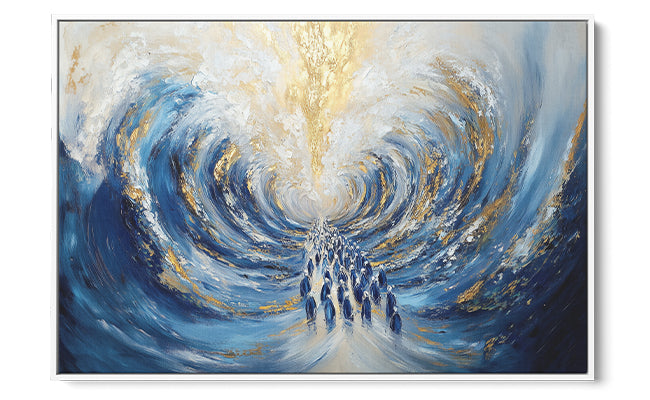
"At the Gates of Jerusalem" works differently: the title is more explicit, the composition more architectural, and the feeling of threshold and arrival is built directly into the visual structure. This is the kind of piece that earns its place near an entryway precisely because it engages the idea of passing through.
For a wider look at how different artists navigate this balance across different subjects and media, the overview of the most significant contemporary Jewish artists working today is worth reading before you commit to any single style.

Bringing Jerusalem Art Into Your Home: How to Choose the Right Piece
The shift from understanding the artistic tradition to choosing a specific piece for a specific room involves a different kind of thinking. Here is a practical framework, moving from inside out: start with mood, then color temperature, then scale.
Step One: Decide on the Emotional Register
Before size or palette, ask what you want the room to feel like. Contemplative and quiet? Look for compositions with open sky, minimal detail, and a horizontal emphasis. Something more active and visually complex? "Glorious Jerusalem" brings more movement and layered color, which suits a dining room or living room where you want a work that rewards extended looking.
Step Two: Match Color Temperature to the Room
If your walls are white or off-white, you have maximum latitude: warm Jerusalem palettes will glow against cool white, and the contrast reads as intentional. Against warm walls, choose a canvas that introduces some sky, so the painting has its own breathing room within the composition. In a room with dark walls, the limestone palette will pop dramatically, but you will lose subtlety in the shadows. In that context, a piece with higher contrast in its own composition will hold up better.
Step Three: Size to the Wall, Not to the Room
The most reliable sizing rule for a single statement canvas: its width should sit between 55 and 70 percent of the furniture piece it hangs above. Above a sofa, measure the sofa width and calculate accordingly. A canvas hung in isolation on a large wall should cover at least 40 percent of that wall's width to avoid looking stranded. Hang the center of the canvas at 57 to 60 inches from the floor in most residential rooms, slightly lower if the seating is very low.
The acrylic works in Bitton's range run from modest formats through large statement sizes, with prices from $320 to $1,300 depending on format. That range means you can find the right scale for the wall without having to compromise.
Designer's tip: In a double-height entryway or stairwell, a vertically oriented Jerusalem canvas can follow the line of ascent and make the space feel intentional rather than awkward. Look for compositions that have vertical movement built in, a gateway, a cypress line, a wall reaching upward.
Mistakes to Avoid
- Hanging too high. The natural instinct in a room with tall ceilings is to hang art at ceiling height. Resist it. Art hung at eye level creates intimacy; art hung near the ceiling creates distance. The 57-inch center rule holds even in tall rooms.
- Choosing a piece only for its subject matter. A canvas that shows the Western Wall will not automatically work in your living room. The composition, color, and scale have to work independently of the subject's meaning to you.
- Underscaling. A canvas that is too small for its wall looks like an afterthought. If you are between two sizes, go up.
- Ignoring the light source in the room. A painting lit from the left by a window will look different than the same painting in a north-facing room. Visit the wall at the time of day you usually occupy the space before finalizing placement.
For further guidance on displaying sacred and Judaica art in a residential setting, this detailed guide on placing sacred wall art with intention covers lighting, grouping, and room-specific considerations.

Canvas vs. Acrylic Format: A Practical Note
Most of Bitton's Jerusalem works are produced on acrylic, which offers a surface quality different from traditional stretched canvas. Acrylic formats hold color with more saturation and a subtle depth that canvas can lack, particularly in the mid-tones where Jerusalem's stone palette lives. In a room with strong natural light, acrylic can also reflect light slightly differently through the day, which suits the subject matter.
The acrylic blocks format suits smaller alcove walls and reading corners where a full canvas would overwhelm. Worth knowing if you are working with a tight wall but still want a serious piece.
Explore Jerusalem-Inspired Israeli Wall Art for Your Space
The works discussed throughout this article all come from Yossi Bitton's Jerusalem-inspired collection, which covers the full range of approaches described here: from the architectural specificity of "The Old City of Jerusalem" to the inward, abstract feeling of "Jerusalem in Heart." Each piece is produced in acrylic, in multiple formats, and each engages the city from a distinct emotional angle.
"The Old City of Jerusalem" suits the buyer who wants a direct compositional connection to the city's actual architecture, and who has a large wall to justify a statement-scale work. "Light Over Jerusalem" suits a more atmospheric interior, one where the quality of feeling in a room matters more than literal reference. "At the Gates of Jerusalem" earns a specific placement, an entryway or hallway, because its visual logic is about arrival and threshold.
If you are drawn to the Western Wall specifically as a subject, the dedicated Western Wall art collection covers that subject across multiple artists and styles, including both representational and abstract approaches.
For buyers who want to understand the full breadth of Israeli artistic approaches to Jewish subjects before narrowing to Jerusalem specifically, the Jewish holy sites art collection provides useful comparative context.

Frequently Asked Questions
What makes Israeli wall art of Jerusalem different from other religious city art?
The key difference is authorial relationship. Most religious city painting traditions involve artists depicting a sacred place from the outside, whether geographically or culturally. Israeli artists working with Jerusalem are usually painting a place they have a living, complex, personal relationship with. That produces a different emotional texture: less reverence, more specificity, and a willingness to depict the city's contradictions rather than its idealized version.
Is abstract Judaica art of Jerusalem considered authentic to the tradition?
Completely. Jewish visual culture has always had a strong abstract strand, partly because of the historical caution around representational religious imagery and partly because abstraction allows artists to work with spiritual ideas without reducing them to illustration. Contemporary abstract Jerusalem art sits in a continuous line from mid-century Israeli modernism, and many of the most respected Israeli artists working today work abstractly. The abstraction does not distance the work from the tradition; in many cases it intensifies it.
How do Israeli artists choose which parts of Jerusalem to paint?
There is no fixed hierarchy. Some artists return obsessively to a single view or neighborhood. Others work thematically, painting the idea of the Old City rather than any specific viewpoint. What tends to drive the choice is personal resonance: a hillside they know at a particular hour, a gate they pass through regularly, a quality of light that keeps demanding to be painted. This is worth knowing as a buyer because it means a title pointing to a specific Jerusalem location reflects a real place the artist has a relationship with, not a generic backdrop.
What should I look for when buying jerusalem inspired israeli wall art for my home?
Three things that rarely appear on product pages but matter enormously: the internal light logic of the painting (does the light source behave consistently across the composition?), the way the artist handles the transition between architectural and natural elements, and whether the palette will age well against your specific wall color. On the practical side, verify the format and that the scale you are considering satisfies the 55-to-70-percent-of-furniture-width rule before ordering.
Can Jerusalem themed wall art work in a non-religious or modern interior?
Readily, provided you choose based on compositional and chromatic qualities rather than subject matter alone. An abstract Jerusalem painting in a warm limestone palette will function in a modern or minimalist interior the same way any strong abstract work in those tones would. The title and subject add a layer of meaning, but they do not change how the painting reads visually. If you want the piece to carry less explicit reference, look for works where the city is evoked through atmosphere and color rather than identified through architectural landmarks.
What are the most common styles used in contemporary Jewish wall art depicting Jerusalem?
Across the broader category, expressionist abstraction is currently the most prevalent approach among serious Israeli artists, followed by architectural realism and geometric abstraction. Straight representational oil painting is less common in contemporary work, though it remains popular in the commercial market. Within Yossi Bitton's body of work specifically, the dominant mode is a layered, textural abstraction that carries representational legibility in the composition's overall shape even when individual elements are not literally described.
Yossi Bitton's Jerusalem-inspired collection brings together the full range of approaches covered in this article, from contemplative abstraction to architecturally grounded compositions, all in acrylic formats across multiple sizes. If the ideas here have clarified what you are looking for, Yossi Bitton's Jerusalem-inspired collection is a logical next step, with enough variety in mood, scale, and visual approach to find a piece that fits both the room and what you want the room to say.
Read more
What Is Judaica Wall Art and What Makes It Different
A practical guide to Judaica wall art: its origins, visual symbols, and how to assess quality before you buy.
Read more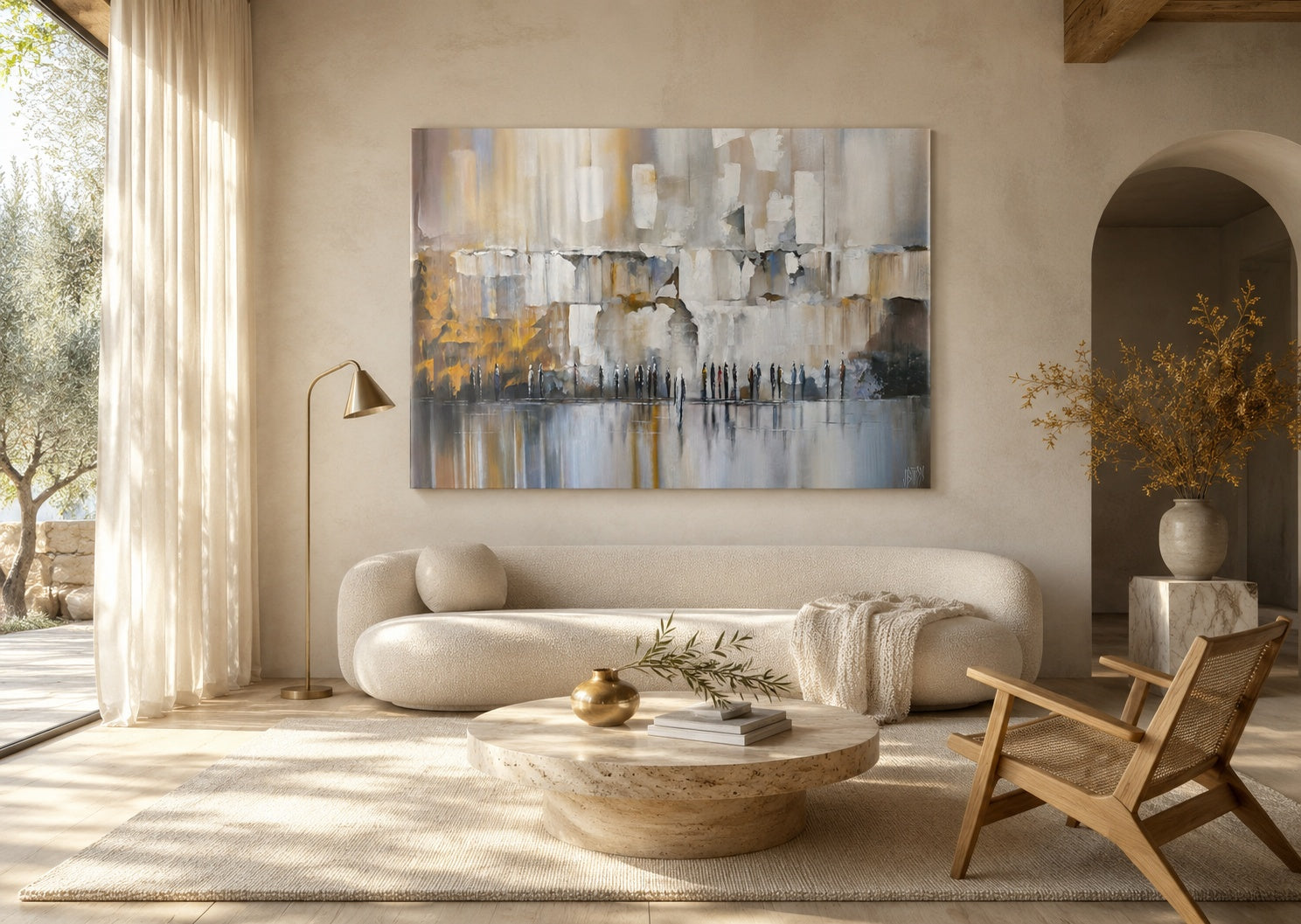
What Is Modern Judaica Wall Art vs. Traditional Jewish Decor
A practical guide to what separates modern Judaica wall art from traditional Jewish decor, covering style, technique, sacred subjects, and how to choose the right piece for your home.
Read more