


What Is Judaica Wall Art and What Makes It Different
What Is Judaica Wall Art and What Makes It Different
So you are asking what is Judaica wall art, and it is a more specific question than it first appears. Judaica wall art is a category of decorative and devotional artwork rooted in Jewish religious tradition, culture, and symbolism. It differs from other religious decor in both its visual vocabulary and its function inside the home: specific symbols, Hebrew text, and sacred geography appear in ways that carry meaning well beyond ornamentation. This guide covers the full picture before you buy.
What Is Judaica Wall Art: A Working Definition
The term "Judaica" refers broadly to objects connected to Jewish religious life and culture. In the context of wall art, it means pieces designed specifically around Jewish symbolism, scripture, prayer, ritual, and geography. That can mean a hand-lettered Hebrew blessing, an abstract rendering of the Western Wall, or a painterly interpretation of the Seven Species of Israel named in the Torah.
What separates it from generic "Jewish-themed" decor is intentionality. A print of Israeli fields is scenic. A piece depicting the Seven Species with the specific seven plants named in Deuteronomy, arranged with compositional deliberateness, carries layers of scriptural meaning. The difference lies in whether the symbol is decorative or communicative.
Judaica wall art also spans a wider range of styles than most buyers expect. From illuminated manuscript-style parchment to fully abstract acrylic compositions, the category is not uniform. Understanding that range is the first step to finding the right piece.
The Origins of Judaica Art and How It Developed Over Centuries
Jewish decorative art has a complicated history shaped partly by the biblical prohibition on graven images. That restriction pushed Jewish artistic expression toward abstraction, pattern, calligraphy, and symbolic representation rather than figurative portraiture. Over centuries, artisans channeled extraordinary craft into objects for ritual use: Torah arks, spice boxes, mezuzot, and marriage contracts called ketubot.
The ketubah tradition is a useful lens here. The ornamental ketubah, an elaborately decorated marriage document featuring floral borders, geometric patterns, Hebrew calligraphy, and symbolic imagery, has its clearest documented roots in Sephardi communities and Renaissance Italy, with early surviving examples linked to Egypt (the Cairo Geniza) and Spain. These works demonstrate how Jewish decorative art found its visual identity not in depicting the divine directly but in surrounding sacred text and occasion with beauty. The tradition continued through modern America, where ornamental ketubot remain a living art form.
By the twentieth century, a generation of artists trained in European fine art academies began applying those skills to Jewish subjects. The founding of the State of Israel in 1948 accelerated that development, giving Jewish art a new landscape and national identity to interpret. Jerusalem, the Galilee, and the Negev became subjects as much as symbols. The result was a tradition of Jewish decorative art for the home that is genuinely distinct from any European religious painting tradition.
For the full arc from tradition to the present, this overview of how contemporary Judaica has evolved traces that trajectory in detail.

Key Visual Symbols That Set Judaica Wall Art Apart
The visual language of Judaica is specific. Knowing the main symbols helps you identify authentic pieces and understand what you are looking at.
- The Hamsa: A palm-shaped symbol popular across Middle Eastern and North African Jewish communities. It represents protection and divine blessing. In Judaica art, the Hamsa frequently incorporates the Hebrew word "Chai" (life) or the Hebrew letter Shin.
- The Star of David (Magen David): The six-pointed star that became a central symbol of Jewish identity. In wall art, it appears both as a standalone graphic element and woven into larger compositions.
- Hebrew text and calligraphy: Blessings, Psalms, the Shema, the Priestly Blessing, and prayers for the home are rendered as visual art. The calligraphic quality of Hebrew letters makes them naturally suited to decorative work. The text is not incidental; it carries the spiritual weight of the piece.
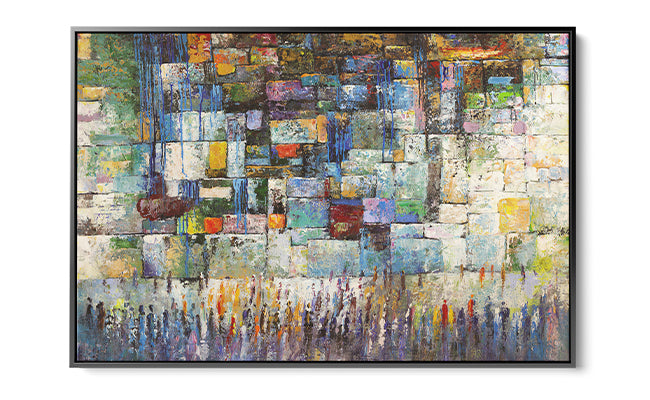
- Jerusalem and the Western Wall (Kotel): The city and its most sacred site appear in Judaica art more than any other geographic subject. The golden limestone walls, the arched gates, and the ancient stones of the Kotel carry enormous spiritual resonance.
- The Menorah: The seven-branched candelabrum, one of the oldest symbols in Judaism, appears in everything from simplified graphic treatments to richly detailed compositions.
- The Seven Species (Shivat HaMinim): Wheat, barley, grapes, figs, pomegranates, olives, and dates, the seven agricultural products praised in the Torah as characteristic of the Land of Israel. Each species has layered scriptural significance beyond its visual appearance.
- The Pomegranate: Both part of the Seven Species and a broader stand-alone motif. Jewish tradition holds that the pomegranate contains 613 seeds, corresponding to the 613 commandments.
None of these symbols appear in Christian religious art with the same meaning or function. That specificity is part of what makes Judaica wall art visually distinctive even to a viewer unfamiliar with the tradition.
How Judaica Wall Art Differs From Traditional Religious Decor in Other Faiths
Christian religious art, particularly in its Catholic and Orthodox forms, centers heavily on figurative representation: portraits of saints, scenes from the life of Christ, Madonna and Child compositions. The image of the sacred person is itself an object of veneration in many of those traditions.
Jewish religious art operates from different principles. Because of the long-standing caution around figurative depictions of the divine, Jewish decorative art developed a richness in non-figurative directions: calligraphy, abstraction, landscape, and symbolic pattern. When human figures do appear in Judaica art (in scenes of Shabbat, prayer, or community life), they are depicted in the context of lived experience rather than devotional veneration.
Islamic decorative art shares some of this non-figurative sensibility, which is why Moroccan and Mizrahi Jewish art traditions show visual overlaps with Islamic geometric patterns. But the specific symbols, texts, and sacred geography of Judaism make Judaica art unmistakably its own category.
Practically speaking, this means Judaica wall art tends to integrate more naturally into secular or contemporary interior spaces than, say, an icon or a devotional altarpiece. A piece centered on abstract Hebrew calligraphy reads as sophisticated typography to some viewers while carrying deep liturgical meaning to others. That dual reading is deliberate: artists like Yossi Bitton compose the Hebrew letterforms so that their visual rhythm holds the composition independently, while the text's content layers in meaning for those who can read it, one object doing two distinct kinds of work at once.

For a side-by-side comparison of modern and traditional approaches within the Jewish art world, this guide on modern versus traditional Jewish decor is worth reading before you commit to a style direction.
The Rise of Abstract and Contemporary Judaica Art
The past two decades have seen a significant shift in how artists approach Jewish subjects. Where traditional Judaica leaned toward illustration, ornament, and text-based decoration, contemporary artists are applying the full range of modern fine art vocabulary to Jewish themes: gestural painting, color field abstraction, mixed media, and photographic manipulation.
The result is work that does not look like a religious object in the conventional sense but carries the same depth of meaning. An abstract painting of the Western Wall in deep ochres and slate blues is not a postcard reproduction of the Kotel. It is an interpretation of what it feels like to stand there, what the stone holds, and what prayer sounds like when it has no words left.
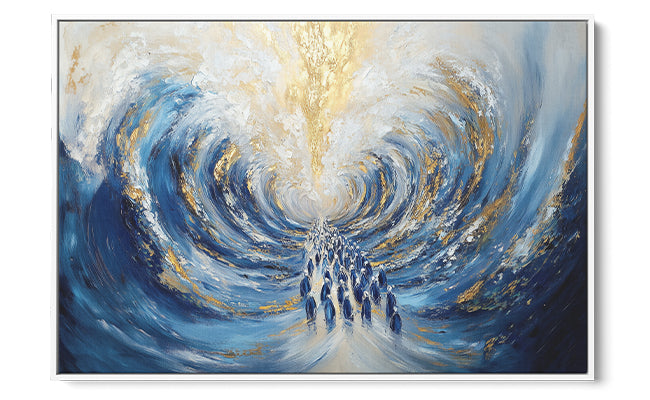
Yossi Bitton works in exactly that register. His acrylic compositions interpret sacred sites and concepts through color, texture, and movement rather than literal depiction. The result is Judaica that suits a modern interior without sacrificing the spiritual content that makes it Judaica in the first place. You can browse contemporary Judaica pieces by Yossi Bitton to see the full range of that approach.
Curator's note: Abstract Judaica is most successful when the underlying subject is still legible in some form, whether through color palette (the warm gold of Jerusalem stone), composition (the vertical rise of the Western Wall), or the presence of Hebrew text as a visual anchor. Pure abstraction without any Jewish referent is not really Judaica; it is abstract art with a title.
This expansion of styles is why the category now draws buyers who care equally about interior design and Jewish identity. The two goals no longer require a compromise.

How to Recognize Quality Judaica Wall Art When You See It
Quality in this category is not just about craft; it is about the relationship between visual execution and meaning. Here is a practical framework for assessing a piece before you buy.
Step 1: Evaluate the Material and Print Quality
For acrylic pieces, look for substantial panel thickness and UV-resistant inks or pigments that will not shift color under direct ambient light. The surface should have depth: clarity in lighter areas and richness in shadow. A flat, uniform surface often signals a basic photographic print rather than a true acrylic artwork.
For canvas works, the weave texture should add to the composition rather than fight it. Fine-grain canvas suits detail-heavy work; a more open weave works better with bold, gestural brushwork. Check whether the canvas is gallery-wrapped (image continues around the edges) or requires a frame, and factor that into your wall budget.
Step 2: Assess the Symbol Literacy of the Work
A quality Judaica piece uses its symbols with intention. The pomegranate or Hamsa should be compositionally integrated, not appliqued as an afterthought onto a generic background. If Hebrew text appears, it should be correctly rendered: letters formed with proper calligraphic proportion, words spelled accurately. Errors in Hebrew text are a reliable signal that the artist (or manufacturer) is not working from genuine knowledge of the tradition.
Designer's tip: Look for pieces where the Jewish symbol and the visual composition reinforce each other. A Seven Species artwork where the seven plants are arranged to create a natural rhythm across the canvas shows compositional thinking. One where they are simply listed in a row shows graphic design, not art.
Step 3: Consider Scale Relative to the Wall
As a general rule, art should occupy roughly 60 to 75 percent of the available wall width. For a sofa that is 84 inches wide, that means a piece (or a grouping) spanning roughly 50 to 63 inches. For Judaica wall art specifically, err toward the larger end of that range: Hebrew text and intricate symbols lose impact when they are too small to read from across a room.

Step 4: Match the Light to the Medium
Acrylic art responds to light differently than canvas or paper. In rooms with strong directional light (south-facing windows, track lighting), the reflective surface of an acrylic piece can create unwanted glare. Position acrylic works on walls perpendicular to the primary light source, or light them from above with a picture light on a dimmer. Canvas and paper prints are more forgiving of varied lighting conditions.
The contemporary and modern Jewish wall art collection includes works across multiple formats and scales, which is useful if you are still deciding on the right medium for your specific room.
How Judaica Wall Art Functions in a Jewish Home Beyond Pure Decoration
In a Jewish home, wall art often carries a functional dimension that purely decorative art does not. This is worth understanding because it affects where and how you hang it.
Pieces bearing blessings or prayers (a Birkat HaBayit, or house blessing, for example) are traditionally hung near the home's entrance, where they greet every person who crosses the threshold. Text-based works in a dining room often connect to Shabbat or the blessing over food. Art depicting Jerusalem is sometimes placed so that it faces east, toward the direction of prayer, though this practice varies by community and level of observance.
Even in contemporary Jewish homes where observance is moderate, art still tends to function as identity: it communicates belonging, memory, and connection to a larger story. A piece depicting the Western Wall above a mantel does different emotional work than a landscape of the Hudson Valley, even if both are equally beautiful as objects.
For homes where multiple pieces will hang together, consistency of palette and scale creates visual coherence without erasing the individual meaning of each work. Consider anchoring with one large-scale piece and flanking it with smaller works that share at least one dominant color. The Jerusalem-focused Jewish art collection is particularly useful for building a thematically cohesive wall because the subject matter creates automatic visual continuity.

Art depicting holy sites carries particular resonance in rooms used for gathering. A piece from the Western Wall art collection above a dining table creates a quiet reference to prayer and communal memory, especially effective during Shabbat and holiday meals when the family is together.
For guidance on practical placement across specific rooms, this guide on displaying sacred art with intention covers the decisions that come after you have chosen the piece.
What Makes Judaica Art Unique as a Design Choice
One angle that most category overviews miss: Judaica wall art is one of the few art traditions that is simultaneously devotional, cultural, and aesthetically contemporary. You do not have to choose between a piece that means something and a piece that looks right in a well-designed room. The best contemporary Judaica does both without conflict.
This is different from, say, hanging a cross in a modern interior, which carries unavoidable religious associations for most viewers regardless of the object's design quality. Judaica, because of its non-figurative tradition and its visual richness, can read as sophisticated fine art to one viewer and as deeply personal faith expression to another. That range of reception is not an accident of the market; it is an extension of the tradition itself.
For buyers who are not Jewish but are drawn to the visual language: the symbols carry specific meaning, and that is worth understanding before you display them. But Judaica art in a non-Jewish home is not inherently inappropriate, particularly for pieces that are explicitly aesthetic interpretations (an abstract Jerusalem landscape, for example) rather than liturgical objects.

For a closer look at the artistic voices shaping this category today, this profile of leading contemporary Jewish artists is a useful companion read.
Frequently Asked Questions
What is Judaica wall art and what makes it different from other religious art?
Judaica wall art is decorative artwork built around Jewish religious symbols, scripture, sacred geography, and cultural tradition. Unlike most other religious art traditions, it developed away from figurative depictions of the divine toward calligraphy, abstraction, and symbolic pattern. That history gives it a visual profile unlike Christian iconography or Buddhist devotional imagery, and makes it function well in contemporary interiors without looking anachronistic.
What symbols are most commonly found in Judaica wall art?
The most frequent symbols are the Hamsa, the Star of David, the Menorah, the Pomegranate, Jerusalem and the Kotel, and the Seven Species of Israel. Hebrew calligraphy, blessings, and Psalm excerpts also appear as primary visual elements rather than captions. Each symbol carries specific doctrinal or cultural meaning; the pomegranate's association with the 613 commandments, for instance, makes it more than an ornamental fruit.
Is abstract Judaica art still considered traditional or authentic?
Yes, provided the Jewish referent is present in some identifiable form. The distinction matters: abstraction that draws on the color, geometry, or emotional experience of a Jewish subject (the warmth of Jerusalem stone, the vertical scale of the Kotel) is firmly within the tradition. Abstraction that uses a Jewish title as a marketing label without any corresponding visual or conceptual connection is not. Authenticity lives in the artist's knowledge of and relationship to the subject, not in the painting style.
Can non-Jewish people display Judaica wall art in their homes?
Practically, yes. Aesthetically and ethically, it depends on the specific piece. An abstract acrylic interpretation of Jerusalem or an artistic rendering of Hebrew script as typography carries no prohibition and does not require Jewish identity to appreciate. Objects used specifically in religious ritual (a Passover Haggadah page, a prayer text designed for liturgical use) carry more cultural specificity and deserve some understanding of their meaning before display. When in doubt, ask yourself whether you appreciate it for what it actually represents, not just for how it looks.
What is the difference between Judaica art and general Jewish-themed home decor?
Judaica art engages deliberately with Jewish religious or cultural meaning through symbol, text, or sacred subject matter, and is designed with that meaning as a primary intention. Jewish-themed home decor uses Jewish visual motifs, often the Star of David or Hebrew letterforms, as aesthetic elements without necessarily engaging their meaning. The line is not always sharp, but quality Judaica art holds up to scrutiny: remove the Jewish elements and the piece would lose its reason for existing. Generic decor with a Star of David would simply become generic decor.
How do I know if a piece of Judaica wall art is high quality?
Four things to check: the material (acrylic panels should have depth and UV stability; canvas should suit the painting style); the symbol literacy (Hebrew text must be correctly spelled and calligraphically proportioned); the compositional integrity (Jewish symbols should be structurally embedded in the composition, not added as decorative afterthoughts); and the artist's background (artists who come from within the tradition or have deep sustained engagement with it tend to produce work with genuine layers of meaning). Price alone is not a reliable indicator, well-made pieces on quality acrylic from established artists can range considerably depending on size and edition, but craftsmanship in materials and symbol literacy will show up in the work itself, regardless of cost. The contemporary and modern Jewish wall art collection is a useful place to see that range firsthand.
Read more
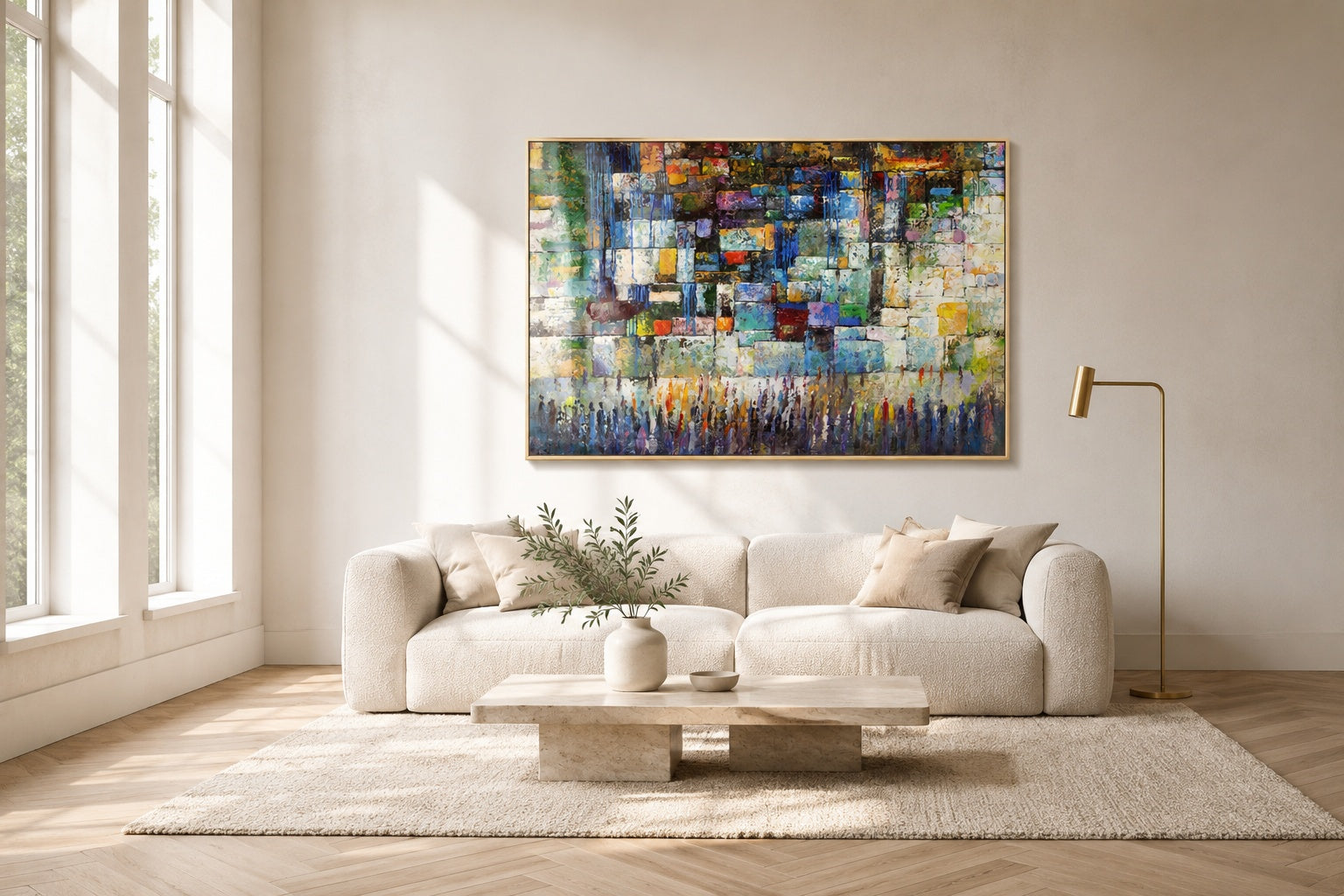
Artistic Judaica: How Sacred Traditions Inspire Contemporary Jewish Fine Art
Artistic Judaica sits at the intersection of Jewish sacred tradition and fine art craft. Learn how to read, choose, and display contemporary Jewish art with intention.
Read more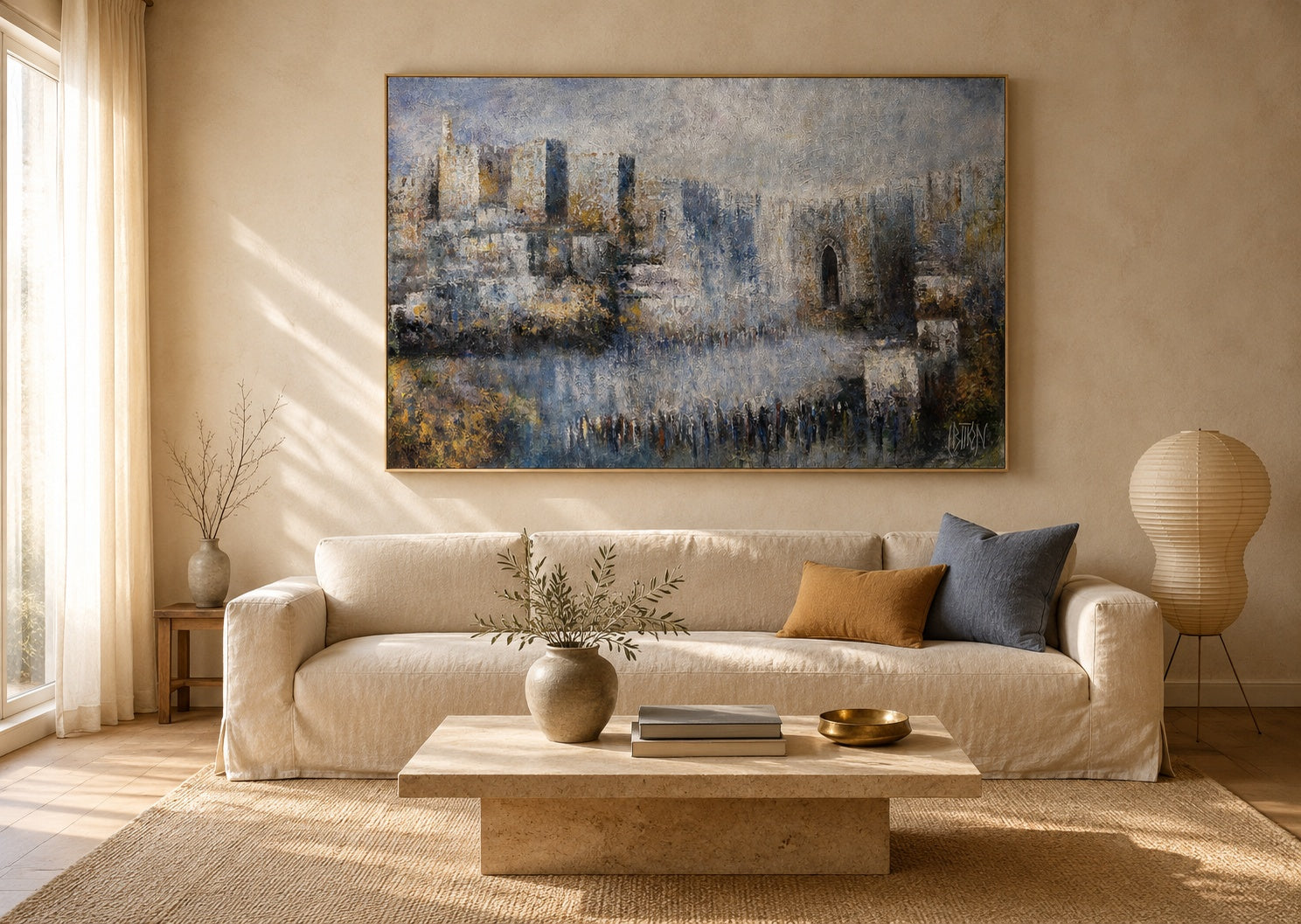
Jerusalem Inspired Israeli Wall Art: How Artists Capture the City
A practical guide to Jerusalem-inspired Israeli wall art, how Israeli artists approach the city, what separates great work from decorative filler, and how to choose the right piece for your interior.
Read more