


Artistic Judaica: How Sacred Traditions Inspire Contemporary Jewish Fine Art
Artistic Judaica: How Sacred Traditions Inspire Contemporary Jewish Fine Art
Artistic Judaica is a category of fine art that draws its visual language, subject matter, and spiritual purpose directly from Jewish sacred tradition, then reinterprets those sources through the skills and sensibilities of a trained contemporary artist. It sits at the intersection of religious meaning and aesthetic craft, which is exactly what separates it from general Jewish-themed decor. A hand-lettered blessing printed on stock paper is decor; an oil or mixed-media canvas in which the shapes of Hebrew letters carry structural weight in the composition is fine art rooted in sacred tradition.
The distinction matters to collectors and to anyone thinking seriously about what hangs on their walls. The pieces you live with daily carry a cumulative influence on how a space feels, and in a Jewish home, they can also quietly reinforce identity, memory, and values. Understanding where artistic Judaica comes from, what it looks like, and how to choose it well makes the difference between a wall that looks assembled and one that feels intentional.
What Is Artistic Judaica and How Is It Defined Today
The term covers a broad field. Ceremonial objects, illustrated manuscripts, architectural ornamentation, and painted canvases have all been understood as Judaica across different eras. Today, the working definition used by serious galleries centers on three qualities working together: the piece references or is shaped by Jewish textual, ritual, or historical tradition; it is executed with the formal skills and material standards of fine art (considered composition, intentional color, archival materials); and its meaning deepens on sustained looking rather than being consumed in a glance.
Jewish-themed decor, by contrast, often prioritizes immediate legibility: a Star of David on a shelf piece, a Hebrew word printed in a script font. That is not a criticism of decor; it serves a different function. Artistic Judaica asks more from the viewer, and it gives more back over time.
Contemporary Jewish fine art has expanded the definition further by embracing styles that range from photorealistic portraiture to gestural abstraction. An artist can paint the Kotel with the precision of a 19th-century academic painter or reduce it to planes of gold and gray and still be working within the tradition, provided the sacred reference is doing real compositional and conceptual work. The contemporary Jewish wall art collection at Ben Ari Art Gallery reflects exactly this range, from figurative sacred landscapes to painterly abstractions grounded in liturgical themes.
Curator's note: A useful test for any piece you are considering: cover the title and any text. If the work still communicates something about Jewish memory, spirituality, or ritual through its visual structure alone, it is functioning as fine art. If it reads as decoration without the label, it probably is decoration.

The Sacred Traditions That Shape Jewish Visual Art
Jewish art does not emerge from a single tradition; it emerges from the tension between several. The biblical prohibition on graven images created a culture that channeled visual creativity into calligraphy, geometric ornament, and symbolic representation rather than figurative idolatry, which produced a distinctly abstract and typographic sensibility that persists in contemporary work. At the same time, diaspora history meant Jewish artists absorbed the visual languages of Babylon, Persia, medieval Europe, North Africa, and Eastern Europe, layering those influences over a core of sacred text and ritual.
The most formative traditions shaping today's artistic Judaica include:
- Torah illumination and scribal arts: The careful proportioning of Hebrew letters, the ornamental crowns on certain characters, and the integration of text within a visual field all come from manuscript traditions stretching back more than a thousand years. Many contemporary artists pull these structural habits into painted work even when no text is visible.
- The mizrach and mizrach-adjacent wall art: Placed on the eastern wall of a home or study to indicate the direction of prayer, the mizrach established the idea that a piece of art could orient a room spiritually as well as aesthetically. That logic extends naturally into the way contemporary Jewish homeowners think about placement.
- Kabbalah and mystical symbolism: Kabbalistic diagrams of the sefirot, the Tree of Life, and numerical relationships derived from gematria give artists a rich system of interlocking symbols that can be read on a purely visual level or on a deeper conceptual one.
- Pilgrimage and holy site imagery: Jerusalem, the Kotel, the Temple Mount, Rachel's Tomb: these sites have been depicted by Jewish artists for centuries because for scattered communities, visual representation was a form of longing and connection. That tradition is alive in the Jerusalem modern Jewish art collection, which brings the topography of the holy city into contemporary compositional frameworks.
Understanding these roots helps when you are standing in front of two pieces that look very different on the surface. A color-field canvas in blue and gold with a barely legible Hebrew word at its center and a detailed portrait of a Torah sage are both shaped by the same underlying traditions. They just emphasize different aspects of them.
Key Symbols and Themes Found in Contemporary Artistic Judaica

Symbols in Jewish art carry centuries of accumulated meaning, which is part of what gives a well-made piece its resonance. The menorah's form, recorded as early as the coin minted by Antigonus II Mattathias, the last Hasmonean king, reigning 40-37 BCE, continues to appear in contemporary abstract canvases because its shape is visually loaded in a way that requires no caption. Here are the symbols that appear most consistently in fine art Judaica today and what they contribute compositionally as well as spiritually.
- The Menorah: Seven branches create a natural radial structure, which artists use to organize light and shadow in a composition. It represents divine light, continuity, and the Temple service.
- Hebrew letters and words: Shema, Shalom, chai, and the names of God appear not just as text but as form. The vertical stress of the letter aleph, the contained geometry of the mem, these create visual rhythm when an artist uses them architecturally within a canvas.
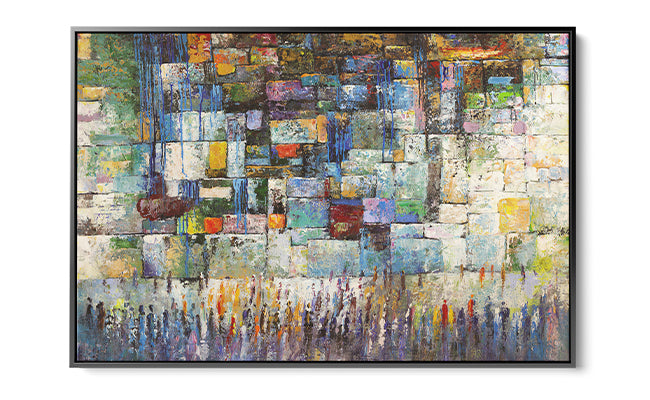
- The Kotel (Western Wall): Stone courses and the quality of ancient light are a recurring subject in Jewish art for reasons that go beyond sentiment. The Wall's horizontal layering gives painters a natural compositional grid. The Western Wall art collection demonstrates how different artists use that same grid to achieve very different emotional registers, from quiet contemplation to charged drama.
- Twelve Tribes iconography: Each tribe carries a traditional symbol, and contemporary artists have used these to build multi-panel works that function as genealogical records as much as images. The Twelve Tribes poster in the Ben Ari collection explores an alternate artistic interpretation of the tribes, foregrounding the heraldic quality of the symbols rather than narrative content.
- Portraits of Torah sages: Likeness in Jewish art has a specific function: to transmit the quality of a person's inner life, not simply their face. Portraits of figures like the Chofetz Chaim or Rabbi Chaim Kanievsky operate as musar art, a visual reminder of values the viewer aspires to.
- Holy land topography: Valleys, hilltop towns, olive groves, and desert light give artists a visual vocabulary that is simultaneously landscape painting and sacred geography.
For a deeper reading of how these visual symbols developed across Jewish art history, the article What Is Judaic Art? A Guide to Jewish Painting Styles and Symbolism traces each tradition with useful historical context.
How Modern Jewish Artists Translate Ancient Meaning Into Fine Art

The translation from sacred source to contemporary canvas is where the most interesting creative decisions happen, and where the quality of different artists becomes apparent. There are several distinct strategies that serious contemporary Jewish artists use, and recognizing them helps you evaluate what you are looking at.
Formal abstraction anchored in sacred geometry: Some artists begin with the mathematical relationships embedded in Torah study, gematria, and Kabbalistic diagrams, and build their compositions outward from those proportional systems. The result often looks like geometric abstraction to a secular eye but carries internal logic that a knowledgeable viewer can read. Avigdor Ben-Ari works in this territory; his modern Judaica art collection is a good place to observe how this translates across multiple formats and scales.
Portraiture as musar: The portrait of a Torah sage is one of the oldest forms of Jewish artistic Judaica, and it continues because it serves a genuine purpose. When an artist succeeds with this form, the viewer feels the quality of the subject's attention, not just their likeness. The portrait of the Chofetz Chaim in the Ben Ari collection captures this through the stillness and interiority suggested by the subject's posture and gaze, qualities the artist emphasizes deliberately rather than as a byproduct of realistic technique.
Place as spiritual argument: Jerusalem paintings are rarely about topography alone. Artists who engage seriously with holy site subjects are usually making a claim about continuity: the city that was, the city that is, and the city that is promised. The material choices matter here. Heavy impasto brushwork on a Jerusalem canvas suggests permanence and depth; looser, more luminous handling suggests hope or longing. Looking at how an artist handles paint surface tells you which emotional register they are working in.
Liturgy made visible: Prayer texts like the Shema, Birkat Hamazon, or the Priestly Blessing become visual material in the hands of artists who understand calligraphy as a spatial art. The spacing, weight, and direction of letters can create movement or stillness within a composition. Contemporary artists in the prayers and blessings art collection demonstrate how a blessing that you have recited hundreds of times can become newly visible when it is given compositional form.
Styling note: When you encounter a piece that uses Hebrew text architecturally, hang it at a height where the letterforms sit at natural reading level for a standing adult, roughly 57 to 60 inches from the floor to the midpoint of the work. This allows the viewer to move from overall composition to close reading without straining.
Jewish Art Styles and Symbolism: A Practical Comparison
| Style | Visual Character | Best Room Setting | Interior Styles It Suits |
|---|---|---|---|
| Geometric abstraction | Bold shapes, limited palette, sacred proportions | Living room, study | Modern, minimalist, Japandi |
| Figurative portraiture | Detailed likeness, warm tones, strong focal point | Study, library, dining room | Traditional, transitional |
| Holy site landscape | Architectural detail, golden or cool light, layered texture | Entryway, living room | Traditional, luxury, transitional |
| Calligraphic text art | Letter-as-form, dynamic rhythm, often monochromatic | Entry, bedroom, dining room | Modern, Scandinavian, minimalist |

Choosing Artistic Judaica That Resonates With Your Home and Heritage
Buying a piece of artistic Judaica involves two simultaneous decisions: what speaks to you spiritually and historically, and what will actually work in your specific room. These are not competing concerns; a piece that fails spatially will eventually feel like a burden rather than a source of meaning. Here is a three-step method for making both decisions well.
Step 1: Establish your point of connection. Before looking at anything, spend a few minutes with a specific question: which moment, ritual, text, figure, or place in Jewish life carries the most personal weight for you? That answer should anchor your search. Someone whose family came from Jerusalem will respond differently to holy city imagery than someone for whom the sages of the Musar movement are the living center of their Judaism. Neither is more valid; they lead to different work.
Step 2: Determine the emotional register the room needs. A study where you learn or write needs a different quality of atmosphere than an open-plan living room or a bedroom. Portraiture creates intimacy and moral weight; abstract sacred geometry creates calm and spatial depth; holy site landscapes create a sense of connection to something larger and older than the room. Match the register to the room's existing purpose rather than simply to your taste.
Step 3: Work from scale, then color. For a standard residential wall, a canvas whose width covers 60 to 75 percent of the furniture below it will feel properly anchored. A piece that is too small for its wall will float without resolution. Color temperature matters too: warm ochres and burnt siennas read as welcoming and grounding; cool blues and silvers feel contemplative and create more visual distance.
For practical advice on sizing and placement within specific rooms, the article Jewish Home Decor Ideas With Wall Art works through room-by-room scenarios with concrete measurements.
Mistakes Worth Avoiding
- Buying for a single holiday context only. A piece chosen exclusively for Sukkot decoration that has no resonance in February will feel incongruous for eleven months. Choose work whose subject has meaning across the year, even if it was initially prompted by a seasonal occasion.
- Matching too literally to existing decor. If a piece of artistic Judaica simply echoes the room's existing colors and shapes, it loses its capacity to command attention. Some deliberate contrast, in tone, texture, or scale, is what makes a work read as art rather than wallpaper.
- Underestimating the power of a single large work. Many buyers default to smaller pieces because they feel less committed. But a single well-chosen canvas at the right scale creates more presence and clarity than three or four small works that compete for attention without cohering.
- Ignoring the light source. Canvas with heavy impasto or textured surfaces changes dramatically under different light. Before finalizing a purchase, consider whether the wall you have in mind receives natural or artificial light, and from which direction. Raking light from the side will animate texture; frontal overhead light will flatten it.
Designer's tip: If you are working with a predominantly neutral interior, a single piece in a saturated color drawn from Jewish iconography, the deep blue of a Shabbat sky, the warm gold of Jerusalem stone, will do more compositional work than multiple smaller neutral pieces. One strong color decision is easier to live with than several tentative ones.

Where to Explore and View Artistic Judaica Pieces From Contemporary Galleries
The most useful thing a gallery can do for a serious buyer is to organize its collection so the conceptual distinctions discussed above are visible. At Ben Ari Art Gallery, the collections are structured around both subject matter and artistic approach, which makes it possible to move from a general interest in sacred subjects to a specific style preference without losing the thread.
For buyers interested in the portraiture tradition as a form of Jewish art rooted in sacred tradition, the rabbi portraits collection gathers works that use the conventions of formal portraiture to transmit the inner quality of Torah scholarship. The portrait of the Steipler (Rabbi Yaakov Yisrael Kanievsky) is a strong example of how a carefully rendered likeness becomes something more than documentation; the artist's attention to the quality of the subject's focus gives the work its moral weight.
For buyers drawn to holy site imagery and the long tradition of depicting sacred geography, the Jewish holy sites art collection brings together works across different scales and handling, from tightly detailed architectural studies to painterly, light-saturated interpretations. The Israel's Holy Landmarks poster, which includes the Western Wall and Rachel's Tomb among other venerated sites, functions well in this context as an accessible and spatially flexible format.
For contemporary abstract work that engages Jewish visual art styles and symbolism at the level of structure rather than subject, the Yossi Bitton collection offers a useful point of entry. Bitton's approach tends toward bold forms and concentrated color fields, which read well in modern and minimalist interiors where more literal sacred imagery might feel at odds with the room's existing language.
You can view new arrivals in artistic Judaica across all of these categories, organized so the curatorial logic behind each grouping is made explicit.
How to Live With Artistic Judaica Every Day: Display, Intention, and Meaning

A piece of fine art in a home is not static. It changes as the light shifts through the day, as your own knowledge of its sources deepens, and as the seasons of Jewish life cycle around it. The practical decisions you make about display have a real effect on how much meaning the work generates over time.
Height and sightline. Hang most works so the center sits 57 to 60 inches from the floor. For pieces viewed primarily from a seated position, such as in a dining room, dropping the center point to roughly 54 inches brings the work into the natural sightline during a meal, which matters when the piece depicts a subject meant to accompany conversation or study.
Grouping with intention. A gallery wall built around Jewish art has a different logic than a general art arrangement. Consider grouping by conceptual affinity: portraits of sages together, sacred landscapes together, calligraphic text works together. This allows each grouping to function as a coherent statement rather than a collection of individual purchases. For advice on anchoring a gallery wall with a significant piece as its center, the article Gallery Wall Ideas With Jewish Art: Kotel as Your Anchor offers a structured approach.
Seasonal and ritual context. Some pieces in artistic Judaica are designed with specific moments in mind. Portrait posters of Torah sages are a traditional element of Sukkot decoration, used to honor guests from Jewish history in the spirit of the ushpizin. The Ben Ari collection includes works in this tradition, priced between $10.99 and $29.99 in poster format, which makes it practical to rotate works seasonally. A piece that spends most of the year in a study can move to the sukkah during the holiday, then return with renewed meaning.
Lighting as curation. Installing a small picture light or angled track light above a significant canvas changes its presence in a room dramatically. Warm LED sources (2700K to 3000K color temperature) suit works with ochre, gold, and warm brown palettes. Cooler sources (3500K and above) suit works in blues, silvers, and neutral grays. The right light makes a canvas read three-dimensionally; the wrong light flattens it to decoration.
The diverse Jewish artistry collection brings together works across these display contexts, and browsing it with your specific room and lighting conditions in mind will make the selection process considerably more focused.
Frequently Asked Questions
What makes a piece of art count as artistic Judaica rather than just Jewish-themed decor?
The key distinction is whether the sacred reference is doing structural work inside the composition. In artistic Judaica, Jewish symbols, texts, or subjects shape the visual architecture of the piece: the proportions, the movement of the eye, the emotional register. Decor applies Jewish iconography to an object whose form and purpose would be identical without it. If you removed the Jewish content and the piece would still cohere as a composition, it is probably decor; if removing it would collapse the work's meaning and structure together, it is artistic Judaica.
Which Jewish symbols appear most often in contemporary artistic Judaica?
The Kotel's horizontal stone courses, Hebrew letters (particularly the letters of the Shema), the Menorah, and the symbolic imagery of the Twelve Tribes appear with the greatest consistency. Beyond those, holy city topography, olive trees, and the color relationships associated with the priestly garments (deep blue, white, and gold) recur so frequently they function as a recognizable palette tradition within the genre.
How have modern Jewish artists updated traditional Judaica aesthetics for today's homes?
The most significant shift has been toward simplification and scale. Traditional Judaica often worked at intimate size with high decorative density (illuminated manuscripts, small ceremonial objects). Contemporary artists have opened up the composition, reducing symbol count and increasing negative space, which allows the work to hold a large residential wall and read from across a room. Color has also shifted: contemporary pieces are more likely to use restrained, architect-friendly palettes than the saturated polychromy of historical ceremonial art.
Is artistic Judaica considered fine art or is it primarily decorative?
The strongest examples are unambiguously fine art: they are produced by trained artists using archival materials, with compositional intentions that reward sustained viewing. The category also includes work that functions primarily as decor, and the line between them is real. Material quality is often a reliable indicator: canvas printed with archival inks or hand-painted original works hold up to the standards of fine art; mass-produced items on non-archival substrates do not, regardless of subject matter.
What styles of painting are most common in contemporary Jewish fine art?
Four styles dominate: painterly realism (especially in portraiture and holy site subjects), geometric abstraction informed by Kabbalistic or scribal traditions, calligraphic text art that treats the Hebrew letter as both language and form, and expressive landscape painting in which the light and topography of Israel carry spiritual rather than purely scenic weight. Many of the strongest works combine elements of more than one of these, which is part of what distinguishes them from work that is simply illustrating a Jewish subject.
How do I choose artistic Judaica that reflects my personal connection to Jewish tradition?
Start from a specific rather than general place. "Jewish heritage" is too broad to guide a good purchase; "the morning light in my grandmother's Jerusalem apartment" or "the particular quality of silence during Neilah" is specific enough to recognize when a piece resonates with it. Buyers who start from a concrete personal anchor almost always end up with work they continue to find meaningful after years on the wall, while buyers who shop by theme alone often find their initial enthusiasm fades. If you are uncertain, looking at the characters in contemporary Judaica collection can help clarify which figurative or symbolic subjects hold genuine personal weight versus which ones simply look appropriate.
The Ben Ari Art Gallery collection covers the full range of contemporary Jewish fine art discussed here, from sacred landscape and portraiture to geometric abstraction and calligraphic work. You can view new arrivals in artistic Judaica organized by both subject and artistic approach, with enough context to make an informed decision before you commit to a piece.
Read more
Ancient Jewish Paintings: History, Themes, and Where to Find Them Today
From the 244 CE Dura-Europos frescoes to medieval illuminated manuscripts, this guide traces the full history of ancient Jewish paintings and shows how their symbols, palette, and compositional log...
Read more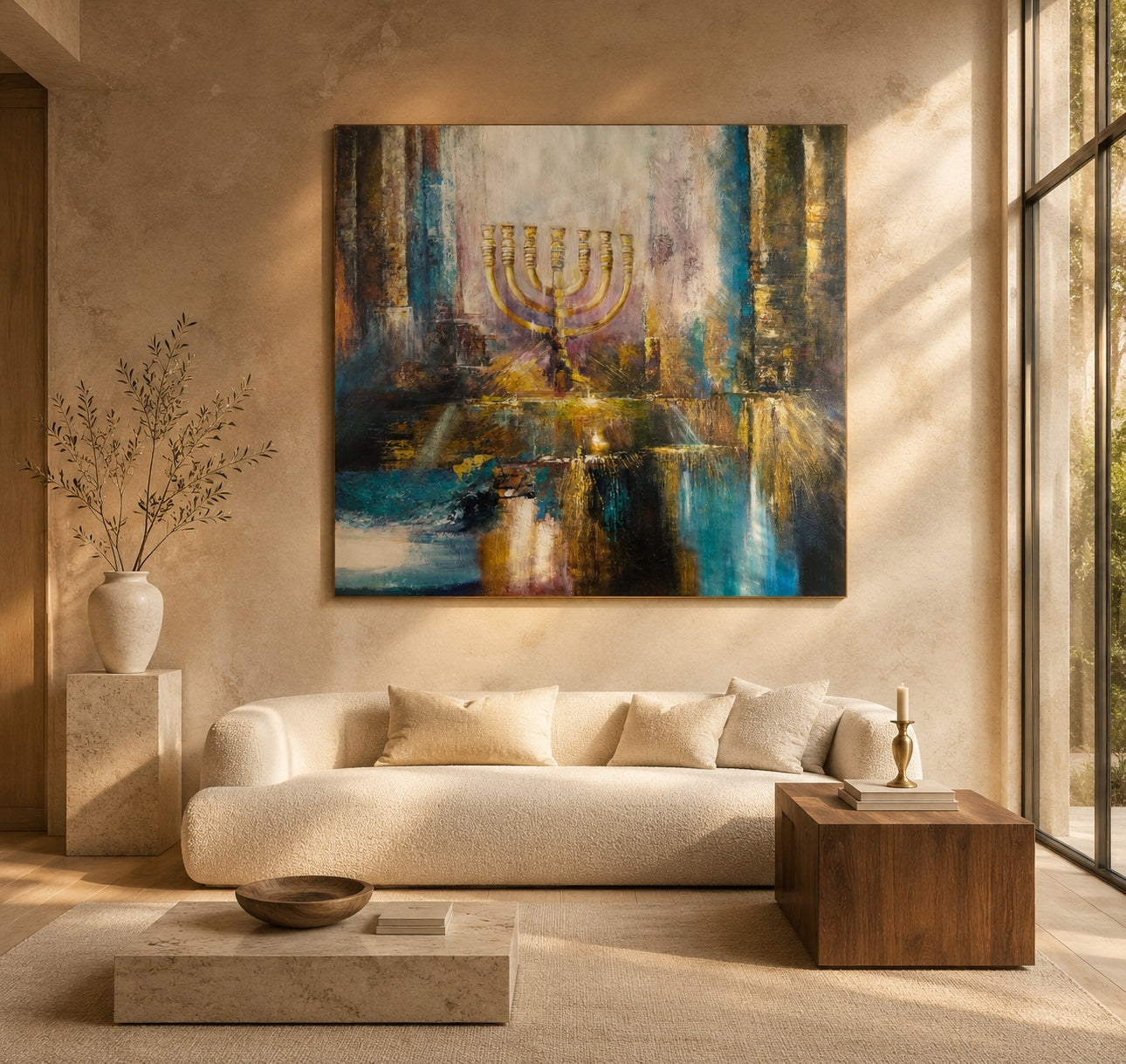
What Is Judaica Wall Art and What Makes It Different
A practical guide to Judaica wall art: its origins, visual symbols, and how to assess quality before you buy.
Read more