


Knowing how to decorate with Jerusalem wall art comes down to three decisions made in the right order: mood, then color temperature, then scale. Get those right and almost any piece in this category will land well, regardless of your interior style.
Why Jerusalem-Inspired Wall Art Works in Any Home Style
There is a reason Jerusalem keeps appearing in serious art: the city carries visual weight that translates across traditions and aesthetics. The layered stone, the quality of desert light, the tension between antiquity and life, all of these translate into imagery with remarkable tonal range. Warm golds and ochres read equally well against a warm-white plaster wall and a cool concrete one. Deep charcoals anchor a contemporary loft without looking out of place next to an Eames chair.
The subject also sits at the intersection of cultural identity and universal resonance. Jewish buyers often want art that reflects heritage without turning the living room into a museum. Non-Jewish buyers are drawn to the architecture and light. Both groups end up looking at the same canvases, which is a quiet sign that the imagery earns its place on visual terms alone.
If you are new to this category, the overview of what modern Judaica art actually is is worth reading before you start shopping. Understanding the movement helps you recognize whether a piece is historically rooted or purely decorative, and that distinction affects how you display it.

Choosing the Right Jerusalem Art Piece: Style, Palette, and Mood
Before you measure a wall, run through three decisions in this order: mood, then color temperature, then scale. Getting mood wrong is harder to fix than getting size wrong, because a contemplative piece in a high-energy kitchen will always feel like a mismatch no matter how well it's hung.
Mood first
Ask yourself what you want to feel when you look up. Reverence and stillness call for abstract or impressionistic work with soft edges and a limited palette. Energy and presence call for bold graphic cityscapes with strong architectural lines. Jerusalem-inspired art covers both ends of that spectrum, and most things in between.
Color temperature second
Jerusalem art tends toward warm golds, amber, dusty rose, and ivory, with cooler slate blues and silvery whites appearing in more contemporary interpretations. Warm-toned pieces advance visually, which makes them feel more intimate. Cool-toned or high-contrast works recede slightly, giving a smaller room more perceived depth. Match the temperature to what the room already does: warm rooms need warm art or a deliberately cool contrast piece, not a lukewarm compromise.
Scale third
Scale is covered in detail in its own section below, but as a first filter: if your dominant wall is under 60 inches wide, a single medium canvas (around 24 by 30 inches) is usually the right call. Larger walls can support statement pieces up to 48 by 60 inches or a composed multi-panel arrangement.
If you want a deeper look at how style and subject interact before committing, the guide on choosing Jewish wall art for your home covers the full decision tree across subject categories.

Room-by-Room Guide to Placing Jerusalem Wall Art
Placement changes everything. The same canvas that feels serene in a study can feel heavy in a narrow hallway. Here is how the logic shifts across the rooms where Jerusalem art most often lands.
Living Room
The living room is the natural home for Jerusalem cityscape art. A large horizontal canvas hung above a sofa anchors the seating area and gives the room a focal point that furniture alone can rarely achieve. The standard rule: the artwork should span roughly two-thirds of the sofa's width. For an 84-inch sofa, that puts your target canvas width at about 56 inches. Keep the bottom edge of the frame 6 to 8 inches above the sofa back, not higher. Viewers should be able to take in the whole piece from a seated position without tilting their heads.
For Jerusalem wall art in a living room, abstract interpretations tend to hold up better over years than photographic prints, because the ambiguity gives the eye something to return to.
Dining Room
A dining room wall faces direct, sustained viewing from seated guests, which makes it ideal for a single statement piece with strong compositional clarity. A vertical or square format suits this room well because the wall above a sideboard is often taller than it is wide. Center the piece at 57 to 60 inches from the floor to the canvas's horizontal midpoint, which is standard gallery hanging height and also happens to be comfortable for both seated and standing viewers in a dining context.
Entryway and Foyer
First impressions are set in the entry. A narrow foyer calls for a vertically oriented canvas or a single acrylic piece with enough visual weight to read quickly. Jerusalem imagery works well here because it signals something about the household's values and aesthetic without requiring a viewer to stand and study it for five minutes.
Styling note: In a foyer, avoid pieces with extremely fine detail. The viewing distance is short and transient. Bold forms and clear color contrast communicate better than intricate linework when someone is passing through.
Home Office or Study
A study is where a contemplative Western Wall piece earns its place. The Western Wall, the Kotel, carries specific spiritual weight for Jewish households, and in a private workspace that resonance is appropriate rather than performative. A piece positioned within your sightline while seated at a desk functions almost like a meditative anchor during the workday.
Bedroom
In a bedroom, prioritize palette over subject. Warmer, softer interpretations of Jerusalem in gold and ivory read as restful. High-contrast pieces with architectural drama can feel activating in a space meant for rest. Size down slightly from living-room scale: a 24 by 36 inch canvas above a nightstand or a 36 by 48 inch piece centered above a headboard both work without overwhelming a sleeping environment.

How to Scale and Size Jerusalem Art for Your Wall Space
Undersizing is the most common decorating mistake with wall art, and it is far more damaging visually than going slightly too large. A canvas that is too small floats on a wall and looks like an afterthought. Here is a reliable sizing method that applies to any Jerusalem piece you are considering.
- Measure the wall's width, then aim for art that covers 50 to 75 percent of that width. On a 10-foot (120-inch) wall, that puts your target between 60 and 90 inches wide, either as a single piece or a gallery arrangement that reads as one unit.
- Above furniture, the piece should be no wider than the furniture beneath it. Over a console table, the canvas can be closer to 100 percent of the table's width because the visual relationship is tighter.
- Hanging height defaults to 57 to 60 inches from floor to canvas center in any room without furniture directly below. When hanging above furniture, the bottom edge of the frame should clear the furniture top by 6 to 10 inches.
- Multiple panels read as a single unit if the gap between them is consistent and no wider than 2 inches. Wider gaps read as separate pieces, which changes the compositional logic entirely.
Curator's note: Print the image at scale on standard paper and tape it to the wall before ordering. It sounds tedious, but it is the single fastest way to confirm your size choice, and it costs nothing.
Pairing Jerusalem Art with Modern, Minimalist, or Traditional Decor
The pairing challenge with Jerusalem-inspired art is real, and the solution is almost always about reducing competition, not finding a perfect match.
Modern and Minimalist Interiors
Abstract Jerusalem works in muted golds and ivory-whites are natural fits for Scandinavian, Japandi, or contemporary minimalist rooms. The rule here is to let the art be the room's sole decorative statement. Clear the surrounding walls, choose a simple floating frame or go frameless with acrylic directly on the wall, and repeat one color from the artwork in a single textile or cushion. That one repetition ties the room together without over-explaining the choice.
Transitional Interiors
A transitional room, one that mixes modern furniture with traditional architectural details like crown molding or wood paneling, gives Jerusalem cityscape art more latitude. The layered quality of the subject mirrors the layered quality of the space. A warm-gold Jerusalem canvas next to a dark-stained wood bookcase is the kind of pairing that looks considered rather than accidental.
Traditional and Formal Interiors
In heavily traditional rooms, choose Jerusalem art with classical compositional structures: clear horizon lines, symmetrical arrangements, or strong architectural framing within the image itself. The frame matters more here than in a minimalist setting. A slim dark-walnut or black frame adds the appropriate formality without competing with the work.
| Interior Style | Art Tone | Frame Choice | Wall Placement |
|---|---|---|---|
| Modern/Minimalist | Muted gold, ivory, cool white | Frameless acrylic or thin black | Solo statement piece, clear surroundings |
| Transitional | Warm amber, warm gold, ochre | Slim walnut or brushed brass | Above a console, bookcase, or sideboard |
| Traditional/Formal | Deep warm tones, architectural detail | Substantial dark frame | Symmetrically centered, gallery hanging height |
| Boho/Eclectic | Mixed warm and cool, layered tones | Natural wood or unframed | Gallery wall as part of a mixed arrangement |

Our Favorite Jerusalem Wall Art Picks to Get You Started
The pieces below are selected for specific placement and pairing reasons, not just availability. The full range is in the Jerusalem art collection.
For a living room centered on warmth and spiritual presence, Avigdor Ben Ari's The Eternal City is the first piece to consider. Ben Ari works in an abstract Judaica idiom that keeps the reference to Jerusalem unmistakable while leaving room for personal interpretation. That balance between specificity and openness suits a shared living space well.
Look for works on acrylic that hold to a limited palette of two or three dominant tones, where the abstraction communicates feeling rather than documenting architecture. Jerusalem of Gold, also by Ben Ari, applies that logic with a luminous gold-forward palette that reads beautifully against both warm-white plaster and gray-toned modern walls.
Yossi Bitton's The Old City of Jerusalem takes a different approach: more architectural in its visual language, with a graphic clarity that suits transitional and contemporary interiors equally well. If your room already has strong geometric furniture, Bitton's compositional structure will feel coherent rather than competitive. His broader body of work is worth exploring through the Yossi Bitton collection if this piece resonates.
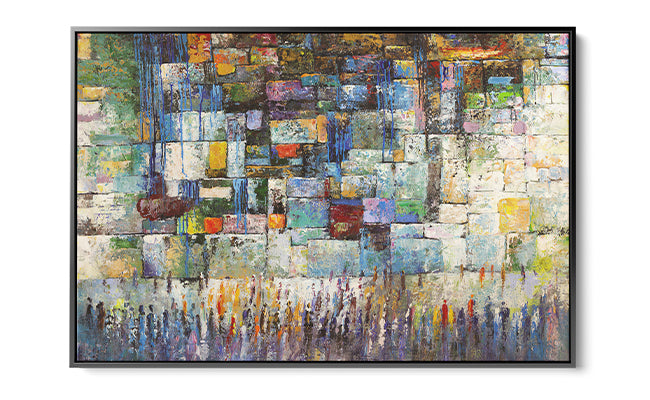
For a study or private room, the Western Wall pieces carry the most focused spiritual weight. Ben Ari's Before the Ancient Stones and Serene Blessings both interpret the Kotel through soft abstraction, where the stone texture is felt rather than rendered literally. This approach ages better in a home context than photorealistic imagery because abstraction does not date. The full range of Western Wall-inspired work sits within the Western Wall art collection, which is useful if you want to compare interpretations side by side.
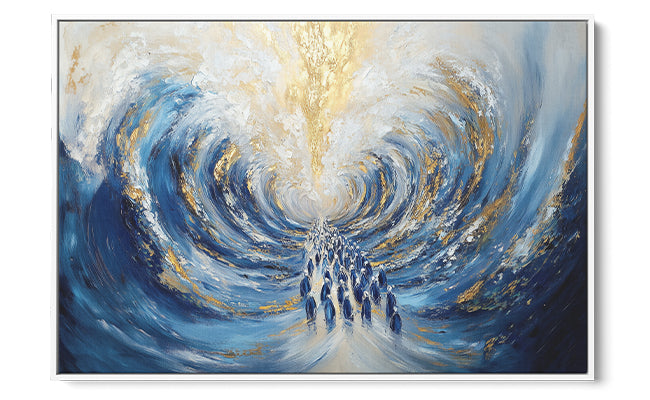
Menucha Yankelevitch's The Way to Jerusalem is the choice for a buyer who wants emotional narrative over architectural reference. The work expresses the journey toward the city rather than the city itself, which makes it the right fit for an entryway, exactly as the room-by-room section suggests for imagery that communicates quickly and meaningfully in passing.
Designer's tip: If you are choosing between two pieces you love equally, select the one whose dominant color appears elsewhere in the room, even subtly, in a textile or a wood tone. That small repetition does real compositional work.

Final Tips for Displaying Jerusalem Art with Intention
A few habits separate a well-displayed piece from one that was simply hung and forgotten.
Light it deliberately. Acrylic surfaces interact with light differently than canvas. Direct overhead light can create glare on acrylic pieces. Position a picture light above the frame or use a track light at a 30-degree angle from the wall plane. Warm-white bulbs (2700K to 3000K) complement the gold and amber tones common in Jerusalem art. Cool-white light (4000K and above) will shift warm-toned works toward gray and flatten the palette.
Give it visual breathing room. The wall space on either side of the piece should be at least as wide as the piece itself. Less than that and the work feels crowded. This is especially important in rooms with heavy furniture or strong architectural features that already compete for attention.
Avoid direct sunlight. Even high-quality acrylic prints will experience color shift over time with sustained UV exposure. Position pieces on walls that receive indirect or ambient light. If a south-facing wall is the best compositional choice, use UV-filtering film on the nearest window rather than relocating the art.
Finally, resist the urge to over-accessorize around a Jerusalem piece. A few objects of similar material or tone placed on a shelf or console below it is enough. The art should be the room's visual anchor, not one of many elements competing for attention.
For broader guidance on displaying sacred art with care, the piece on Jewish home decor and sacred art display covers the full picture of intention and placement across different art types and room contexts.
Mistakes to avoid:
- Hanging art too high. Eye level is 57 to 60 inches to the center, not the top edge. Most people hang 4 to 6 inches too high.
- Choosing a size based on the smallest piece available rather than what the wall actually needs. Start from the wall measurement, not the product page.
- Pairing a warm-toned Jerusalem piece with cool-toned furnishings and no mediating element. One warm textile in the room resolves the tension.
- Using a thick ornate frame on an abstract piece. Clean acrylic or a thin profile frame lets the art speak without adding a contradictory visual style.
- Forgetting to account for glare from lighting positioned directly in front of the piece. Angle the light source, not the art.

Frequently Asked Questions
What style of frames works best with Jerusalem-themed wall art?
Acrylic pieces often look strongest without a traditional frame at all: the clean edge of the acrylic itself provides a finished look that suits modern and minimalist rooms. When a frame is appropriate (transitional or traditional settings), choose a slim walnut, black, or brushed-brass profile. Avoid heavily ornate frames on abstract work because the decorative detail in the frame fights the expressive quality of the image.
Can Jerusalem wall art work in a non-religious or secular home?
Yes, and it happens more often than people expect. Jerusalem cityscape art is as much an architectural and atmospheric subject as it is a religious one. The stone, the light, the layered history read as compelling visual material regardless of the viewer's background. The deciding factor is the specific piece: highly abstract interpretations with minimal text or iconography work most naturally in secular contexts. Works that incorporate Hebrew text, prayer references, or Judaic symbols will feel deliberate in a secular setting, which is not a problem if that is the intention, but worth considering in advance.
How do I create a gallery wall using Jerusalem-inspired pieces?
The most common mistake on a gallery wall is mixing too many sizes randomly. For a coherent look, anchor the arrangement with one large piece (the largest in the group) and build outward in a consistent direction. Keep all pieces within two sizes of each other: if your anchor piece is 24 by 30 inches, the smallest supporting piece should be no smaller than 8 by 10 inches. Maintain a uniform gap of 2 to 3 inches between all pieces, and make sure the outer edges of the arrangement form a clean rectangle, even if the pieces inside vary in size and orientation. A mix of two Jerusalem cityscape pieces, one Western Wall piece, and a smaller abstract complement can tell a cohesive visual story about the Holy City without repeating the same image. The Jewish holy sites art collection includes pieces across several subjects that compose well together on a gallery wall.
What room is best for displaying Jerusalem cityscape art?
The living room handles large-format cityscape art best because the scale of the room matches the visual ambition of the subject, and the sustained dwell time means the image earns its place. A dining room is a strong second choice for exactly the reasons described in the room guide: sustained viewing from a fixed seated position. The one room where Jerusalem cityscape art rarely works well is a kitchen, not for cultural reasons but practical ones: cooking vapor and temperature fluctuation are hard on acrylic surfaces over time.
How do I match Jerusalem wall art colors to my existing furniture?
Pick the one color in your furniture or textiles that you most want to reinforce, and find a Jerusalem piece where that color appears as a secondary or accent tone, not the dominant one. The dominant tone of the artwork should contrast just enough to stand apart from the room. For example, a room with warm-honey wood furniture pairs well with a Jerusalem piece where warm gold is the dominant tone and a cooler dusty rose or slate appears in the secondary areas. That relationship reads as intentional. If you cannot identify even a trace of the room's palette in the artwork, the contrast is likely too sharp, and the piece will feel unanchored.
Is Jerusalem wall art appropriate as a housewarming or wedding gift?
It is one of the more considered gift options for Jewish households, precisely because it is personal without being presumptuous. A piece in a neutral warm palette, something in ivory, soft gold, or muted stone, travels well across different home styles and is unlikely to conflict with an unfamiliar interior. For a wedding, pieces that reference the Western Wall carry traditional resonance because the Kotel is connected to prayers for marriage and blessing in Jewish tradition. The practical sizing advice for gift-giving: mid-range formats in the 16 by 20 to 24 by 30 inch range are easy to hang in most rooms and require no structural preparation beyond a standard wall anchor.
The full range of Jerusalem and Holy City works, across artists, scales, and color palettes, is available in the Jerusalem modern Jewish art collection. You will find pieces organized by artist and style, which makes it easier to narrow your choice once you have worked through the mood, color, and scale decisions in this guide.
Read more
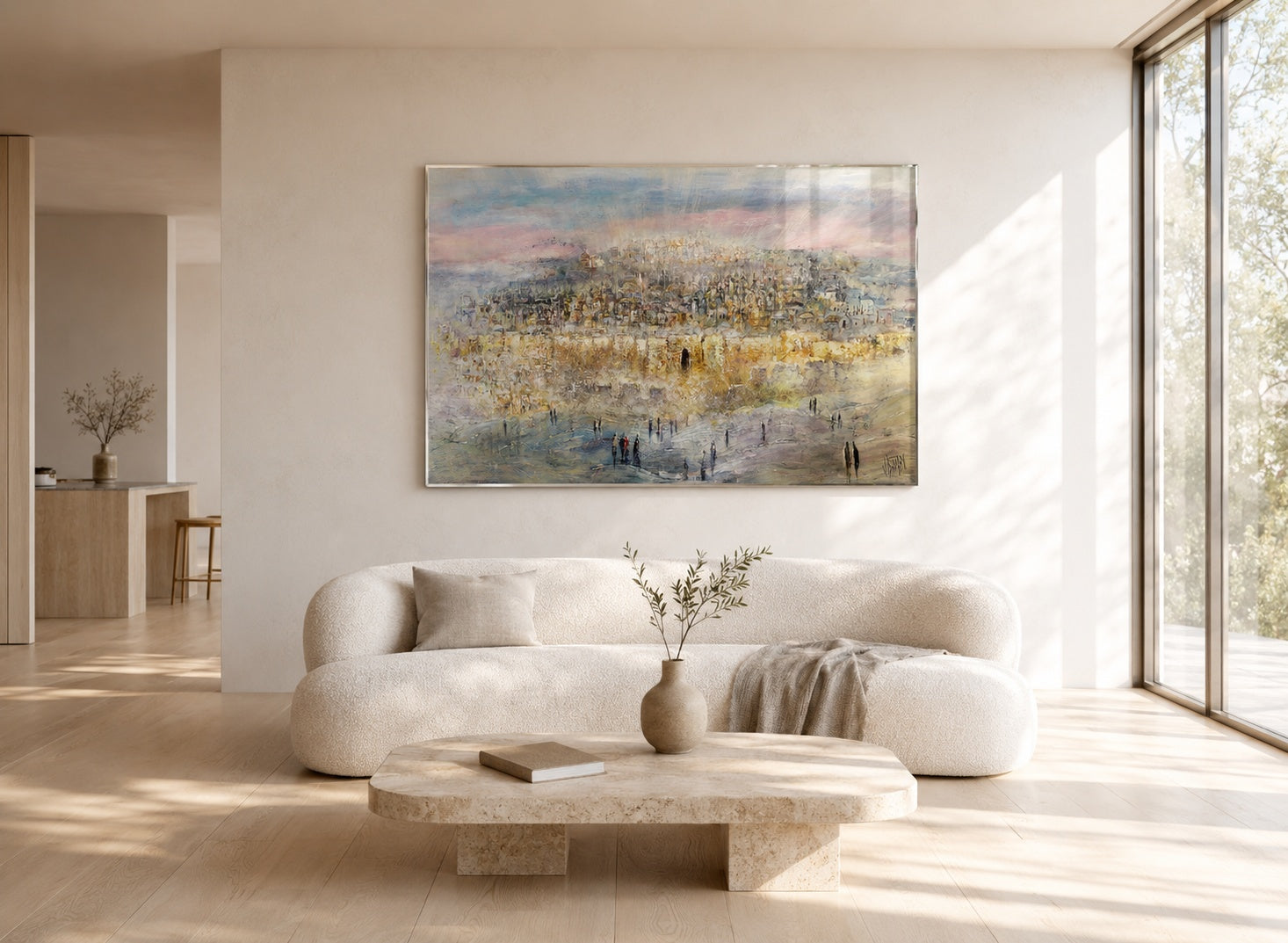
How to Choose Jewish Wall Art for Home: Style, Scale & Subject
Start with aesthetics, not symbolism. This guide walks through interior style matching, sizing rules, subject matter, and a three-question decision framework for choosing Jewish wall art that genui...
Read more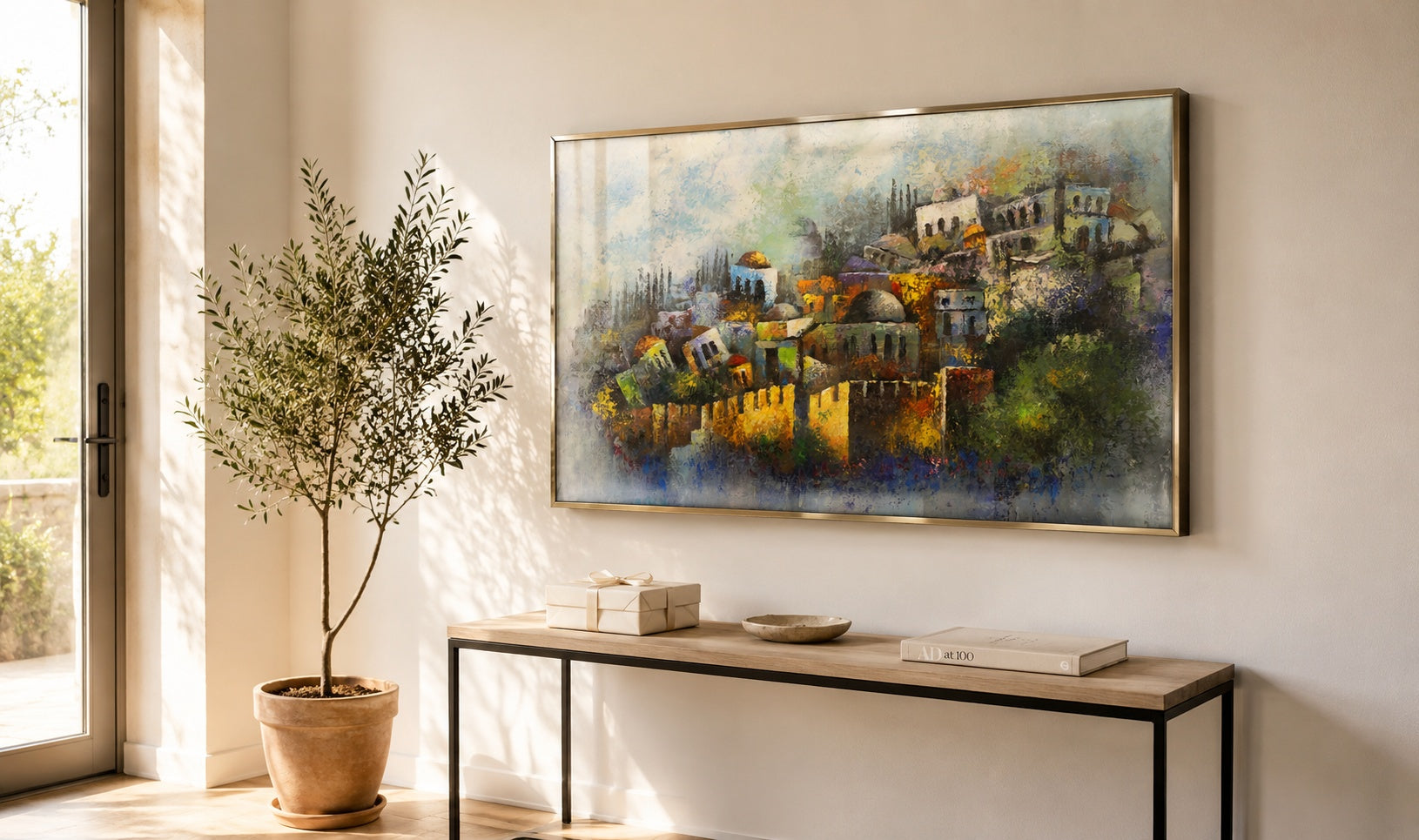
Abstract Jerusalem Art vs Realistic Style: Which Is Right for Your Space
Choosing between abstract Jerusalem art vs realistic style comes down to your room, your reason for buying, and how literally you want the city to read on the wall. This guide walks through exactly...
Read more