


Abstract Jerusalem Art vs Realistic Style: Which Is Right for Your Space
Abstract Jerusalem Art vs Realistic Style: Which Is Right for Your Space
When buyers ask about abstract jerusalem art vs realistic style, the short answer is this: realistic and impressionist works place you inside a legible city, specific stone, specific light, specific place, while abstract pieces work on mood and color first, meaning second. Neither is universally better. The right choice depends on your room, your reason for buying, and how literally you want Jerusalem to read on the wall.
Jerusalem is one of the most painted cities on earth, and the range of visual approaches is genuinely wide. You will find loose, expressionistic washes of gold and ochre sitting in the same collection beside precise, stone-by-stone renderings of the Old City. Understanding what separates them, and what each one does to a room, is the most useful thing you can know before buying.
What Do We Mean by Abstract vs. Realistic Jerusalem Art
The distinction is not always as clean as it sounds. "Realistic" in this context covers a spectrum from photorealistic Jerusalem painting (every dome and minaret in accurate proportion) to impressionist Jerusalem work (the city is identifiable but softened by light and brushwork). "Abstract" ranges from semi-abstract pieces where the Western Wall or Dome of the Rock is still discernible in fragmented form, to fully non-representational canvases where color, texture, and shape carry the whole emotional load.
A useful working definition: if a viewer unfamiliar with Jerusalem could identify the city without a title card, the work leans realistic or impressionist. If they would need the title to connect it to Jerusalem at all, it is operating in the abstract register.
Then there is the expressive middle ground, sometimes called figurative expressionism or contemporary Judaica painting. Artists like Yossi Bitton occupy this territory. His work renders recognizable Jerusalem imagery, golden stone, arched alleyways, the shimmer of late-afternoon light, but dissolves the edges and layers color in ways that feel modern rather than documentary. That middle ground is worth understanding because it often resolves the "which style" dilemma entirely.
For a broader grounding in how contemporary artists approach Jewish sacred subjects, the article on Jerusalem's endurance as a painting subject covers the historical arc well.

The Case for Realistic Jerusalem Art: History, Detail, and Emotional Grounding
Realistic and impressionist Jerusalem paintings do something abstract work cannot: they place the viewer physically inside a specific, legible world. You see the particular honey color of Jerusalem limestone at dusk. You feel the weight of the Old City walls. For many buyers, that specificity is the entire point. The artwork functions as a connection to a place, not just a mood.
This matters most for three buyer profiles. First, people who have been to Jerusalem and want to re-experience it. A painting that accurately captures the Via Dolorosa at dawn or the view from the Mount of Olives carries autobiographical weight that abstraction cannot replicate. Second, families passing Jewish heritage forward who want younger generations to see the actual city. Third, offices and communal spaces, synagogue lobbies, law firm reception areas, Judaica-focused businesses, where the work needs to communicate identity clearly to visitors who may not share context.
Figurative work also tends to read more easily across a large wall. Because the composition has a built-in focal structure (the eye follows the architecture), a 48-inch realistic cityscape holds its coherence even in a high-ceilinged great room. You do not need the same design literacy to hang it successfully.
Curator's note: Impressionist Jerusalem paintings often carry the emotional resonance of realism alongside some of the color freedom of abstraction. If you want the city to be recognizable but do not want a photograph on canvas, look for works where the architecture is present but the edges blur into light.
The category also ages well inside traditional and transitional interiors: rooms with wood paneling, antique furniture, Persian rugs, or warm-toned wallpaper. A richly detailed Jerusalem painting in those contexts feels at home rather than in tension with its surroundings.

The Case for Abstract Jerusalem Art: Mood, Movement, and Modern Spaces
Abstract Jerusalem wall art for a modern home does something realistic work rarely manages: it fits the room first and the subject second. The viewer receives color and form on their own terms before knowing the title. That two-stage experience, aesthetic response followed by meaning, can be more resonant than recognition alone.
Yossi Bitton's "Jerusalem of Light" illustrates this precisely. Rendered in acrylic on canvas and available in sizes from roughly small-format up to large statement pieces (priced from $320), it uses golden stone tones and expressive layering to evoke the city's atmosphere rather than its street plan. Hang it in a white-walled living room and it reads first as a warm, luminous abstract canvas; read the title and the meaning deepens. That layering is difficult to achieve in a purely representational work.
Abstract pieces also give designers more flexibility with color palette. Because they work in fields of color rather than documentary accuracy, they can be chosen to harmonize with existing upholstery, cabinetry, or flooring in ways a realistic painting of a specific Jerusalem alley cannot. A canvas that pulls warm amber and cream out of a Jerusalem subject will still coordinate with a greige linen sofa; a photorealistic painting of the same subject may or may not, depending on the dominant stone color captured.
Styling note: When selecting an abstract Jerusalem canvas for a minimalist or Japandi interior, look for works that commit to a limited color family, two or three related tones, rather than pieces with high color contrast. Busy abstraction fights the quietness those styles depend on.
The Jerusalem modern Jewish art collection holds pieces across this spectrum, from quietly atmospheric to energetically expressive, which makes it a practical starting point for side-by-side comparison.
Abstract work also tends to carry spiritual meaning in a less literal, more meditative way. The feeling of Jerusalem, its light, its gravity, its sense of accumulated history, can be present in pure color and texture without the imagery being shown. For buyers who want the spiritual connection but find explicitly devotional imagery too direct for their home's aesthetic, this is a real advantage.

How Your Room Style Should Guide Your Choice
This is where the decision gets practical. Room style, light quality, and existing color palette are all reliable guides, and they often point in a clear direction once you assess them honestly.
Modern, minimalist, and Scandinavian interiors
These rooms are built on restraint: white or light gray walls, clean-lined furniture, limited ornamentation. A highly detailed realistic painting can feel busy against that backdrop, especially if it contains a lot of architectural complexity. Semi-abstract or fully abstract Jerusalem work tends to integrate more naturally. Look for canvases with clear negative space and a warm, limited palette. A piece like "Light Over Jerusalem" by Yossi Bitton, which captures the essence of the city through layered acrylic light rather than architectural inventory, would suit this setting.
Traditional, transitional, and maximalist interiors
Rich wood tones, layered textiles, antique or heirloom furniture. Here, a realistic or impressionist Jerusalem painting earns its complexity because the room itself welcomes visual density. The artwork becomes one more layer in a considered whole rather than the only focal point. The Jewish holy sites art collection includes pieces that address this appetite for recognizable sacred geography with genuine craft.
Industrial and loft spaces
Exposed brick, concrete, steel, high ceilings. Abstract work with strong gestural marks or bold color fields can hold the scale and energy of those volumes. Realistic paintings often feel too domestic or delicate in spaces with that much raw material. If the ceiling is over twelve feet, consider canvases in the 36-by-48-inch range at minimum.
Warm transitional rooms (the most common case)
Warm white walls, mixed wood tones, neutral upholstery. This is the easiest scenario: both styles work. The deciding factor here shifts to meaning, which the next section addresses.
| Interior Style | Recommended Art Approach | Key Reason |
|---|---|---|
| Minimalist / Scandinavian / Japandi | Abstract or semi-abstract | Fewer competing elements; color harmony matters most |
| Traditional / Transitional | Realistic or impressionist | Architectural detail reads as richness, not clutter |
| Industrial / Loft | Abstract with strong gesture | Scale and energy need to match the raw architecture |
| Warm neutral / Mixed | Either; decide by meaning intent | Room accommodates both; personal connection is the tiebreaker |
Designer's tip: Before buying, hold a large paint swatch or fabric sample from your room against the piece's color field on screen. The goal is not a match but a conversation: do the colors pull from the same warm or cool family, or do they fight each other?

How the Meaning You Want to Convey Should Shape Your Decision
Shifting from aesthetics to meaning is the part most buying guides skip. It matters enormously, especially for Jerusalem art, which is almost never purely decorative for the people who buy it.
Ask yourself what role you want this piece to play. Is it primarily a connection to the city, to family history, to a specific sacred site? Or is it primarily a spiritual or emotional anchor, something that carries the feeling of Jerusalem without making you re-experience a specific place? The first intent calls for realistic or impressionist work. The second is served just as fully, often more so, by abstraction.
Gifting adds another layer. A realistic painting of the Kotel or the Jerusalem skyline communicates its meaning immediately to the recipient without requiring any art literacy. It is a clear statement: this place matters, and I am giving it to you. An abstract piece requires the recipient to engage with it more personally, which can be a gift in itself, but carries more aesthetic risk: the recipient must connect with the color field and composition on their own terms, which is not guaranteed. If you do not know their space and taste well, realistic or impressionist work is the safer choice.
For spaces with communal or liturgical function, a library, a study, a room where Shabbat is regularly observed, the question of legibility becomes central. Realistic or impressionist work tends to function better as a devotional object in those contexts, because the recognizable imagery invites focused attention. Abstract work functions better as ambient sacred presence, coloring the atmosphere of the space without demanding to be read.
Menucha Yankelevitch's "Rachel's Blessing," a figurative acrylic piece drawn from Rachel's Tomb in Bethlehem, sits in this middle territory well. The subject is deeply specific and spiritually loaded, yet the painterly approach keeps it from feeling documentary. It works in a bedroom or a nursery as an object of quiet faith rather than a religious statement piece.
The article on displaying sacred art with intention covers room-by-room placement decisions in depth and is worth reading alongside this guide before you commit to a location.

See Both Styles Side by Side: Exploring the Collection
Reading about the difference is useful; looking at them together in the same visual environment settles the question faster. The best way to do that is to see both styles in our Jerusalem collection, where abstract and figurative works by the same artist, Yossi Bitton, allow a direct comparison of approach without the variable of different artistic hands.
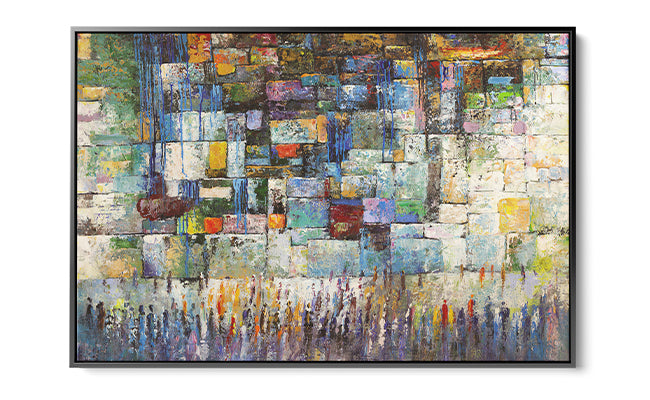
"Jerusalem Mosaic" earns attention for buyers drawn to the realistic end of the spectrum. It captures the essence of the city through texture and recognizable architectural fragments. The mosaic-like composition gives it a formal structure that anchors it in rooms with strong existing geometry, built-in shelving, symmetrical furniture arrangements, coffered ceilings.
"Givaat Halevona" operates differently. It expresses a quiet, enduring connection to Jerusalem through mood and atmosphere rather than literal topography. The palette is restrained, the composition contemplative. This is the piece for a study or reading room where you want Jerusalem present but not insistent.
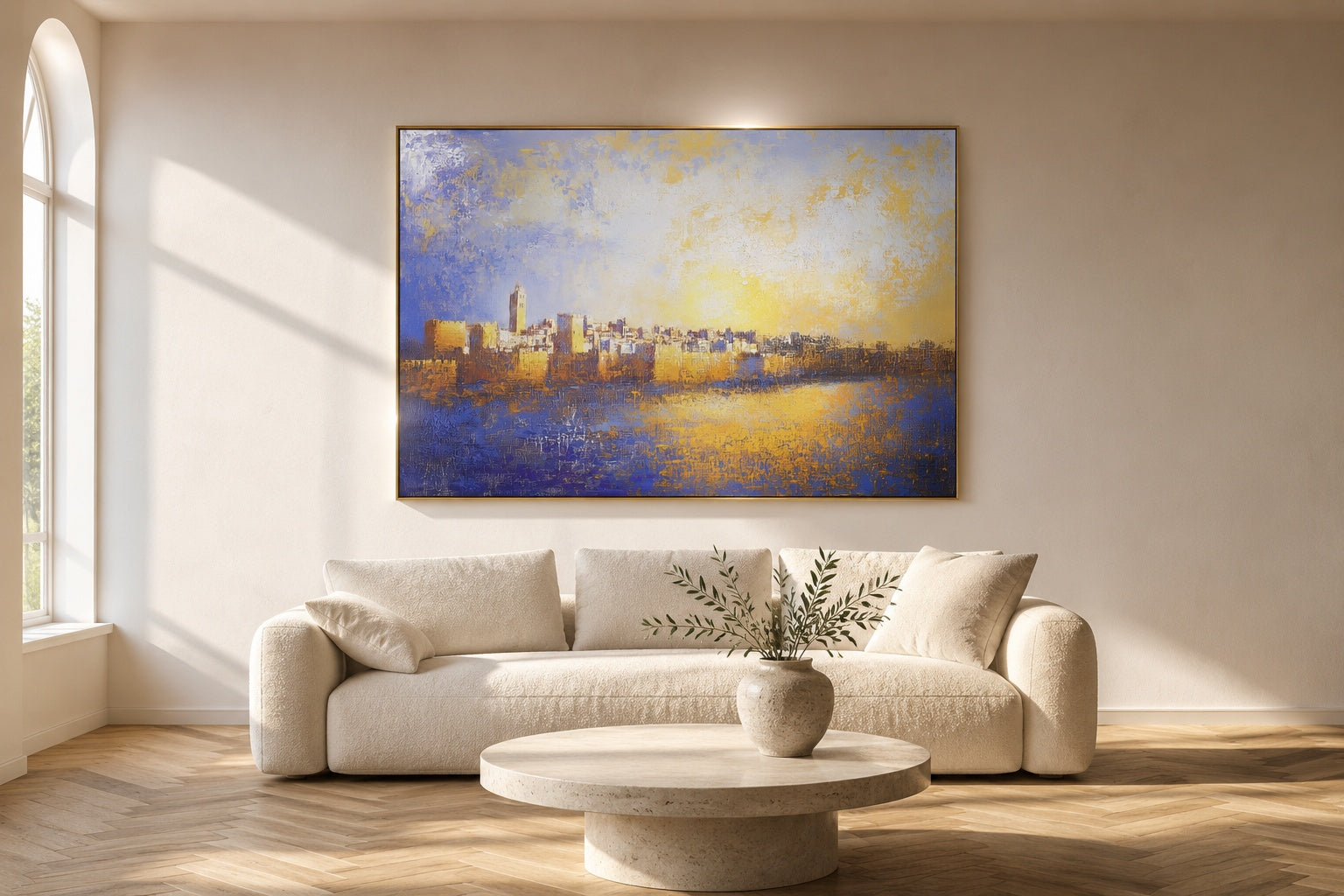
"Jerusalem of Light," discussed earlier in the context of abstract work for modern spaces, bridges the two registers more than either of the above. The golden tones are unmistakably Jerusalem, but the composition is loose enough to read as pure warm abstraction in a room where the title is not visible. That dual legibility is rare and worth paying attention to when you assess your own space.
For buyers interested in the full body of Yossi Bitton's work beyond Jerusalem subjects, the Yossi Bitton collection shows how consistently his expressive language holds across different Jewish subjects.
How to Make Either Style Work Once You Have Chosen
The choice of style is only the first decision. How you hang and scale the piece determines whether it actually succeeds in the room.
Sizing the work to the wall
A canvas should occupy between 57 and 75 percent of the wall width it anchors, measured horizontally. On a ten-foot sofa wall, that means a piece roughly 68 to 90 inches wide, or a gallery arrangement that spans that distance. Undersized work feels apologetic; oversized work crowds the room. This proportion holds for both abstract and realistic pieces, though large abstract canvases tolerate being pushed toward the 75 percent ceiling more comfortably because they do not compete with furniture details the way busy realistic compositions can.
Hanging height
The center of the artwork should sit at approximately 57 to 60 inches from the floor, which aligns with average eye level. Above a sofa, drop it to 6 to 8 inches above the back cushion rather than raising it to the standard center-of-wall height. These numbers apply regardless of style.
Lighting abstract vs. realistic work
This is where the styles diverge in practice. Realistic and impressionist paintings benefit from even, warm-toned illumination that reveals surface texture and color depth. A picture light or an adjustable recessed spot at a 30-degree angle works well. Abstract canvases, especially those with gestural marks or heavy acrylic layering, reward raking light that catches the physical texture of the paint surface. That texture is part of the work's meaning; flat lighting flattens the reading of it.
Styling note: Acrylic work, which describes the format of almost all pieces in this collection, has a surface sheen that changes under different lighting angles. View the piece in person, or request a photo in natural light and in artificial light, before finalizing placement against a light source.
Mistakes worth avoiding
- Hanging a small realistic cityscape on a large, open wall. The architectural detail reads from close range; at ten feet, it becomes a small brown rectangle with no presence. Reserve detailed figurative work for smaller walls or corridors where the viewer will pass within four feet of it.
- Choosing abstract work purely because it matches the sofa. Color harmony matters, but a piece selected only on palette compatibility, with no connection to the room's meaning or your own attachment to the subject, tends to feel anonymous within a few months.
- Mixing a very busy abstract piece with a room that already has strong pattern: patterned wallpaper, a large-scale geometric rug, or heavily textured upholstery. One of those elements needs to yield. Either choose an abstract canvas with a quiet, tonal composition, or simplify the room's existing pattern before introducing the work.
- Ignoring scale when gifting. A 12-by-12-inch canvas is a personal object. It works on a desk or a small bedroom wall. It is not a statement gift for a large dining room. If you do not know the recipient's wall, the safest formats for gifting are mid-range sizes, typically in the 24-by-30 to 30-by-40-inch range, which fit most walls without requiring planning.
For more practical placement guidance across a full room or home, the article on how to choose Jewish wall art by style, scale, and subject addresses the broader decision framework in detail.

The contemporary and modern Jewish wall art collection is also worth scanning if your room calls for something beyond Jerusalem as a primary subject, while keeping the same standard of craft and spiritual weight.
Frequently Asked Questions
What is the difference between abstract and realistic Jerusalem art?
Realistic Jerusalem art renders the city's physical features, its stone walls, domes, light quality, in recognizable form. Abstract Jerusalem art uses color, shape, and texture to evoke the emotional or spiritual atmosphere of the city without requiring the viewer to identify specific landmarks. Impressionist work sits between the two: the city is present but dissolved into light and painterly gesture rather than architectural precision.
Which style of Jerusalem art works better in a modern or minimalist home?
Abstract or semi-abstract work typically integrates more cleanly into minimalist spaces, particularly when the palette is warm and limited to two or three tones. Realistic pieces with high architectural detail can read as visually busy against spare white-wall interiors. The exception is a single, large-format impressionist canvas with significant open sky or negative space; that can work in a modern room if the composition breathes.
Can abstract Jerusalem art still feel spiritually meaningful?
Yes. Spiritual meaning does not require literal imagery. A canvas that distills Jerusalem's light, warmth, and weight into pure color and mark-making can carry just as much devotional presence as a painted view of the Old City. The difference is in how the meaning activates: realistic work invites recognition; abstract work invites contemplation. Some buyers find the second more genuinely meditative over time.
Is realistic Jerusalem wall art better as a gift than abstract?
For recipients whose taste you do not know well, realistic or impressionist work communicates its subject clearly and requires no art-world context to appreciate. Abstract pieces carry more aesthetic risk: the recipient must connect with the color field and composition independently, which is not guaranteed. If you know the recipient prefers contemporary art and lives in a modern interior, an abstract piece may actually suit their home better than a figurative one. The key variable is how well you know their space and taste.
How do I know if a Jerusalem painting is abstract or impressionist?
Ask whether you can identify a specific Jerusalem landmark, the Dome of the Rock, the Western Wall, the Old City walls, without reading the title. If yes, and the forms are softened or dissolved into light rather than drawn with hard edges, it is impressionist. If the answer is no, and the imagery depends entirely on color and texture to carry meaning, it is abstract. Many contemporary works, including several in this collection, are deliberately positioned between the two, using recognizable color language (Jerusalem gold, warm ochre) while keeping the forms ambiguous.
Does the size of the artwork affect whether I should choose abstract or realistic?
Yes, in a specific way. Very large canvases, 40 inches and above, favor abstract or semi-abstract compositions because the gestural marks and color fields gain physical presence at that scale. Highly detailed realistic work is often best appreciated at a closer viewing distance, which makes it better suited to hallways, studies, and smaller rooms where you naturally stand within a few feet of the wall. At distances over eight feet, fine architectural detail in a realistic painting begins to flatten out, and the compositional energy of an abstract piece reads more powerfully.
If you are still deciding, the full range of approaches, from expressive abstraction to contemplative figurative work, is available to browse in the Jerusalem art collection. Each piece includes material details, available size ranges, and enough visual context to judge how it would read against your wall.
Read more
How to Decorate with Jerusalem Wall Art
A practical room-by-room guide to choosing, sizing, and placing Jerusalem-inspired wall art, with expert advice on mood, color temperature, framing, and lighting for high-end interiors.
Read more
How to Choose Kotel Painting for Home: Style, Scale & Placement
A practical guide to choosing a Kotel painting for your living room, covering style, sizing math, color palette, and placement, with specific artist and framing recommendations.
Read more