


How to Choose Jewish Wall Art for Home: Style, Scale & Subject
How to Choose Jewish Wall Art for Home: Style, Scale & Subject
If you're working out how to choose Jewish wall art for home, start with aesthetics and let symbolism follow. Good Jewish wall art can anchor an entryway, hold its own above a sofa, or become a quiet focal point in a study. The challenge most people face is that they shop the symbolism first and the aesthetics second. Flip that order and the whole process gets easier.
Choosing Jewish wall art for your home comes down to three things working together: the visual language of the piece, the interior style of the room, and what the art means to you personally. Get those three in sync and the result never looks forced or overly themed.
Why Jewish Wall Art Is About More Than Decoration
A mezuzah fulfills a mitzvah. A piece of Jewish wall art does something subtler: it holds memory, identity, and meaning in a form that speaks visually every single day. A painting of the Western Wall in your dining room is not just imagery. It marks the room as a space where heritage is present and valued.
That's a different function than a landscape print or abstract canvas. It means the art carries emotional weight before it carries aesthetic weight. And that extra layer of meaning is actually a design advantage. Art with genuine significance reads as intentional and considered. It signals something real about the people who live there.
The practical implication: you don't need to treat Jewish wall art as a category separate from "real" art. Contemporary Judaica has moved well past decorative motifs printed on poster stock. Painters like Yossi Bitton and Menucha Yankelevitch work in oil, acrylic, and mixed media, using abstracted color fields, loose compositional gestures, and richly built surfaces that hold up against any serious contemporary work. The subject matter is Jewish; the visual quality is universal.
If you want a deeper sense of how this category has evolved, the piece on what modern Judaica art actually is covers the art-historical context well.

Understand Your Home Style Before You Shop
Before you look at a single piece, spend five minutes identifying your interior style clearly. Most homes are not purely one thing, but they usually have a dominant register. That register tells you which visual qualities to prioritize in a piece of art.
Here are the styles most likely to come up when choosing Jewish art for a home, and what each one asks of the artwork:
- Modern and contemporary: Clean lines, neutral or monochromatic palettes, minimal ornamentation. Art needs strong compositional restraint and a limited color story. Acrylic works with loose, gestural marks read better here than dense figurative scenes.
- Traditional and transitional: Warm wood tones, upholstered furniture, layered textiles. Art can carry more visual complexity. Rich golds, deep blues, and detailed imagery of Jerusalem's architecture feel at home here.
- Minimalist (including Japandi and Scandinavian): Negative space is furniture. Art must earn its presence. One large-format piece with a quiet, two-tone palette works far better than several smaller ones competing for attention.
- Eclectic and maximalist: More tolerance for pattern and layering. Jewish art with text, figurative elements, and layered color can hold its own, but placement and framing still need to create visual order.
- Industrial and loft: Raw materials, exposed structure, high ceilings. Oversized acrylic works with bold tonal contrast read strongly against brick or concrete. Avoid overly ornate frames; gallery-mount or float-mount styles suit the rawness of the space.
Once you know your style register, you have a filter. Apply it to every piece you consider before you think about subject matter.
Matching Jewish Art Styles to Your Interior Aesthetic
There's a practical translation step between "I have a modern home" and "I know which piece to buy." This is where most people get stuck. So here's how specific visual qualities in Jewish art map to specific interior styles.
Abstract and semi-abstract Judaica in modern spaces
The strongest Jewish art for modern home decor keeps the subject matter legible but not literal. A composition that evokes the Kotel through layered stone-gray and warm gold tones, without rendering individual stones, gives a contemporary room the spiritual resonance it needs without overloading the visual field. Look for works where color temperature does the narrative work, warm amber and ochre for Jerusalem light, cool silver-blue for reflection and prayer.
The Jewish wall art collection for contemporary and modern interiors is the right place to start when your room leans toward clean architectural lines. The acrylic-on-panel format used by many artists here gives works a luminous depth that canvas can't match, and the surface holds up well in rooms with strong directional lighting.

Figurative and text-based Judaica in traditional spaces
Traditional interiors can carry more visual weight. A large depiction of the Old City's winding streets, painted in warm earthy tones with architectural detail, integrates naturally into a room with crown molding, dark wood furniture, and layered rugs. Text-based works with Hebrew lettering in a classic script also read well here, particularly in dining rooms and studies where the written word carries cultural precedent.
One note of caution: figurative work in a traditional space can tip into decorative kitsch if the color palette is too saturated or the execution feels illustrative rather than painterly. Look for tonal complexity, places where the color shifts within a single passage, rather than flat, even fields of pigment.
Large-scale single works for minimalist rooms
In a minimalist or Japandi interior, one well-chosen large-format piece outperforms any gallery wall arrangement. The logic is the same as with furniture: fewer, better things. A single 40-by-60-inch acrylic work of Jerusalem, its palette restricted to two or three tones, can carry an entire wall without visual clutter. The Jewish holy sites art collection has several works in this format that hold their own with the restraint minimalism demands.
For more on how to place art with intention across different room types, the guide on displaying sacred art with intention covers room-by-room logic in useful detail.

How to Choose the Right Subject Matter and Symbolism
Jewish art has a rich visual vocabulary. The challenge is that some symbols carry heavy visual weight and need the right room context to land well. Others are compositionally versatile and adapt across interior styles.
Here's how to think through the main subjects and where they work best:
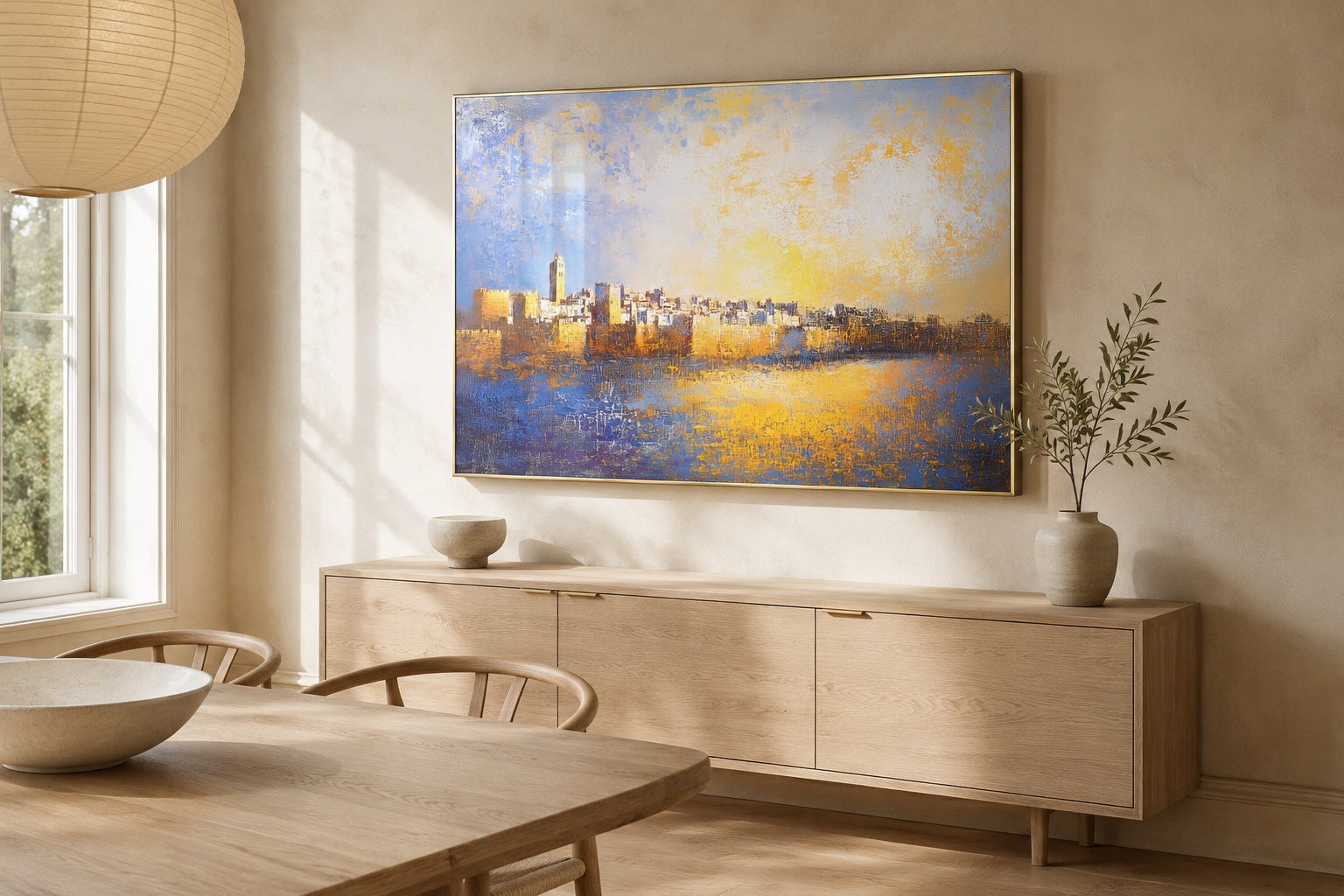
- Jerusalem and the Old City: The most widely used subject in contemporary Judaica, and for good reason. Jerusalem imagery works in almost any room and any interior style because it can be rendered abstractly or architecturally depending on the artist's hand. Works depicting the streets, light, and stone of the Old City suit living rooms, dining rooms, and entryways equally well.
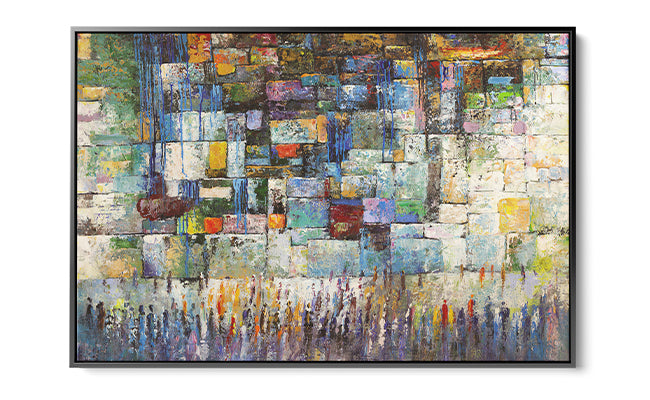
- The Western Wall (Kotel): Carries strong devotional weight. Best placed in rooms with some intimacy: a study, a home office, a landing at the top of a staircase. A large Kotel piece over a living room sofa works if the painting's visual language is restrained; if the composition is crowded with figures and detail, it can overwhelm a casual social space.
- The Shofar: Compositionally dynamic, the curved horn creates a strong diagonal or arc that suits rooms with clean architectural geometry. In rooms with high contrast, a white wall against dark furniture, for instance, the form reads clearly at a distance.
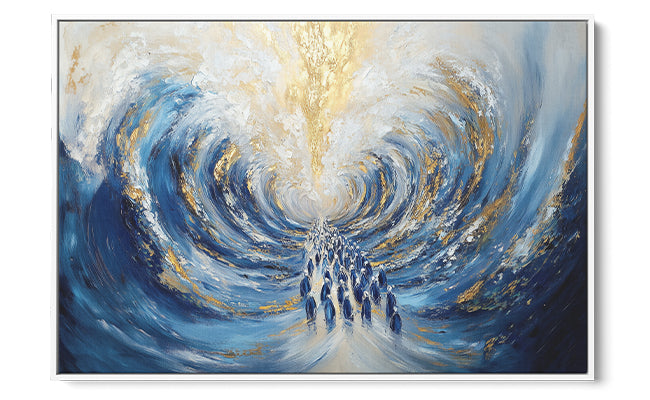
- Splitting of the Sea (Kriyas Yam Suf): Movement and drama are built into the subject. Works depicting this moment suit larger walls where there's room for the composition to breathe. It's an especially strong choice for a hallway with length, a room where the viewer approaches the wall from a distance.
- Hebrew text and blessings: Functional as focal points in dining rooms and kitchens where the written word reinforces daily ritual. In living rooms, text works best when it's integrated into the composition rather than dominating it.
Curator's note: Subject matter and palette are not independent decisions. A painting of Jerusalem rendered in cool silvers and deep blues reads as contemplative and suits a home office or bedroom. The same subject in warm amber and gold reads as celebratory and belongs in a dining room or entryway. Look at the color temperature before you commit to the subject.

Size, Scale, and Placement: Getting the Basics Right
Scale is where most art purchases go wrong. The piece looks right on a screen, arrives home, and suddenly reads as a postage stamp on a ten-foot wall. These are the proportions that actually work:
- For a sofa or console arrangement, the art's width should be roughly 60 to 75 percent of the furniture width below it. A six-foot sofa calls for art that spans roughly 43 to 54 inches across, whether that's a single large work or a composed grouping.
- Hang the center of the work at 57 to 60 inches from the floor in most residential rooms. That's eye level for the average standing adult. In a dining room where guests are mostly seated, drop the center to around 52 inches.
- Above a fireplace, the bottom edge of the art should sit no lower than the mantel surface and no higher than 6 to 8 inches above it. Anything higher creates a visual disconnect between the art and the architectural element it's meant to anchor.
- For an entryway or foyer, a vertically oriented piece works better than a horizontal one. The proportions echo the shape of the door frame and lead the eye upward in a narrow space.
The acrylic works in Ben Ari's collection are available across a price range of roughly $310 to $1,280 depending on size, which gives you room to match the scale your wall actually needs rather than compromising on dimensions to fit a budget. Pick the right size first, then find the piece within that size range that fits your aesthetic.
Styling note: In a room with high ceilings (nine feet or above), a single 36-by-48-inch piece will look underpowered. Either go larger, to 48 by 60 inches or more, or create a vertical stack of two works with a consistent frame style and roughly two to three inches of space between them.
A detailed breakdown of how to pick the right size for different wall configurations is covered in this guide to choosing Judaica art if you want to go further with the technical side of placement.
Three Common Mistakes Worth Avoiding
Experience in this category surfaces the same errors repeatedly. Knowing them in advance saves a return.
- Buying too small: The single most common error. Pieces that measure 18 by 24 inches look appropriate in a showroom and disappear on a real wall. Unless the space is genuinely compact (a small bathroom, a narrow hallway niche), lean toward the larger size in a range.
- Treating Jewish art as a separate visual category: Art with Jewish subject matter still needs to follow the same compositional rules as any other wall art. It needs to relate to the furniture below it, to the palette of the room, and to the other objects on the wall. A Kotel painting in warm bronze tones will not sit well in a room styled with cool gray and black steel. The faith content doesn't override the color logic.
- Overcrowding with multiple symbols: A mezuzah at the door, a hamsa in the hall, a menorah on the shelf, and a large Kotel painting above the sofa can feel like a checklist rather than a home. Choose one or two focal pieces that carry real visual weight and let them be the primary statement. Supporting objects around the room can reinforce the theme quietly without competing for attention.

Where to Find High-Quality Jewish Wall Art Worth Buying
Quality in this category comes down to two things: the artist's hand and the print or production medium. Original paintings and limited-edition acrylic works on panel hold up over time and retain visual presence in ways that mass-printed reproductions don't. The surface texture, the depth of color, and the way light moves across the work all depend on the substrate and the process.
Yossi Bitton's "Streets of the Old City" is a useful example of what to look for in a contemporary Judaica work for a modern interior. Bitton works primarily in oil on canvas, and also across acrylic and mixed media, and that range shows in the compositional depth his works achieve. This piece uses architectural abstraction rather than photographic realism, so the visual interest comes from the relationship between planes of color and the suggestion of light and movement, not from documentary detail. That quality is what makes it versatile across interior styles. Works structured this way hold up as the rest of the room changes over time. You can see his full range in the Yossi Bitton Judaica collection.
Menucha Yankelevitch's "Toward the Holy City" works from a different register. The composition prioritizes spiritual atmosphere and visual movement over architectural specificity. It suits rooms where the art is meant to create a mood rather than anchor a narrative, a bedroom, a meditation corner, a living room designed around contemplation rather than social energy. You can see the full range of her work in the Menucha Yankelevitch Judaica collection.
For works centered specifically on Jerusalem, both in abstracted and more architectural approaches, the Jerusalem modern Jewish art collection brings together artists whose primary subject is the city's light, stone, and spiritual geography. It's a useful shortcut if Jerusalem imagery is the direction you've settled on.
The Kotel-specific works, including "Gathered at the Kotel" and the more restrained Western Wall compositions, are gathered in the Western Wall art collection. The range includes both high-contrast dramatic compositions and quieter, more introspective takes on the same subject, which is useful if you're trying to match the emotional register of a specific room.
Designer's tip: When you're choosing between two pieces you like equally, put them both against the dominant color in your room. The piece whose secondary tones pick up something already present in your space, a warm wood floor, a cool linen sofa, a brass fixture, will integrate more naturally than the one that introduces a new color story.

Bringing It All Together: A Simple Decision Framework
If you want a repeatable process, here it is. Three questions, answered in order.
1. What mood do I want the room to hold? Contemplative, celebratory, warm, expansive, intimate. The answer determines color temperature and composition type before anything else. Cool tones and sparse compositions for quieter spaces; warm tones and dynamic compositions for social ones.
2. What scale does the wall need? Use the proportional guidelines covered in the sizing section. Identify the minimum dimensions first. Then look only at pieces that meet or exceed that size. Do not fall in love with a piece and then rationalize the size.
3. Which subject and symbolic register fits this room and this family? Jerusalem as a city, the Kotel as a devotional site, the Shofar as a call to renewal, Kriyas Yam Suf as a statement of faith through motion. Each carries different emotional weight and suits different rooms. Let the room's function and the family's relationship to the subject guide the final choice.
Run any piece you consider through those three questions in that order. If it passes all three, buy it with confidence.
Frequently Asked Questions
What style of Jewish wall art works best in a modern home?
Abstract and semi-abstract works in limited palettes are the strongest fit for modern interiors. The key quality to look for is compositional restraint: the subject should be legible but not literal, with color and form doing most of the narrative work. Acrylic-on-panel formats suit modern rooms well because the luminous surface depth integrates with the clean architectural lines typical of contemporary interiors.
Can Jewish wall art work in a non-Jewish home?
Yes, with the same logic that applies to any culturally specific art. A painting of Jerusalem's light and stone is visually compelling regardless of the viewer's background. The question is whether the subject resonates with the people who live there. For non-Jewish homes that want the visual quality without personal devotional connection, abstract interpretations of Jewish subjects tend to read as art first and religious imagery second.
How do I know what size Jewish wall art to buy for my wall?
Measure the furniture it will hang over and aim for art that spans 60 to 75 percent of that width. Then check against the wall height: in a room with eight-foot ceilings, a piece taller than 48 inches will start to dominate. For walls with no furniture anchor below them, the art's width should not exceed 75 percent of the wall's width, and it should leave at least 12 inches of visible wall on each side.
What Jewish symbols are most popular in contemporary wall art?
Jerusalem cityscape and Kotel compositions are by far the most prevalent in serious contemporary Judaica. The Shofar, Menorah, and Magen David are also common, but in high-quality contemporary work they tend to appear as compositional elements within a larger scene rather than as isolated symbols. Works that integrate symbolic content into a painterly composition carry more visual longevity than those that isolate a single motif on a plain background.
Should Jewish wall art always include Hebrew text?
No. Hebrew text adds a specific kind of meaning and is particularly fitting in dining rooms or study spaces, but many of the strongest contemporary Judaica pieces carry their meaning entirely through color, form, and subject without any lettering. Text introduces a readable element that changes how the viewer engages with the work, which is sometimes exactly right and sometimes a distraction depending on the room's function and the viewer's daily relationship with the Hebrew alphabet.
How do I mix Jewish wall art with other decor without it looking mismatched?
The most reliable approach is to treat the Jewish art as the primary piece and build the room's supporting objects around its palette. Pull one or two colors from the artwork into textiles, ceramics, or furniture. Keep other wall objects either neutral in subject matter or compositionally simple enough that they don't compete. One strong Jewish art piece surrounded by quiet supporting objects reads as intentional; multiple symbolic objects competing at the same visual volume reads as a collection, not a room.
If you're ready to find a specific piece, the contemporary and modern Judaica art collection brings together works across subjects, scales, and palettes from artists whose work is worth serious consideration. You'll find compositions ranging from large-format Jerusalem abstractions to intimate Shofar works, all produced on high-quality acrylic panel substrates.
Read more
How to Choose Jewish Art for Home That Honors Holy Sites
A designer's framework for choosing Jewish holy-site art: pick a meaningful site, confirm the artist treats it with respect, and size and place it well.
Read more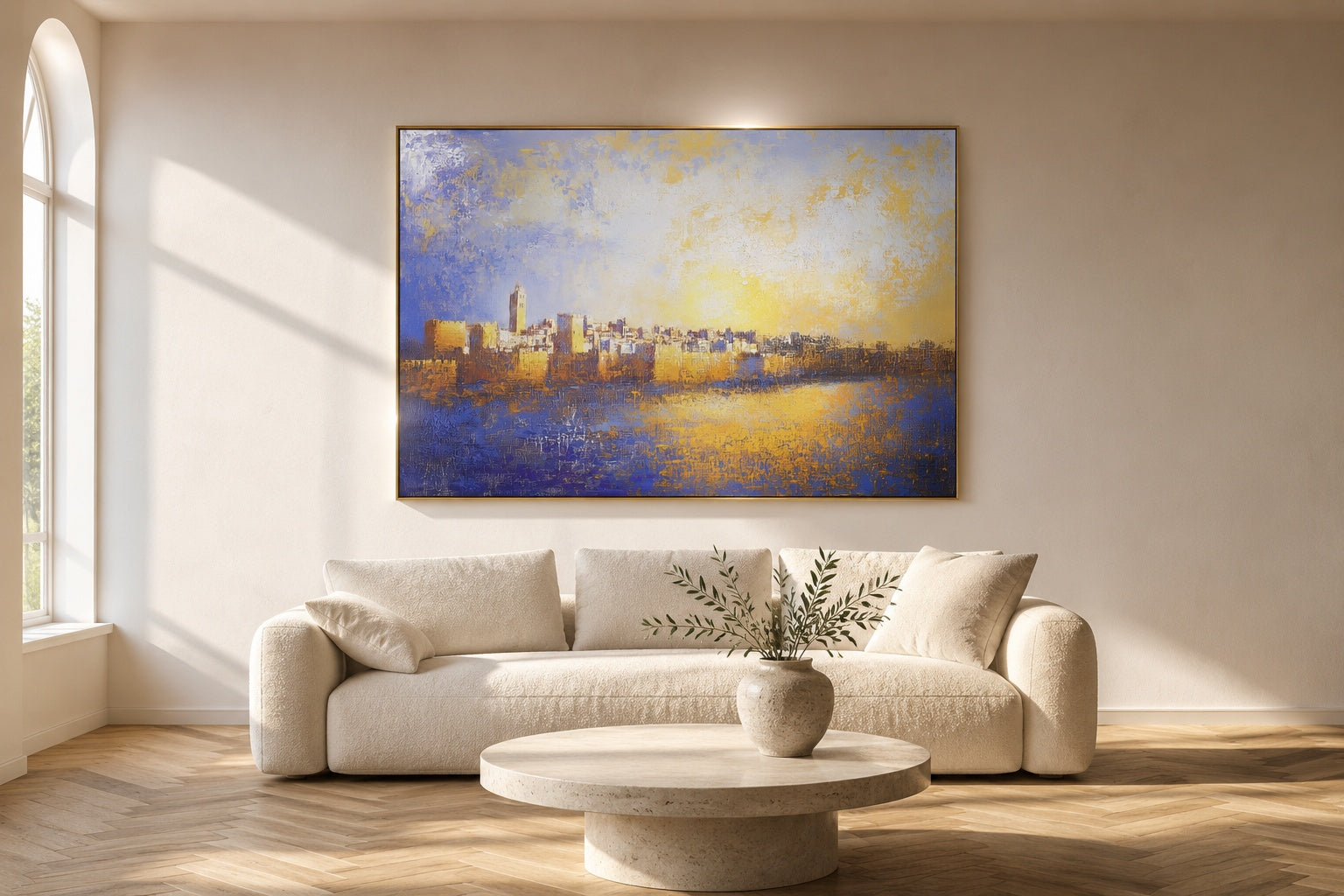
How to Decorate with Jerusalem Wall Art
A practical room-by-room guide to choosing, sizing, and placing Jerusalem-inspired wall art, with expert advice on mood, color temperature, framing, and lighting for high-end interiors.
Read more