


Gallery Wall Ideas With Jewish Art: Kotel as Your Anchor
Gallery Wall Ideas With Jewish Art: Kotel as Your Anchor
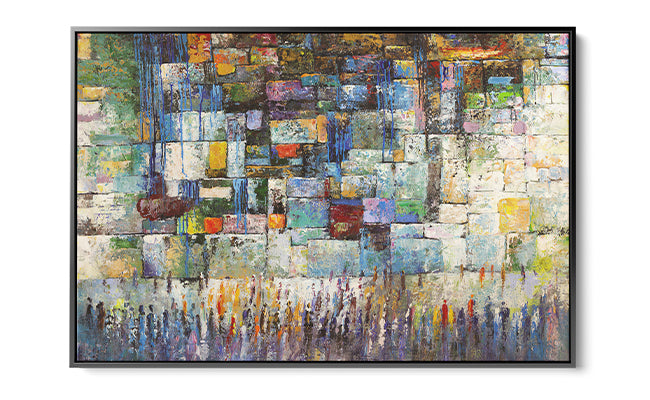
If you're searching for gallery wall ideas with Jewish art, the most effective approach centers on a single strong Kotel piece and builds outward with intention. Treat the Western Wall artwork as a true anchor, size it to command the wall, and choose surrounding works that add context without competing. Done well, the result feels less like a collection of prints and more like a considered interior statement rooted in meaning.
This guide walks through layout logic, framing decisions, complementary piece selection, and room-by-room placement, with practical measurements at every step. The same core principles apply whether you are working with a large open wall in a formal dining room or a narrow hallway.
Why a Kotel Artwork Makes the Perfect Gallery Wall Anchor
A gallery wall needs one piece that stops the eye before anything else does. The Kotel, the Western Wall in Jerusalem, carries both visual weight and emotional gravity that very few subjects can match. Its stone texture, vertical scale, and layered human history give an artist enormous material to work with, and a strong Kotel composition almost always contains the contrast, depth, and focal movement that make a piece command a wall.
Practically speaking, most Kotel artworks are produced in horizontal or near-square formats with strong central subject matter. That makes them ideal anchors because you can build outward in any direction without the composition pulling sideways. Paintings with a clear light source, whether the warm gold of late-afternoon sun on limestone or the cool blue of an abstracted night scene, also set the color temperature for every piece you hang around them.
There is a deeper reason to center the wall here. Jewish homes have always set aside space for objects and images that orient the household toward something sacred. A gallery wall built around a Kotel piece does that work architecturally, turning an otherwise neutral wall into a focal point with real intention behind it. For more on this idea, the article on displaying sacred art with intention offers a useful philosophical framework before you pick up a single nail.
Choosing the Right Wall and Layout for Your Jewish Art Gallery
Start with the wall before you start with the art. The best gallery walls live on surfaces you encounter the moment you enter a room, not the ones you face when seated. In practice, that usually means the wall directly across from a doorway, the wall above a console or credenza, or the long wall of a dining room that draws the eye down the table.
Measure the usable width of your wall, then identify a zone roughly 60 to 70 percent of that width for the full gallery cluster. Centering the cluster rather than stretching it edge-to-edge keeps the arrangement from looking crowded and gives the wall room to breathe. For a wall that is 10 feet wide, your cluster should span roughly 6 to 7 feet.
The anchor Kotel piece should occupy the visual center of that cluster. Its center point should sit approximately 57 to 60 inches from the floor, which is standard gallery height and aligns with average eye level. Smaller surrounding pieces then radiate from that center, not from the edges inward.
Three layouts work especially well with a dominant religious centerpiece:
- Symmetrical grid: The Kotel anchor in the center, pairs of equal-sized prints flanking it horizontally and a matched pair above and below. Clean, formal, well-suited to traditional and transitional interiors.
- Organic cluster: The Kotel anchor off-center by a third of the wall, with smaller pieces cascading asymmetrically around it. Works well in contemporary and modern spaces where strict symmetry can feel rigid.
- Horizontal band: A single row of art at the same horizontal midline, with the Kotel piece the tallest in the row. Especially effective above a long sideboard or sofa, keeping the arrangement legible at a glance.
For a dedicated look at how Jerusalem and holy-site art fits into these layouts, the Jewish holy sites art collection shows the range of formats and scales available.

How to Select Complementary Jewish Art Pieces That Work With Kotel Art
The pieces around your anchor should share at least one visual element with it: color family, compositional weight, or subject matter that belongs to the same spiritual universe. They do not need to match in style. In fact, a mix of realistic and abstract Jewish art often produces a more interesting wall than pieces that are stylistically identical.
A practical three-step method for selecting companions:
- Identify the anchor's dominant color temperature. Warm-toned Kotel art (ochres, golds, sandy limestone) pairs naturally with other works in amber, copper, or deep reds. Cool-toned Kotel paintings (blues, silvers, moonlight) want companions in navy, charcoal, or soft violet.
- Choose subject matter that extends the narrative. Pieces depicting Jerusalem in a wider context, Torah life, prayer, or other holy sites create thematic coherence. This keeps the wall from feeling like a random assortment of Jewish-themed prints.
- Vary scale deliberately. A 24-by-24-inch anchor wants at least one piece at roughly half that size on each side, then smaller accent pieces (8-by-10 or 10-by-10 inches) filling the gaps. Never place two large pieces side by side at the same height; it fragments the eye.
Yossi Bitton's "Kol BeRamah" is a good example of a companion piece that follows the first two rules without fighting for dominance. It references Kever Rachel, a site closely linked to Jerusalem and prayer, and its palette tends toward the same limestone and sky tones common in strong Kotel paintings. At its mid-range acrylic size it reads as a meaningful secondary presence rather than a competing anchor. You can find more of Bitton's work in the Yossi Bitton collection.
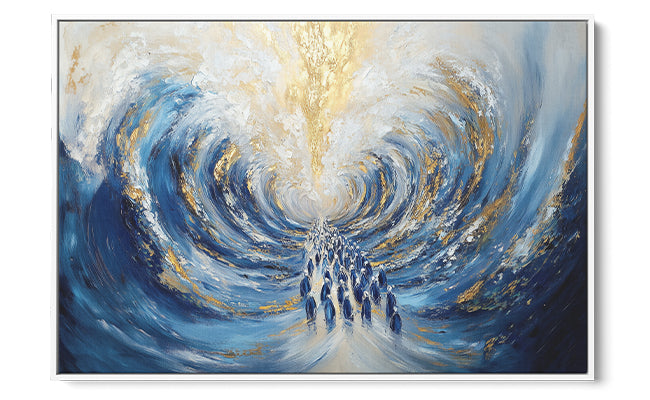
Menucha Yankelevitch's "Bearers of the Torah" brings movement and warmth to a wall that might otherwise feel contemplative to the point of stillness. Its figural energy creates contrast in mood without breaking the Jewish thematic thread, and the vibrant palette adds life to quieter, stone-toned Kotel compositions.
For a gallery wall with a more celebratory register, a chuppah-themed piece like "Kol Sason VeKol Simcha" connects Kotel imagery to Jewish life-cycle tradition in a way that feels personal and layered. Many families choose this pairing in a dining room where Shabbat and holidays are observed, giving the wall year-round resonance.

Framing Styles and Matting Choices That Tie the Wall Together
Frames are the connective tissue of a gallery wall. Get them right and the viewer reads the whole arrangement as one composed statement. Get them wrong and it looks like a storage wall.
The most reliable approach is to anchor the Kotel piece in a substantial frame that sets the material and finish, then use a limited family of frames for the surrounding pieces. "A limited family" means two or at most three frame styles that share either the same finish or the same material. A walnut wood frame on the anchor reads beautifully with thinner walnut frames on secondary pieces, or with a dark bronze metal frame that echoes the wood's warmth.
Avoid mixing more than two frame metals (gold and silver together, for instance, rarely settle). And resist the temptation to use ornate frames on every piece: save the heavier moldings for the anchor and use simpler profiles on the surrounding work so the eye knows where to land first.
Matting decisions matter for scale as much as for aesthetics. A wide, off-white mat around a smaller print adds visual weight without changing the print's actual dimensions, which is useful when you need a small piece to hold its own next to larger works. For acrylic-mounted pieces, the float-mount presentation already provides that halo of space, so additional matting is rarely needed.
Curator's note: If your Kotel anchor is an acrylic-mounted piece with a glossy face, use matte-finish frames on the surrounding works. The contrast in surface texture keeps individual pieces legible without requiring large gaps between them.
| Frame Style | Best Anchor Pairing | Interior Style Fit | Matting Recommendation |
|---|---|---|---|
| Wide walnut wood | Warm-toned Kotel painting | Traditional, transitional, Japandi | Cream or natural linen mat |
| Thin black metal | Graphic or abstract Kotel print | Modern, minimalist, industrial | Wide white mat or no mat |
| Antique gold leaf | Rich jewel-toned Kotel canvas | Luxury, maximalist, classical | Ivory or deep-toned mat |
| Natural light oak | Cool-toned or abstract Kotel piece | Scandinavian, boho, coastal | White mat or none |

Step-by-Step Guide to Arranging Your Gallery Wall Around a Focal Kotel Piece
Laying out a gallery wall is much less stressful when you work on the floor first. Before anything goes on the wall, here is a reliable sequence:
- Trace and cut paper templates. Cut kraft paper or newspaper to the exact dimensions of each piece, including its frame. Label each template with the piece's name and orientation.
- Arrange on the floor directly below your wall. Start with the Kotel anchor in the center of your planned cluster. Place the next largest pieces first, then fill the remaining space with smaller works. Photograph the arrangement before you move anything.
- Set your spacing rules and keep them. A 2 to 3 inch gap between frames is the professional standard for a cohesive gallery wall. Tighter than 2 inches reads as chaotic; wider than 4 inches starts to break the sense of a unified group. Choose your spacing and hold it consistently.
- Tape templates to the wall. Use painter's tape on the back of each template. Once you are satisfied with the arrangement, mark the hanging hardware position through the template before removing it.
- Hang the anchor first. Everything else is positioned relative to it, so it must go up first and be level. Use a laser level or a long spirit level, not a phone app, for accuracy across wider arrangements.
- Work outward from the anchor, checking the gap with a piece of cardboard cut to your chosen spacing. This keeps the spacing consistent without measuring every time.
Styling note: Do not try to hang every piece in one session. Hang the anchor, step back and look at it for a day, then add the secondary pieces. The anchor will often reveal whether the surrounding pieces you chose actually hold their weight alongside it.

Room-by-Room Inspiration: Where Gallery Walls With Jewish Art Work Best
The honest answer is that there is no room in a Jewish home where a Kotel gallery wall is inappropriate. But some rooms create a particularly strong context for it.
Dining Room
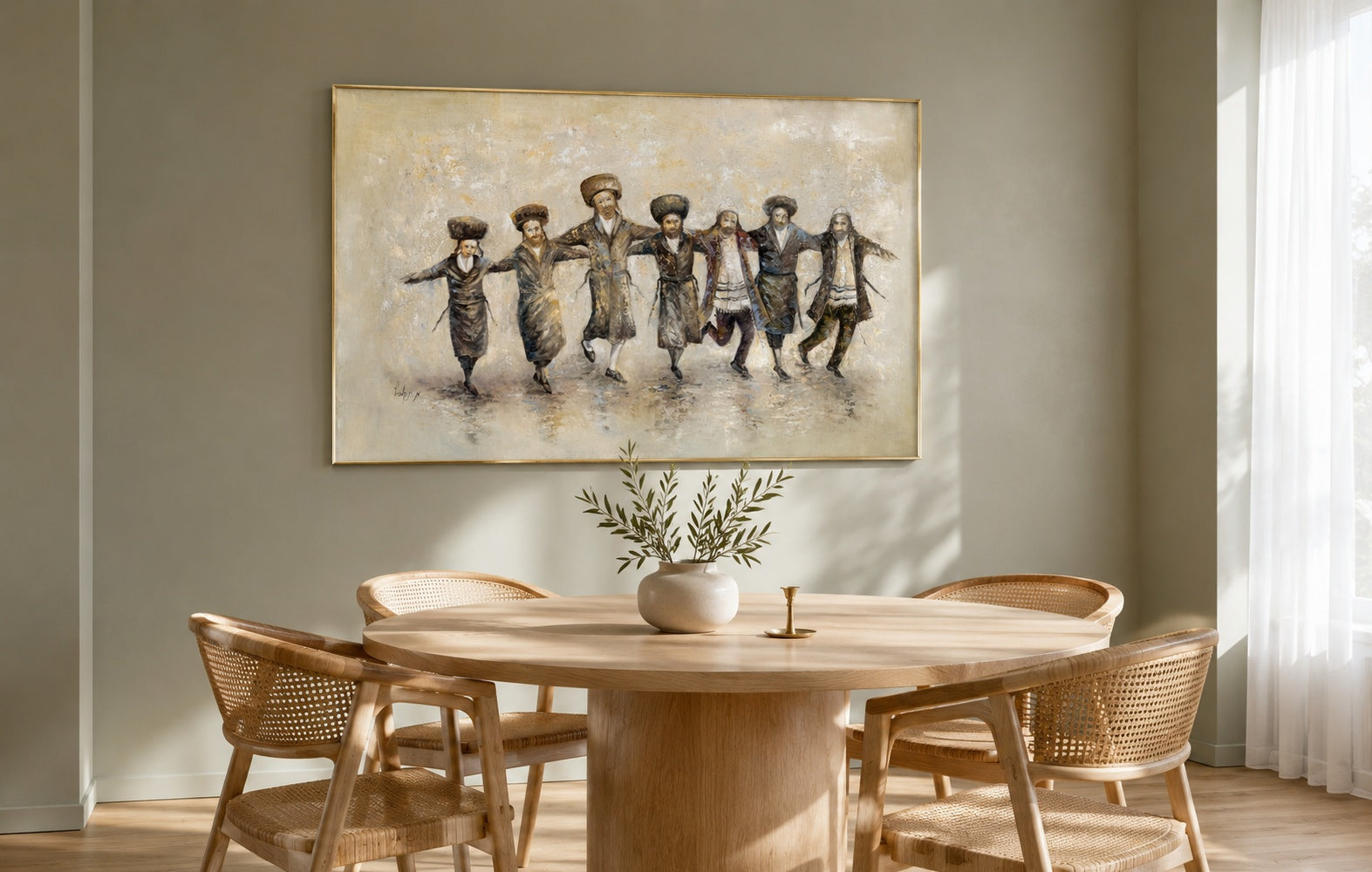
The dining room wall that faces the table is the most-viewed surface in a Jewish home. Every Shabbat meal unfolds with that wall in the background, holidays, family gatherings, the ordinary Tuesday dinner that becomes a little less ordinary because of what hangs there. A gallery wall anchored by a Kotel piece grounds every meal in something larger than the occasion. The scale can be ambitious: a 36-by-48-inch anchor with four to six secondary pieces around it is not too much on a dining room wall that is 12 or more feet wide.
Entry Foyer
A foyer gallery wall is the first and last thing residents and guests encounter. Keep the arrangement tighter here, since foyers are rarely wide enough for more than three to five pieces. The anchor should be the first thing the eye finds, so scale it to the wall and center it on the narrowest axis of the space. A horizontal band layout works especially well in a narrow hallway foyer.
Home Office or Study
A study gallery wall benefits from including text-based or figure-based Jewish art alongside the Kotel anchor. Works depicting Torah learning, rabbinic figures, or Hebrew calligraphy add intellectual texture that suits the room's function. The rabbi portrait collection offers pieces at a range of price points that layer well into a study gallery wall without overpowering it.
Living Room
Above a sofa, keep the total width of the gallery arrangement to approximately two-thirds of the sofa's length, the professional standard, with an acceptable range of 60 to 75 percent, and the bottom edge of the lowest piece no less than 6 to 8 inches above the sofa back. This keeps the arrangement visually connected to the furniture below it. A contemporary Kotel anchor works well in living rooms with modern or transitional design, particularly when the surrounding pieces include abstract or semi-abstract Jerusalem art that echoes the anchor without duplicating it.
For a deeper look at placement mechanics across different room types, the article on how to decorate with Jerusalem wall art covers proportional placement in more detail.

Common Mistakes to Avoid
Even well-intentioned gallery walls fall apart because of a few recurring errors. Knowing them in advance saves time and wall repair.
- Hanging too high. The single most common mistake. Gallery height is a center-point of 57 to 60 inches from the floor. Above that, pieces read as floating disconnected from the room.
- Too many anchor-scale pieces. If three pieces all compete for dominance, none of them win. One anchor, two secondary pieces at most half the anchor's size, and smaller accent pieces beyond that.
- Ignoring the wall's own architecture. A gallery wall that runs into a light switch, outlet, or vent looks careless. Map the wall's fixed features before you plan your cluster.
- Inconsistent frame depth. When some frames project far from the wall and others sit flush, the arrangement looks three-dimensional in an unintended way. Aim for frames of similar depth, or deliberately graduate from thicker at the center to thinner at the edges.
- Skipping the floor layout step. This is the step most people skip, and it is the one that costs them the most in extra holes. The floor layout described in the step-by-step section above takes 20 minutes and prevents most hanging regret.
Final Touches: Lighting, Spacing, and Making the Display Feel Intentional
A gallery wall that is not lit properly reads as wallpaper. Lighting is what separates a considered display from a collection of things on a wall.
Picture lights mounted directly on the anchor frame are the cleanest solution for a formal space. They focus attention on the primary piece and cast a warm halo that brings out the texture of oil or acrylic work. For a more distributed effect, directional recessed lighting or adjustable track heads positioned 24 to 30 inches from the wall and angled at 30 degrees will illuminate the full arrangement without hotspots.
Avoid overhead ambient light alone. Flat downlight removes all shadow and texture from art, making even a high-quality piece look flat and dull.
Designer's tip: Use a warm-white bulb in the 2700K to 3000K range for Kotel and Jerusalem art. Cool-white light (above 4000K) shifts warm limestone tones toward gray and flattens the palette most Israeli artists work in.
Once the pieces are hung and lit, look at the wall from across the room and identify the negative space, the actual wall visible between and around the frames. That negative space is part of the composition. If it feels too fragmented, close up the spacing by half an inch between each pair of frames. If the arrangement feels too dense, you may have one piece too many: remove the least essential secondary piece and reassess.
Finally, level every piece with a proper spirit level after hanging. Frames that are even a degree off read immediately to the eye, and in a gallery wall that slight tilt spreads a sense of visual unease through the whole arrangement.

Where to Find the Right Anchor and Supporting Pieces
The pieces discussed throughout this article point toward one consistent principle: the anchor has to earn its place before anything else can. For a Kotel-centered gallery wall, the anchor needs scale, depth, and a quality of finish that holds up at close range and across a room. The contemporary Judaica pieces in the Western Wall art collection cover the full range of formats and sizes that the layouts in this article require.
The Yankelevitch and Bitton pieces mentioned earlier represent the kind of secondary works that add warmth and narrative alongside a strong Kotel anchor, and both artists are part of a broader group of contemporary Jewish artists whose work spans scales suited to gallery walls. The contemporary Jewish wall art collection offers an overview of what is available across style, medium, and scale, which is the most practical starting point once your anchor is confirmed.
Frequently Asked Questions
What size should the focal Kotel artwork be in a gallery wall arrangement?
As a rule of thumb, the anchor piece should cover roughly 40 to 50 percent of the total visual area of your gallery cluster. For a standard dining room wall, that often means a piece between 30-by-40 and 40-by-48 inches. Go below 24-by-24 and the anchor loses its authority over the surrounding pieces; the eye starts jumping around rather than landing first on the focal work.
Can I mix abstract and realistic Jewish art styles on the same gallery wall?
Yes, and the mix often produces more visual interest than a stylistically uniform wall. The key constraint is color: abstract pieces should share at least one color from the anchor's palette, even loosely. A realistic Kotel painting in gold and sand tones can sit comfortably next to an abstract Jerusalem piece in ochre and deep blue, because the warm undertone connects them. What breaks the wall is a piece that has no tonal relationship to anything around it.
What other Jewish symbols or prints pair well with Western Wall art?
Subject matter that deepens the spiritual or geographic context works best: other Jerusalem or holy-site imagery, Torah-themed figurative work, calligraphic Hebrew blessings, and chuppah or lifecycle pieces all extend the narrative. Purely decorative Jewish motifs, like standalone Hamsa or generic Chai prints, tend to feel thematically thin alongside a serious Kotel anchor. Choose pieces that have their own point of view rather than pieces that simply signal a Jewish identity.
How do I hang a gallery wall without damaging my walls?
Adhesive strips rated for the weight of your frames are a legitimate option for lighter pieces, typically those under 5 pounds per frame. For heavier acrylic-mounted works, anchor directly into studs or use toggle bolts rated for the piece's weight. Always check the manufacturer's weight rating on any adhesive product and reduce your load by 30 percent in humid rooms. In a rental, the floor layout step described earlier is especially important: plan the arrangement completely before drilling, since repositioning later multiplies the damage.
Should all frames in a Jewish art gallery wall match, or can I mix frame styles?
Two or three coordinating styles within the same finish family is a stronger approach than perfectly matched frames, which can read as rigid, or completely mixed frames, which fragment the arrangement. The anchor frame should be the most substantial in the group. A secondary set of frames can differ in profile but should share the finish or material of the anchor. A third accent frame style, used only on the smallest pieces, adds personality without disrupting the hierarchy.
Is it appropriate to display Kotel or Jerusalem art in any room of the home?
Halachically, there is no prohibition on displaying Jerusalem or Kotel imagery in any room of a Jewish home. The traditional consideration is placing Torah verses or a Mezuzah text in a bathroom, which does not apply to landscape or figurative artwork. From a design standpoint, the bedroom is the only room where the weight and scale typical of a gallery wall anchor can feel overpowering, particularly for pieces with strong contrasts. A smaller, quieter Kotel piece as a single statement in a bedroom is appropriate; a full six-piece gallery wall with a large anchor is better reserved for a more public room.
How much space should I leave between frames on a gallery wall?
The professional standard is 2 to 3 inches between frames. That range keeps the arrangement reading as a unified group without feeling cramped. Below 2 inches, the wall starts to feel chaotic; above 4 inches, the pieces begin to drift apart visually.
For a closer look at the range of Western Wall pieces available in formats suited to gallery wall anchors, the Kotel art collection at Ben Ari Art Gallery includes original works and limited editions in acrylic, canvas, and print formats, with sizes from modest secondary-piece dimensions up to large-format anchors.
Read more
Best Ways to Display Religious Art at Home | Ben Ari Art Gallery
A room-by-room guide to displaying Jewish and religious art at home, covering wall selection, framing, scale, lighting, and gallery arrangements with specific measurements and placement guidance.
Read more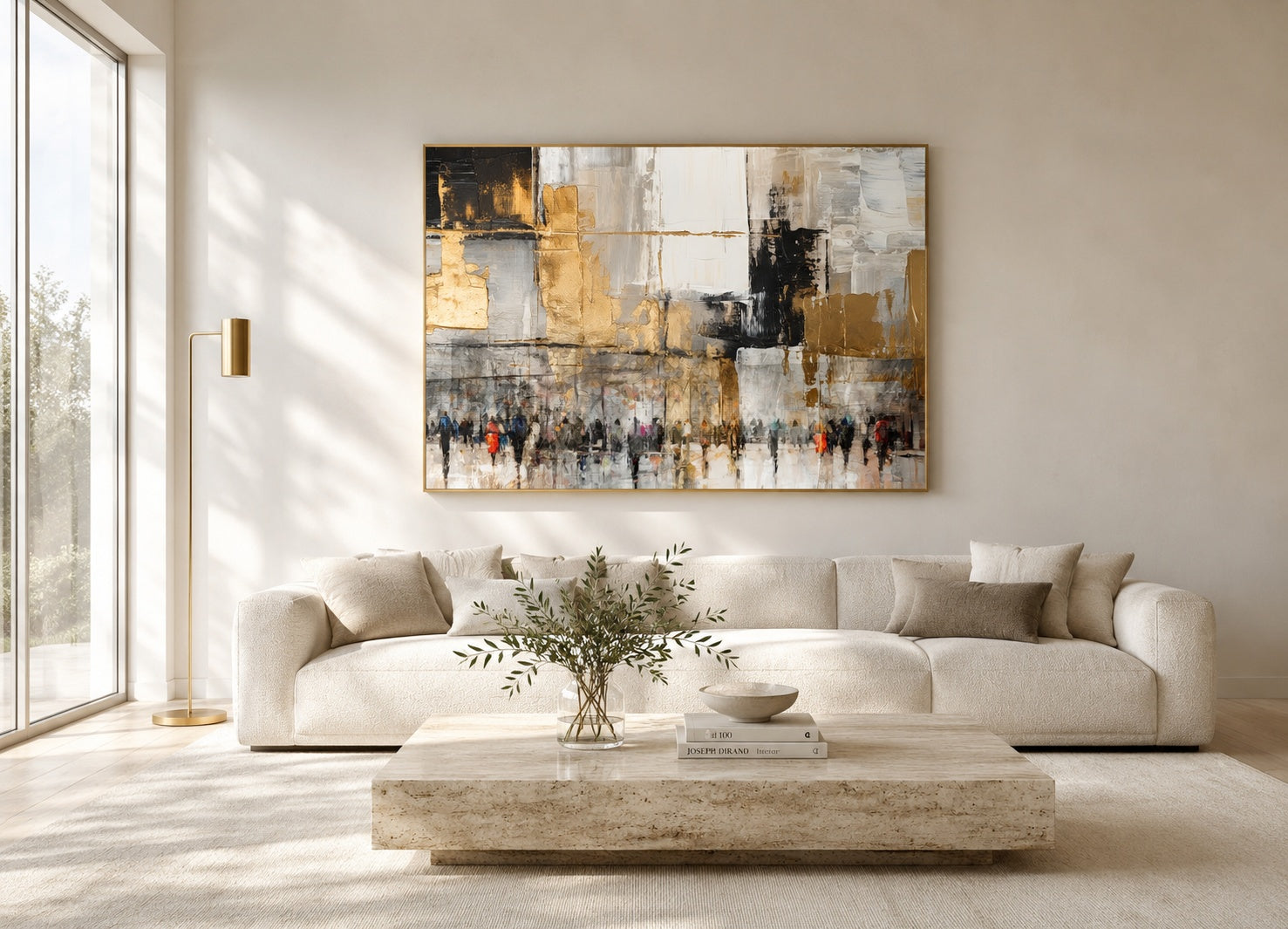
How to Display Jewish Art in Modern Home Without Losing Meaning
Treat the work as art first and symbol second. A room-by-room guide to placement, framing, scale, and pairing for contemporary Jewish wall art.
Read more