

Article: Best Jewish Art Styles for Home Decor: A Room-by-Room Guide

Best Jewish Art Styles for Home Decor: A Room-by-Room Guide
Best Jewish Art Styles for Home Decor: A Room-by-Room Guide
The best jewish art styles for home decor span a wide range, from classical Judaica with illuminated manuscript motifs to bold abstract paintings that carry deep spiritual meaning without a single Hebrew letter in sight. The style you choose depends less on how religious your home is and more on how you want the room to feel. This guide walks through the main styles available today, explains what makes each distinctive, and gives you a concrete method for matching one to your existing decor.
What Makes Jewish Art Distinct in a Home Decor Context
Most wall art is purely visual. Jewish art carries an extra layer: it holds cultural memory, religious intention, and sometimes a living practice. A painting of the Western Wall is not just an architectural study, it is a reference point for prayer, history, and belonging. That added meaning changes how a piece functions in a room.
That does not mean the art has to announce itself loudly. The best Jewish art for contemporary homes works on two levels simultaneously: it reads as serious, well-made visual art from across the room, and it rewards closer attention with its symbolic or spiritual content. A piece that only functions as a religious sign without visual strength will feel like an object rather than art. A piece with only visual strength and no meaningful content could have come from anywhere.
Practically speaking, Jewish wall art tends to organize around a handful of recurring formal strategies: dense, layered compositions drawn from manuscript illumination; architectural views of sacred places; figurative scenes of Jewish life; and increasingly, abstract color-field work where the spiritual content lives in gesture and light rather than imagery. Each approach has real implications for how it sits in a room.
For a deeper look at how the genre has developed over the past century, the overview at what modern Judaica art is and why it matters is a useful starting point before you begin comparing styles.

The Main Styles of Jewish Art You Will Encounter Today
Before getting into specific sub-styles, it helps to know the four broad categories most collectors and designers work with. Think of these as the organizing principle, and everything else as variation within them.
- Traditional/Classical Judaica art: Micrography, manuscript-style borders, illuminated text, and ritual object imagery. Highly detailed, often symmetrical, and tied visually to historical Jewish decorative tradition.
- Figurative Jewish life art: Scenes of Shabbat, prayer, markets, and family life. Rooted in the figurative tradition of artists like Marc Chagall, though contemporary versions range from painterly realism to loose expressionism.
- Sacred cityscape art: Jerusalem, the Western Wall, Rachel's Tomb, the Old City's rooftops. Often photographic in source but interpreted through paint, mixed media, or digital means into something more atmospheric than documentary.
- Abstract and expressive Jewish art: Color, movement, and form carry the spiritual content. May include Hebrew letters, but often does not. This is the fastest-growing category in contemporary Judaica.
Most pieces sold today fall clearly into one of these four, though some artists cross the lines deliberately. Knowing which category a piece belongs to tells you immediately which rooms it suits and which decor styles it will complement.
Traditional and Classical Jewish Art: Timeless Motifs with Enduring Appeal
Classical Judaica art draws from a rich formal vocabulary: the illuminated pages of medieval manuscripts, the ornate metalwork of Torah crowns and spice boxes, the geometric precision of micrographic texts written in the shape of animals or menorahs. When that vocabulary is translated into wall art, the result is intricate, patterned, and deeply layered.
These pieces work best in rooms with some traditional weight: a formal dining room with dark wood furniture, a library with upholstered seating, or an entryway with architectural detail. They tend to compete with very spare interiors. Against a white wall in a minimalist loft, a dense classical Judaica print can feel visually overwhelmed rather than celebrated.
Color in traditional Judaica tends toward rich jewel tones: deep cobalt, gold leaf, burgundy, and forest green. If your existing palette runs neutral or light, look for classical pieces that have been reinterpreted in a more restrained palette, or plan to let the art anchor a color story rather than match it.
Curator's note: In traditional Judaica, scale matters more than in abstract work. A highly detailed piece hung at smaller than 20 by 24 inches will lose the visual complexity that makes it worth having. Give it room to breathe at arm's length.
The Jewish life art collection shows how figurative and traditional motifs are being reinterpreted by contemporary artists, a useful reference if you are drawn to this territory but want something with a fresher visual sensibility.

Modern and Abstract Jewish Art: Bold Expression for Contemporary Spaces
Abstract Jewish art is where the category has grown most dramatically over the past two decades. Artists working in this mode are less interested in depicting a recognizable Jewish subject and more interested in using the formal language of painting, color relationships, texture, and movement, to evoke a spiritual or emotional state that is recognizably Jewish in its source even when nothing pictorial gives it away.
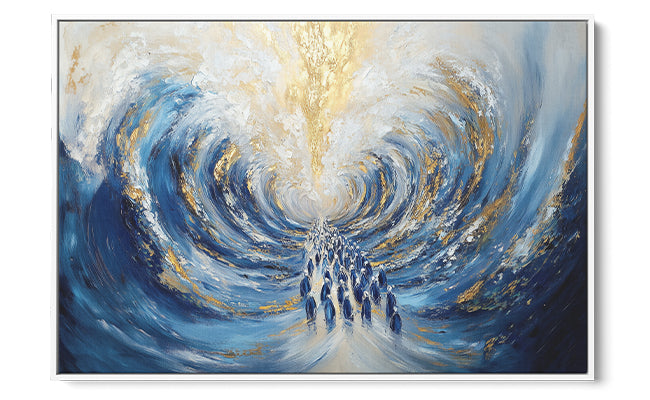
What this looks like in practice: a canvas built from layered fields of deep indigo and warm amber, with the suggestion of light breaking through, referencing the transition from Shabbat into the work week. Or an expressionist swirl of figures in motion, capturing the collective joy of Simchat Torah without illustrating it literally. The spiritual content is present, but you have to meet it halfway.
For contemporary interiors, this is usually the most useful category. Abstract Jewish art integrates into modern, minimalist, Scandinavian, and Japandi-inflected spaces far more naturally than classical Judaica. It does not require a specific cultural context to read as strong visual art. A non-Jewish guest will see a serious abstract painting. A Jewish viewer will see something more personal.
Yossi Bitton's "When the Soul Dances," available as an acrylic print, is a strong example of this category. The piece captures physical movement and spiritual energy in loose, expressive brushwork, and it reads as energetic without being decoratively aggressive. In a living room with light-colored sofas and natural wood, it pulls the room toward life rather than weight. The full range of his abstract work appears in the Yossi Bitton collection.
When evaluating abstract Jewish art, look for pieces where the composition has a clear focal point, not just a busy field of color. Strong abstract work holds the eye even when you are not reading its symbolic content. If the subject matter is the only reason the piece is interesting, that is a warning sign.
Styling note: Acrylic-mounted prints add a layer of visual depth and luminosity that conventional canvas cannot replicate. In rooms with strong natural light, the way an acrylic surface catches and redistributes that light changes the piece throughout the day.
For a broader look at how abstract and contemporary approaches sit across the full category, contemporary and modern Jewish wall art covers the widest range of what is currently being made.

Jerusalem-Inspired Art: Sacred Cityscape as a Decorating Statement
Jerusalem has been painted, photographed, and interpreted more than almost any city on earth, and the best contemporary Jewish art in this sub-category does not just document it. It asks you to feel something about the city, its weight, its layers of time, the way the light falls on limestone at dusk.
What separates strong Jerusalem-inspired art from a tourist image is interpretive distance. The best pieces use the city as material, not as subject. They compress centuries of meaning into a visual atmosphere rather than an architectural record.
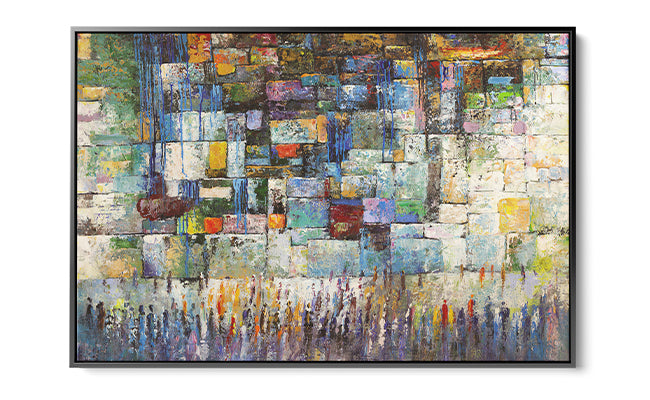
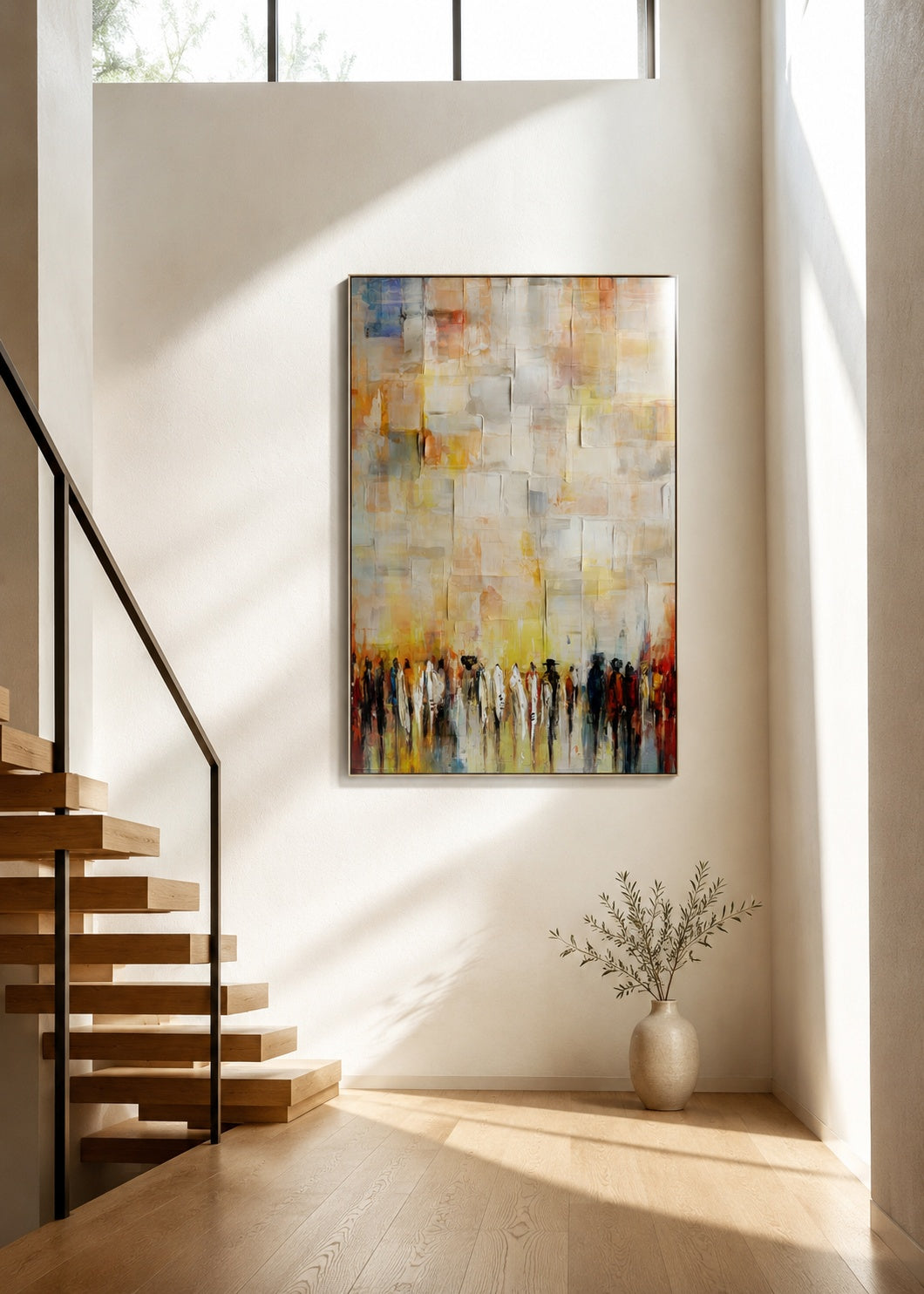
Look for paintings that keep to a focused palette, typically two or three dominant tones, and that use light as a structural element rather than mere illumination. Avigdor Ben Ari's "Facing Eternity" does exactly this: the Western Wall's ancient stones are rendered in a way that emphasizes spiritual presence over physical texture. The composition directs attention to the space between viewer and wall, which is where the emotional content lives. His "Morning Devotions," also an acrylic print, approaches the same site differently, focusing on the quiet intensity of early prayer rather than monumental scale. Both pieces are available starting at $320 in smaller formats, scaling up for larger wall applications.
Menucha Yankelevitch brings a different sensibility to the same geography. "The Gates of Zion" and "The Mother of the Road," which centers Rachel's Tomb near Bethlehem, both work with atmospheric color fields and emotionally resonant subject matter. "The Mother of the Road" is particularly well-suited to an entryway or hallway, where its narrative of longing and return aligns with the physical act of threshold-crossing that happens in those spaces every day.
For rooms where the wall art needs to do significant decorative work, Jerusalem-inspired pieces have an advantage: they carry a strong sense of place, which gives the room a psychological anchor, a feeling that the space belongs somewhere, not just to a style moment.
The dedicated modern Jewish art pieces in our Jerusalem collection give a thorough sense of how artists are currently interpreting the city across different formal approaches.

How to Match a Jewish Art Style to Your Home's Existing Decor
Here is a simple three-step method that works regardless of budget or room size. Run through it in order before you commit to a piece.
Step one: Start with mood, not subject. Decide how you want the room to feel, not what imagery you want it to contain. Quiet and contemplative calls for muted palettes and slower compositions. Joyful and alive calls for movement and warm color. Serious and grounded calls for architectural weight and deep tone. Once you have a mood, the subject almost selects itself.
Step two: Check color temperature against your existing palette. Cool-toned rooms, those with gray, blue, or white as base colors, absorb warm-toned art beautifully and vice versa. Conflict arises when a warm-toned room gets warm-toned art: the result is either a very intentional monochromatic statement or a visual clash. If you are unsure, lean toward a piece with one dominant neutral and one accent color pulled from something already in the room.
Step three: Match scale to the room's weight, not just its size. A large room with spare furniture and high ceilings can absorb a complex, detailed classical Judaica piece. A small, densely furnished room will be served better by a single strong abstraction than by a detailed pictorial work. As a rough rule, the art's width should reach at least two-thirds of the width of the furniture it hangs above.
| Interior Style | Best Jewish Art Match | Format to Consider | What to Avoid |
|---|---|---|---|
| Modern/Minimalist | Abstract, Jerusalem cityscape | Large-format acrylic | Dense classical Judaica |
| Traditional/Formal | Classical Judaica, figurative life scenes | Framed canvas or print | Very loose abstraction |
| Scandinavian/Japandi | Tonal abstract, muted sacred cityscape | Acrylic block or unframed canvas | High-chroma figurative work |
| Eclectic/Boho | Expressive figurative, mixed motif | Layered gallery wall | Single very large cold abstraction |
One observation most buying guides miss: the room's relationship with natural light changes which style reads best. A north-facing room with cool, indirect light needs art with inherent warmth, either in subject (candlelight, gold tones) or palette. A south-facing room flooded with direct light can handle cooler, more restrained work because the room itself provides the warmth.
Designer's tip: Hang art so the center of the piece sits at roughly 57 to 60 inches from the floor, which is standard gallery eye level. Above a sofa, keep the bottom edge 6 to 8 inches above the top of the sofa back, not higher, or the two elements will read as unrelated.

Where to Find and How to Display Jewish Art at Home
The question of display is just as consequential as the question of which piece to buy. Even strong art can be undermined by placement, lighting, and framing decisions.
For acrylic-mounted prints specifically, avoid hanging them in direct, unfiltered sunlight for extended periods. Indirect or diffused light is ideal: it brings out the luminosity of the medium without the UV exposure that degrades color over time. If you want to add focused lighting, a narrow-beam picture light or recessed adjustable spot positioned at a 30-degree angle to the wall will create definition without glare.
For rooms where drilling is not an option, high-strength adhesive strips rated for the weight of the piece (most acrylic prints fall in the 5 to 15 pound range depending on size) are genuinely effective on smooth plaster or drywall. Confirm the specific weight of the piece before purchasing hardware, as the manufacturer's documentation is the authoritative source.
Grouping multiple pieces requires more planning than a single statement work. When building a gallery wall with Jewish art, avoid mixing vastly different scales or frame styles unless you have a very deliberate visual logic connecting them. A consistent framing treatment, or a consistent lack of frames in the case of acrylic prints, creates cohesion even when the subjects vary.
The Avigdor Ben Ari collection is particularly suited to pairing: his Western Wall series maintains a consistent visual language across multiple compositions, which makes building a thematically unified multi-piece wall much simpler than mixing artists with different stylistic vocabularies.
For entryways and hallways, vertically oriented compositions tend to work better than horizontal ones because of the proportions of most corridor walls. Menucha Yankelevitch's Rachel's Tomb pieces, with their vertical emphasis and emotional resonance with the threshold concept, are a natural fit here. Her full range is in the Menucha Yankelevitch collection.
If the context is a living room where the art needs to function as a social and aesthetic anchor, the guidance in displaying sacred art with intention goes deep on placement decisions specific to that room type.
A common mistake: buying a piece that is emotionally right but physically wrong for the wall. Measure the wall, measure the furniture below it, and then look for art within those proportions, not the reverse. It is far easier to find art that fits a specified dimension than to redecorate around a piece you fell in love with online.
One more thing worth saying plainly: Jewish art does not require a specifically Jewish home to work beautifully. It requires a home where the owners care about meaning. A piece that carries genuine spiritual or cultural weight brings something into a room that purely decorative art cannot: the sense that the people who chose it were thinking about more than aesthetics.

Frequently Asked Questions
What are the most popular styles of Jewish art for home decor?
Sacred cityscape art, particularly Jerusalem and Western Wall imagery, leads in popularity by a considerable margin because it combines immediate visual impact with deep symbolic resonance. Abstract and expressive Jewish art is the fastest-growing category, especially among buyers furnishing modern or minimalist interiors. Figurative Jewish life scenes remain a steady favorite for dining rooms and family spaces.
What is the difference between traditional Judaica art and modern Jewish art?
Traditional Judaica art draws directly from historical decorative conventions: micrography, manuscript illumination, ritual object motifs, Hebrew text as ornament, and symmetrical compositions organized around religious imagery. Modern Jewish art uses the same thematic material but approaches it through contemporary visual languages, abstraction, atmospheric color fields, expressive mark-making, or photographic interpretation. The subject matter may be identical; the formal strategy is entirely different. Neither is more "authentically" Jewish than the other.
Can Jewish art work in a non-religious or minimalist home?
Yes, with style-appropriate selection. Abstract Jewish art and spare sacred cityscape pieces integrate into non-religious and minimalist spaces the same way any serious abstract painting does. The key is choosing pieces where the visual quality stands entirely on its own. If a piece requires its cultural context to be visually interesting, it will feel out of place in a context-neutral interior. If it works as strong painting first, the cultural layer is a bonus rather than a dependency.
What Jewish art themes are most meaningful for a living room or entryway?
For living rooms, themes of communal joy, prayer, and sacred light tend to create the right emotional register: welcoming, substantial, and socially generous. For entryways, threshold themes are unusually resonant: Rachel's Tomb near Bethlehem, with its associations of longing and return, imagery of gates or doorways in Jerusalem, or Chuppah-inspired pieces that mark a new chapter. "A Path of Light," inspired by the Jewish wedding canopy, carries exactly this kind of liminal quality that reads particularly well in a transitional space like a foyer.
How do I know which Jewish art style fits my home decor aesthetic?
Run through the three-step method described in the "How to Match" section above: mood first, then color temperature, then scale. The interior style table in that section maps the most common decor contexts to their most compatible Jewish art categories. If you are still unsure after that, defaulting to a tonal abstract piece in your room's existing color family almost always works, because it introduces the cultural layer without requiring a style commitment.
Is abstract Jewish art considered authentic or does it lose religious meaning?
This is genuinely debated among collectors, but the historical record is clear: abstraction has been a legitimate vehicle for Jewish spiritual expression since at least the mid-twentieth century. The question of authenticity is less about form and more about intent and context. An abstract piece made by an artist working consciously within a Jewish spiritual framework, drawing on concepts of light, divine presence, or sacred time, carries authentic religious meaning even without a single recognizable symbol. What it loses is legibility to a viewer without that shared context, which is a practical trade-off, not a theological one.
The full range of contemporary Jewish wall art at Ben Ari Art Gallery covers all four major styles discussed here, from classical motifs to bold abstraction, with pieces by Israeli artists including Avigdor Ben Ari, Menucha Yankelevitch, and Yossi Bitton across multiple formats and size ranges.
Read more
How to Choose Kotel Painting for Home: Style, Scale & Placement
A practical guide to choosing a Kotel painting for your living room, covering style, sizing math, color palette, and placement, with specific artist and framing recommendations.
Read more