

Article: What Is Modern Judaica Art and Why It Belongs in Every Jewish Home

What Is Modern Judaica Art and Why It Belongs in Every Jewish Home
What Is Modern Judaica Art and Why It Belongs in Every Jewish Home
What Is Modern Judaica Art? A Plain-Language Definition
Modern Judaica art is visual artwork that draws on Jewish themes, history, scripture, and identity using the formal language of contemporary fine art. Think abstraction, expressive brushwork, bold color fields, and mixed media rather than the ornate decorative objects most people associate with "Judaica." It is, simply put, Jewish meaning made through modern artistic tools.
The category sits at a crossroads. It includes sacred subject matter, such as biblical narrative, holy sites, and Jewish ritual, but it treats those subjects with the same visual ambition you would expect from any serious contemporary painter. The result is artwork that functions both as observance and as interior design in the fullest sense of the word.
Understanding the full picture requires separating a few overlapping terms, tracing where the movement came from, and knowing what to look for on a wall. That is what this guide covers, in that order.

How Modern Judaica Art Differs from Traditional Judaica
Traditional Judaica is primarily ceremonial and functional: Shabbat candlesticks, Passover seder plates, Hanukkah menorahs, Kiddush cups, and illuminated manuscripts like the Haggadah. These objects are made to be used in ritual practice. Their beauty serves a religious purpose, and their visual style tends to follow centuries-old conventions, often incorporating filigree, calligraphy, and symbolic motifs passed down through generations.
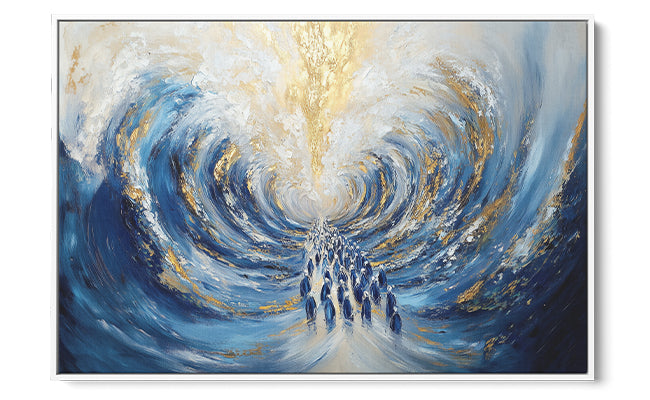
Modern Judaica art, by contrast, is made to be seen. Its primary home is the wall, not the ritual table. And its visual language is open to interpretation rather than fixed by tradition. An artist painting the Splitting of the Sea does not need to illustrate the event literally; she can render it as a collision of deep blues and fractured gold that captures the emotional truth of standing between fear and faith, without ever depicting a single human figure.
The philosophical difference matters too. Traditional Judaica reinforces communal continuity through consistency of form. Modern Judaica art invites personal interpretation, connecting the viewer to Jewish identity through feeling and visual experience as much as through explicit symbol or text.
| Dimension | Traditional Judaica | Modern Judaica Art |
|---|---|---|
| Primary purpose | Ritual use and observance | Visual expression and meaning-making |
| Primary medium | Silver, ceramics, illuminated parchment | Acrylic, canvas, archival print |
| Visual language | Fixed symbolic conventions | Abstract, illustrative, expressionist |
| Typical placement | Sideboard, shelf, ritual table | Feature wall, hallway, living room |
Practically speaking, this difference affects what you buy and where it lives in your home. If you are furnishing a modern interior, you are almost certainly looking at the second column.
Core Themes and Symbols Found in Modern Judaica Art
The richness of modern Judaica wall art comes partly from the breadth of its source material. Artists working in this space draw from Torah narrative, Kabbalistic mysticism, Israeli landscape, diaspora memory, and daily Jewish life. A few themes recur consistently across the genre.
- Biblical moments: The Splitting of the Sea (Kriat Yam Suf), the giving of the Torah at Sinai, the Binding of Isaac. These carry universal drama alongside specifically Jewish spiritual weight.
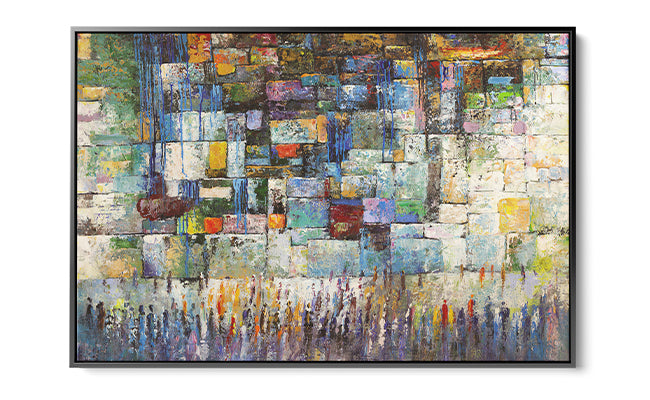
- Holy sites: Jerusalem, the Western Wall, Rachel's Tomb, and Mount Sinai ground art in a physical geography that many Jewish viewers feel personally connected to, even if they have never visited.
- Jewish life and movement: Dancing, prayer, community celebration. The image of Hasidim in joyful motion is one of the most emotionally legible symbols in the whole genre.
- Rabbinic portraiture: Spiritual leaders, particularly revered rebbes, painted in a way that conveys authority and inner depth rather than photographic likeness.
- Land and agriculture: The Seven Species of Israel (shivat haminim), olive trees, pomegranates, and the landscapes of the Land of Israel serve as symbols of covenant and abundance.
- Hebrew text and calligraphy: Prayers, blessings, or phrases from scripture integrated into the composition as visual element as much as readable text.
None of these themes are mandatory. An entirely abstract composition that uses color and form to evoke Shabbat stillness is as legitimately Judaica as a detailed rendering of the Kotel. The breadth is the point.
For artwork centered specifically on Jerusalem's holy geography, the Jewish holy sites art collection gathers pieces organized around these sacred locations and the emotions attached to them.

The Main Styles You Will Encounter: From Abstract to Illustrative
Knowing the visual styles helps you buy with confidence rather than guessing at terminology. Modern Judaica art does not belong to a single school. Here are the four main approaches you will see.
Expressive Abstraction
Color, texture, and form carry the narrative rather than literal depiction. A piece inspired by Mount Sinai might use a shaft of warm gold breaking through deep violet without showing a mountain or a figure. The emotional impact is immediate; the interpretation is personal. This style suits minimalist and contemporary interiors especially well because it reads as serious contemporary fine art first and Jewish art second, which can be an advantage in shared spaces.
Semi-Figurative and Symbolic
The most widely collected style in modern Judaica. Recognizable forms, a dancing figure, a skyline, a tomb, a flame, are present but rendered with expressive freedom. Hard edges dissolve, colors are heightened beyond realism, and the emotional atmosphere dominates the literal scene. Works by artists like Menucha Yankelevitch and Yossi Bitton tend to occupy this territory. They are immediately legible as Jewish without being illustrative in a didactic way.
Illustrative and Narrative
Closer to traditional Jewish manuscript illumination but executed in a modern palette and format. Figures, scenes, and symbols are rendered clearly and with narrative intent. These pieces tend to work well in family spaces, children's rooms, and settings where the artwork is meant to educate and inspire as much as to decorate.
Typography and Calligraphic Art
Hebrew letters and words as the primary visual element. The form of the text is as important as its meaning. This style can read as extremely contemporary, sitting comfortably in a Japandi or Scandinavian interior, while carrying deep liturgical content. A blessing rendered in a spare, modern typeface requires no further decoration.
Curator's note: When a piece uses Hebrew calligraphy as its main visual element, hang it where the light source comes from the side rather than directly above. Raking light brings out the texture of the brushwork and makes the letters feel three-dimensional against the wall.

Why Modern Judaica Art Belongs in Every Jewish Home
This is where the practical and the meaningful converge. The argument is not sentimental; it is spatial and cultural.
A home is a statement of identity. The objects you choose to live with every day, and place at eye level, shape the atmosphere of the space and, quietly, the values that circulate within it. In Jewish tradition, the concept of hiddur mitzvah, beautifying a commandment, explicitly values the aesthetic quality of religious expression. Modern Judaica art is one of the most direct applications of that principle in a contemporary domestic setting.
Beyond the philosophical, there is a practical design argument. A well-chosen large-scale painting does for a room what a focal point does for any composition: it gives the eye a place to rest, anchors the furniture arrangement, and introduces color and texture that cannot come from upholstery or cabinetry alone. When that painting also carries meaning for the family living with it, the effect compounds.
There is also a generational dimension worth naming. Children who grow up surrounded by images that are simultaneously beautiful and Jewish develop an intuitive sense of their heritage as something worthy of artistry and attention. That is not a small thing.
Artists like Yossi Bitton and Menucha Yankelevitch, both represented in depth at Ben Ari Art Gallery, have made careers out of the premise that Jewish spiritual content deserves the same formal ambition as any serious fine art practice. The Yossi Bitton collection shows what that looks like across a body of work.
How to Choose and Display Modern Judaica Art in Your Space
With the conceptual background in place, the practical choices become clearer. Here is a three-step method: start with emotional register, then address scale, then resolve color.
Step 1: Emotional Register First
Before you pick a subject or a size, decide what you want to feel in the room. Expansive and joyful? A piece centered on communal dancing or the abundance of the land would suit that. Contemplative and grounding? Rabbinic portraiture or a meditative rendering of a holy site carries a different atmosphere entirely. Awe-inspiring and vast? Biblical narrative moments, a parting sea, a revelation at Sinai, occupy psychological scale regardless of physical dimensions.
Step 2: Scale Relative to the Wall
A standard rule that holds up in practice: a piece used as a single statement should cover roughly 60 to 70 percent of the wall width above a sofa or console, and hang so its center sits at 57 to 60 inches from the floor. For a wall that is nine feet tall, that typically means a canvas of at least 30 inches in height, often more. The product range at Ben Ari Art Gallery runs from smaller formats up to very large acrylic prints exceeding 40 inches, so the scaling options are genuine.
If the piece is too small for its wall, it floats uncomfortably. If it crowds the furniture beneath it, the room feels oppressive. Get the proportions right first, then make the aesthetic decisions.
Step 3: Color Temperature and Palette Harmony
Modern Judaica art spans a wide color range. Blues and deep teals evoke water, sky, and spiritual depth; they read as calm in a bedroom or study. Warm ochres, burnt siennas, and desert golds belong to the landscapes of Israel and carry a grounding, earthy quality suited to living rooms and dining spaces. Pieces that move between warm and cool in a single composition, as many expressionist works do, are versatile across room types.
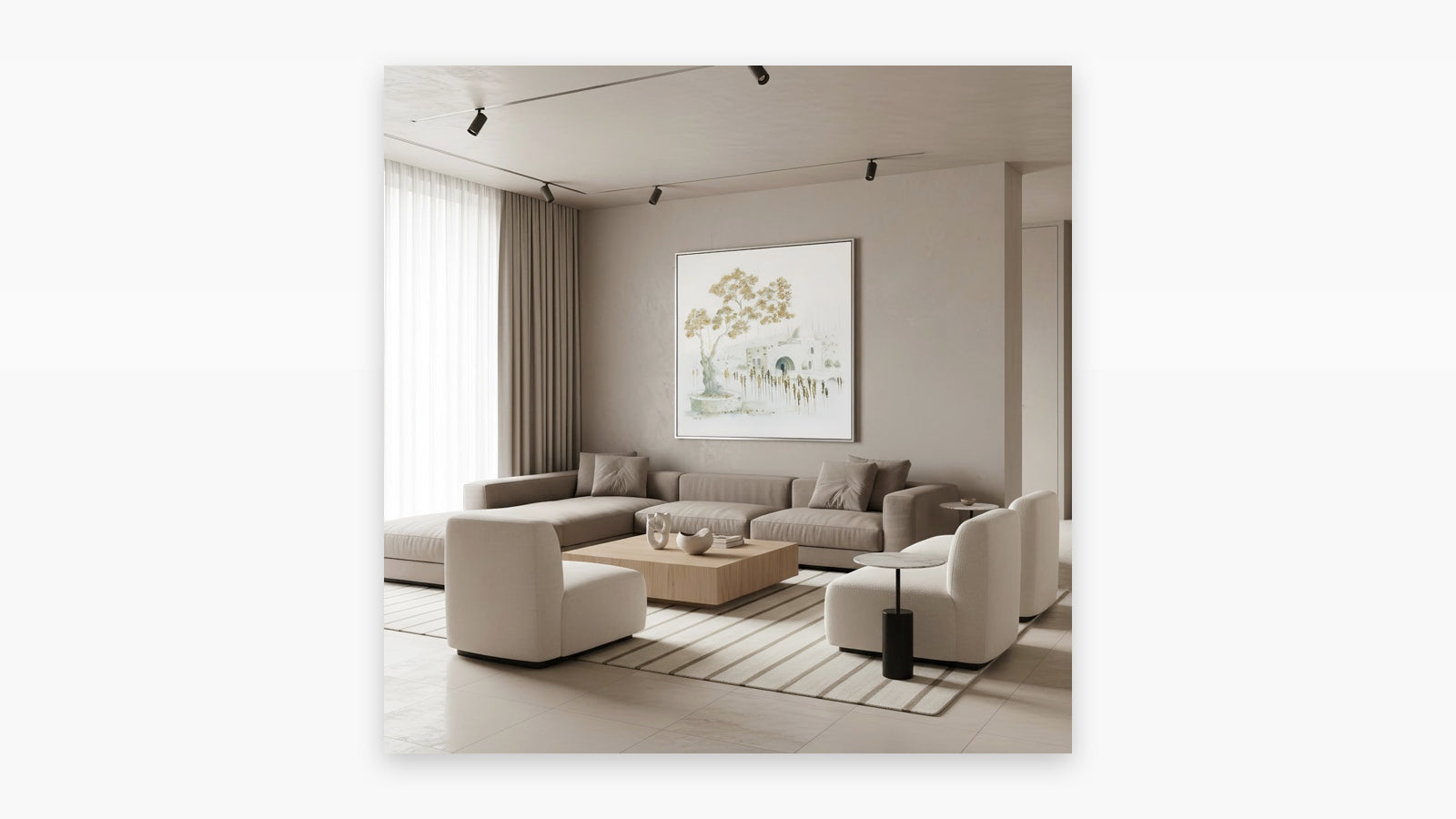
Match the dominant tone of the art to the undertone of your wall. A warm-toned painting on a cool gray wall creates low-level tension; a warm painting on an off-white or warm plaster wall reads as intentional and resolved.
Styling note: Acrylic-mounted prints, the primary format at Ben Ari Art Gallery, have a slight luminosity that oil and canvas do not. In rooms with limited natural light, this medium retrieves depth and saturation that would be lost in a matte finish.

Pieces Worth Considering
Earlier in this article, the dancing figure appeared as an example of the semi-figurative style. Yossi Bitton's "Rising in Joy" realizes that description in acrylic, capturing the rhythmic energy of Jewish dance in a way that reads as movement even at a standstill. It suits a dining room or an entry hall where the first impression should feel alive.
For the contemplative register described in Step 1, Menucha Yankelevitch's portrait of the Kresteter Rabbi offers something different: a work in which spiritual gravitas is conveyed through restraint rather than spectacle. Pieces of this character work particularly well in a home office or study where the atmosphere calls for focus and depth.
Yankelevitch's interpretation of the Splitting of the Sea operates on both levels. The biblical drama is present, but the handling is painterly enough that the work reads as serious abstraction at a distance. "Between Fear and Faith," a second treatment of the same moment, approaches the narrative from an explicitly emotional angle, foregrounding the psychological experience of the Israelites rather than the visual spectacle. The two pieces make an interesting comparison in any room where wall space allows for a related pair.
Bitton's "The Day the World Listened," centered on Mount Sinai, brings that sense of vast spiritual scale down into domestic proportion. It is the kind of piece that reads differently depending on where you stand in the room, which is exactly the behavior you want from art hung in a space where people move and gather.
The "Seven Species of Israel" rounds out Bitton's range with warmth and abundance. It is an easier entry point for rooms with existing warm palettes and would suit a kitchen, breakfast room, or sukkah setting. Speaking of which, if you are furnishing a sukkah for Sukkot, the Sukkot decorations collection covers that space with comparable aesthetic care.
Rachel's Tomb by Yankelevitch belongs to the category of holy site art discussed earlier. It carries an intimate grief alongside its reverence, making it appropriate for spaces that see quiet moments: a hallway, a sitting room, beside a bed.
To see the full breadth of what artists working in this style are producing right now, explore original modern Jewish art pieces across the gallery's contemporary collection.
Designer's tip: When hanging multiple pieces from the same artist, keep them on the same horizontal centerline and space them consistently. Inconsistent gaps read as indecision, not variety. A gap of four to six inches between frames is the comfortable range for most wall proportions.

How to Tell If a Piece Is Authentic and Meaningful
The market for Jewish art online is wide, and quality varies considerably. Here is what separates work worth living with from work that disappoints once it arrives.
- Artist identity: Meaningful modern Judaica art comes from an artist with a coherent body of work and a genuine relationship to the subject matter. Look for a named artist, not a stock illustration dressed up with Hebrew text.
- Medium and print quality: Acrylic-mounted fine art prints from a reputable gallery use archival inks and UV-resistant coatings. Ask specifically about lightfastness if the piece will hang in a room with direct sunlight. The guide to preserving Judaica art covers this in practical detail.
- Edition and provenance: Limited editions have documentation. Open editions from a serious gallery are still a legitimate choice, but the distinction matters for long-term value and for knowing what you own.
- Visual coherence: A strong piece has a clear compositional logic. The eye moves through it intentionally, rests somewhere specific, and finds a point of tension or harmony. If a piece feels busy or unresolved on a screen, that feeling will intensify on a wall.
- Resonance with the subject: Ask whether the treatment adds something to the theme. A painting of the Western Wall that could be any stone wall with different textures is not Judaica art; it is architectural illustration. Genuine modern Judaica art makes you feel the weight of the subject, not just recognize it.
The complete guide to choosing Judaica art goes deeper on the practical evaluation process, including how to assess a piece from a product image and what questions to ask a gallery before purchasing.
For art organized by artist rather than by theme, the Menucha Yankelevitch collection and contemporary figurative Judaica collection each offer a coherent aesthetic starting point for buyers who prefer to shop by artistic voice.

Frequently Asked Questions
What is the difference between Judaica and Jewish art?
Judaica traditionally refers to ritual objects used in Jewish religious practice: menorahs, mezuzot, seder plates, and similar ceremonial items. Jewish art is a broader term covering any visual artwork made by Jewish artists or engaging Jewish themes, regardless of whether it has a ritual function. Modern Judaica art occupies the overlap: it carries Jewish content and meaning but exists primarily as fine art for the wall, not as a functional object.
Does modern Judaica art have to include Hebrew text or religious symbols?
No. A piece can be entirely abstract and still qualify as modern Judaica art if it is grounded in Jewish experience, narrative, or spiritual intention. Hebrew calligraphy and religious symbols are common elements, but they are tools, not requirements. Some of the most powerful contemporary Jewish paintings contain no text at all, communicating through color, scale, and composition alone.
Is modern Judaica art appropriate for non-observant or secular Jewish homes?
Absolutely, and it is often a natural fit. Secular Jewish identity is still a rich identity, and artwork that connects to Jewish history, landscape, and cultural memory serves that identity without requiring religious observance. The Seven Species of Israel, a Jerusalem skyline, or an expressive rendering of Jewish community life carries cultural significance that operates independently of ritual practice. The emotional connection to the subject matters more than the level of observance.
What are the most popular themes in modern Judaica wall art?
Across galleries and collectors, the most consistently sought-after subjects are Jerusalem and its holy sites, biblical narrative moments (particularly the Splitting of the Sea and Mount Sinai), Hasidic dance and celebration, and rabbinic portraiture. Pomegranates, olive trees, and the Seven Species appear frequently as symbolic motifs. Abstract work inspired by Kabbalistic ideas, especially light, infinity, and divine presence, forms a growing segment among buyers with contemporary interior sensibilities.
How do I know if a modern Judaica art piece is high quality?
Three things that are not immediately obvious but matter significantly once the piece is on your wall: first, the color depth of the print medium, a flat reproduction loses the luminosity the artist intended; second, the finish of the mounting, acrylic-faced prints should have polished rather than matte-cut edges; third, whether the composition holds at close range as well as from across the room. Lesser work tends to dissolve into indistinct marks when you stand near it. Strong work reveals more detail and intentionality the closer you get.
Can modern Judaica art work in a contemporary or minimalist interior?
Very effectively, provided the piece is chosen with restraint in mind. Opt for works with a limited palette of two or three tones, clear compositional structure, and a format that respects the negative space on the wall rather than competing with it. A single large acrylic print in a contemporary interior tends to outperform a gallery wall of smaller pieces in terms of visual impact and spatial calm. The calligraphic and abstract styles mentioned earlier in this article are particularly compatible with minimalist, Japandi, and Scandinavian interiors.
The contemporary Jewish art collection at Ben Ari Art Gallery spans the full range of styles, formats, and price points described here. The modern Jewish art collection includes original works by Yossi Bitton, Menucha Yankelevitch, and other artists whose practices center Jewish meaning without compromising formal ambition.
Read more
Best Jewish Art Styles for Home Decor: A Room-by-Room Guide
A practical guide to the best Jewish art styles for home decor, from classical Judaica and sacred cityscapes to bold abstraction, with a concrete three-step method for matching any style to your ex...
Read more