

Article: Ancient Jerusalem in Modern Painting: Why It Endures

Ancient Jerusalem in Modern Painting: Why It Endures
Ancient Jerusalem in Modern Painting: Why It Endures
Ancient Jerusalem in modern painting endures as a subject for a simple reason: no city carries more concentrated meaning in a single skyline. Its stones hold three thousand years of religious, political, and human history, and painters keep returning to it because that density of meaning gives their work a built-in emotional charge that purely invented subjects rarely achieve. For collectors, that depth is exactly what makes Jerusalem-themed painting something other than decorative wallpaper.
The question worth asking is not just why artists paint it, but what specifically they find there that translates onto canvas, and how those choices can guide a buyer toward a piece that will hold its power on the wall for decades.
The Timeless Pull of Ancient Jerusalem on the Modern Artistic Imagination
Cities that exist simultaneously in historical time and in the human imagination are rare. Jerusalem is one of them. An artist painting Paris is painting a real city. An artist painting ancient Jerusalem is painting a real city and a concept, a spiritual geography that billions of people carry in their minds even if they have never visited Israel. That doubling, the actual place layered with its symbolic counterpart, gives painters an almost inexhaustible subject.
Contemporary painters working with Jerusalem are not illustrating history. They are navigating a tension between what the city looks like and what it means, and that tension is productive. It forces decisions about color, abstraction, and scale that purely representational subjects do not demand. The result, when the painter gets it right, is a canvas that reads differently at ten feet than at ten inches. Up close you see the material: brushwork, impasto texture, the way light catches an acrylic surface. From across a room, the composition resolves into something you feel before you fully analyze.
That layered reading experience is one reason the subject keeps drawing serious artists. The range of Jerusalem paintings in modern Jewish art shows how differently painters interpret the same source: one will work in near-monochrome to emphasize the limestone's austerity, another will flood the canvas with gold and amber to express spiritual warmth, and both will be responding to the same city.

The Historical and Spiritual Layers That Give Jerusalem Its Visual Power
Any painter approaching Jerusalem has to decide which layer of the city they are addressing. There are at least four distinct visual and historical eras available: the biblical city of David, the First and Second Temple periods, the medieval walled city, and the Ottoman-era stone construction that defines the Old City's skyline today. Most contemporary painters work from the last of these, because it is the one physically present in photographs and lived experience, but they load it with references to all the others.
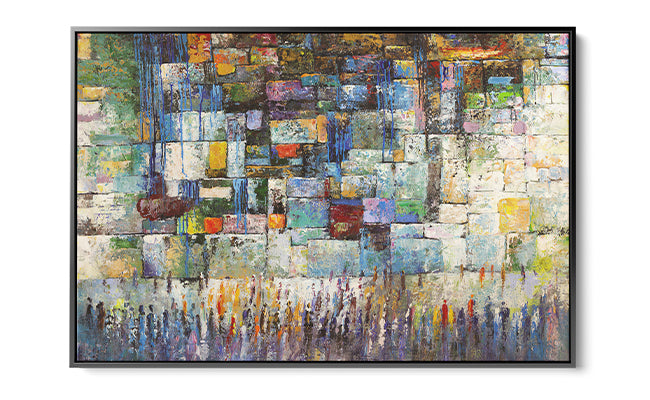
The Western Wall is the clearest example of this layering. It is a retaining wall built by Herod, surviving from the Second Temple period, now the holiest accessible site in Judaism. When a painter depicts its massive limestone blocks, they are simultaneously showing Herodian engineering, two thousand years of Jewish prayer, and a living spiritual site visited by millions every year. No other single architectural element in the world compresses that range of meaning into one surface.
For painters working within the Jewish tradition, this layering is not just historical context. It is the subject itself. The city represents exile and return, destruction and continuity, human aspiration and divine promise. Those are not ideas you can easily paint directly, but Jerusalem's physical forms, the walls, the gates, the golden stone in afternoon light, give those ideas a visible container. Understanding this helps explain why the artistic tradition around Jerusalem in Jewish painting has produced such a consistent visual vocabulary: warm limestone tones, strong horizontal wall courses, golden atmospheric light, and geometric gate forms recur across painters and centuries because they are the forms that carry the weight.
For a broader look at how Jewish artists across generations have engaged with sacred space and heritage, the guide on best contemporary Jewish artists you should know offers useful context on the painters shaping this conversation today.

How Modern Painters Translate Sacred Architecture Into Contemporary Style
The practical challenge facing any contemporary painter is how to make an ancient, symbolically loaded subject feel immediate rather than archival. Several approaches have emerged in modern Jewish painting, and each produces a noticeably different object on the wall.
Expressive abstraction is the most common. The painter retains the city's recognizable forms, a gate arch, a wall plane, a dome silhouette, but loosens the rendering so color and texture carry as much information as line. Yossi Bitton works consistently in this mode. His "Glorious Jerusalem" piece uses the city's forms as armature for color relationships and surface energy rather than as architectural documentation. The result reads as Jerusalem to anyone who knows the city, but functions as abstract painting to anyone who doesn't.
Tonal minimalism takes the opposite approach: reducing the composition to two or three values and one dominant form. This mode suits the Western Wall particularly well, because the wall's own geometry, long horizontal courses interrupted by vertical joints, is already a near-abstract composition if you crop tightly enough. Look for canvases in this mode that maintain a strong tonal hierarchy: one dominant value (usually the warm stone), one dark accent (shadow in the crevices), and a single light area (sky or reflected light). That three-tone structure is what keeps a minimal Jerusalem painting from reading as flat or empty.
Impasto and layered texture is the third major mode, using built-up paint surface to create a tactile equivalent of the stone's own roughness. Menucha Yankelevitch's approach in pieces like "Spring Light" brings this forward: the acrylic surface catches light the way limestone does, creating a painting that changes character as natural light in the room shifts through the day. This makes the piece function almost as a living element of the room rather than a fixed image.
Collectors shopping across the contemporary and modern Jewish wall art range will recognize these three modes immediately once they know to look for them, and the mode should guide the choice of room and hanging position as much as the subject matter does.
Curator's note: When choosing between these modes for a living room, consider how the room's ambient light behaves. Tonal minimalism holds best in high-contrast lighting. Impasto texture rewards rooms with shifting natural light, because the surface reads differently in morning versus evening.
Color, Light, and Texture: The Visual Language of Jerusalem on Canvas
Jerusalem stone, the pale golden limestone mandated by a municipal ordinance introduced in 1918 for all building facades, gives the city its most distinctive visual quality: a warmth that shifts from cream in midday sun to deep amber and rose at dusk. Every painter working with Jerusalem is, in some sense, painting light as much as architecture. The stone is almost secondary; it is the medium through which light is being discussed.
This is why Jerusalem paintings tend to read differently at different times of day in the home. A canvas with warm amber tones will intensify as afternoon sun enters a west-facing room and recede into quieter presence under cooler evening artificial light. That variability is a feature, not a liability. It means the painting participates in the room's daily rhythm rather than holding a fixed note.

Gold as a color in Jerusalem painting carries dual weight: it is literal (the famous golden light of the city) and symbolic (holiness, divine presence, the gold of the Temple). Abstract pieces that work heavily in gold tend to read as spiritually charged even to viewers unfamiliar with the iconographic tradition. This is why so many buyers from outside Jewish practice respond strongly to Jerusalem paintings. The visual language of warmth, weight, and vertical solemnity is cross-cultural.
Texture does something that color alone cannot. Acrylic paint built up in thick layers creates a surface that casts its own micro-shadows, especially under raking light from a side-mounted picture light or a directional track fixture. For high-ceilinged rooms or formal living spaces, a heavily textured Jerusalem canvas on a prominent wall will hold visual authority without competing with furniture. For lower-ceilinged or more intimate spaces, a flatter surface treatment with strong tonal contrast will do the same work at smaller scale.
Styling note: If you are hanging a Jerusalem painting in a room with warm-toned wood furniture (walnut, cherry, or aged oak), the amber and gold palette common to Jerusalem paintings will extend the room's warmth rather than fight it. In rooms with cooler tones (concrete, gray linen, pale ash wood), a painting that incorporates blues and gray-whites alongside the gold will create a more balanced temperature.
What Jerusalem Symbolizes in Jewish Tradition and Why It Resonates Today
In Jewish tradition, Jerusalem is not simply the capital of ancient Israel. It is the point where the earthly and the divine are understood to meet, the location of the Temple, the spiritual center of Jewish prayer oriented toward across three thousand years of diaspora, and the destination of the ultimate national-religious return. The phrase "Next year in Jerusalem," spoken at the end of Passover Seder and at the close of Yom Kippur, encodes a whole theology of exile, hope, and redemption into four words.
This means that a painting of Jerusalem on a Jewish home's wall is never purely decorative. It is a statement of orientation, a constant visual reminder of where prayers point, what holidays commemorate, and what continuity of identity looks like made material. That is a weight very few secular subjects can carry.
For non-Jewish collectors, or for mixed households, the symbolism operates differently but not less powerfully. Jerusalem has functioned as a universal symbol of spiritual aspiration in Christianity and Islam as well as Judaism, and in broadly secular Western culture it carries associations with ancient wisdom, religious pilgrimage, and the deep past of human civilization. A Jerusalem painting in a non-specifically Jewish home can be chosen for its visual qualities alone and still carry that resonance implicitly.
The question of what these images mean across different household contexts is addressed more directly in the piece on displaying sacred art with intention, which offers practical guidance on placement and context alongside the meaning.

Bringing Ancient Jerusalem Into the Modern Home: Art That Carries Meaning
Choosing a Jerusalem painting for a specific room involves three decisions, in this order: mood, then color temperature, then scale. Getting them in the wrong order is where most buyers go wrong.
Mood first. Decide whether you want the painting to feel meditative and still, or charged and dynamic. Tonal minimalism and cooler palettes produce the former; expressive abstraction with gold and amber, especially with visible brushwork, produces the latter. A home office or study usually benefits from the meditative register. An entryway or dining room can carry something with more visual energy.
Color temperature second. Match the painting's dominant temperature to the room's existing palette, or make a deliberate contrast. Warm-gold Jerusalem pieces in a warm room create depth and continuity. The same piece in a cool-palette room becomes the focal point by contrast.
Scale last, but this is where mistakes are most visible. The most common error is choosing too small. A Jerusalem painting that needs to hold a 10-foot wall should be at least 40 inches on its longest dimension; anything smaller will read as a framed photograph rather than a work of art. As a practical rule, the painting's width should cover 60 to 75 percent of the furniture below it (a sofa, console, or bed headboard), and the bottom edge should sit 8 to 10 inches above that furniture's top surface.
The Western Wall art collection offers an instructive range in this regard, with works available across multiple size configurations, so you can assess the same composition at different scales before committing.
For entryways, a vertically oriented piece with a strong gate or archway motif suits the space well, because the vertical emphasis echoes the passage through a door. Yossi Bitton's "At the Gates of Jerusalem" uses exactly this compositional logic. For a dining room or main living wall, a wider horizontal format gives more visual breathing room and suits the landscape quality of the Old City's silhouette.
Designer's tip: Hang Jerusalem paintings at eye level for seated viewing in living rooms (center of the canvas at 57 to 60 inches from the floor), but raise them to standing eye level (center at 62 to 65 inches) in entryways and hallways where the viewer is always in motion.
Pairs of works by the same artist hang naturally together without demanding a unifying frame color or matting choice, because the artist's palette and texture provide internal coherence. Avigdor Ben Ari's "Stones of Light" and Yossi Bitton's "Moriah, Jerusalem" are different in character but both engage the Western Wall's stone surface, and a pairing that places the more abstract piece to the left and the texturally richer piece to the right gives the eye a readable left-to-right progression.

Why Jerusalem Paintings Endure Across Generations of Artists and Collectors
The art market for Jewish subjects has cycled through fashions, but Jerusalem as a specific subject has shown unusual staying power. The reason is structural rather than sentimental: the city provides a subject with enough specific visual character to reward close looking, enough symbolic weight to sustain meaning over time, and enough universality to speak beyond a single community.
Compare this to, say, a synagogue interior or a Shabbat table scene. Both are valid subjects with genuine warmth, but they are intimate and domestic in scale. A Jerusalem cityscape or Western Wall composition operates at a different register, closer to landscape painting, where the viewer is placed in relation to something larger than any domestic moment. That shift in scale is part of why Jerusalem paintings tend to anchor rooms rather than simply inhabit them.
The tradition is also actively evolving. Artists like Menucha Yankelevitch bring a different sensibility than the older figurative tradition, working with light and surface in ways that connect Jerusalem painting to the broader contemporary art conversation rather than keeping it siloed as a purely devotional genre. This cross-pollination gives the work a longevity that purely market-driven subjects rarely sustain.
For collectors building a collection rather than buying individual pieces, the Avigdor Ben Ari collection and the Yossi Bitton collection offer a useful way to compare how two established Israeli artists with distinct approaches each engage with Jerusalem's visual and spiritual weight. Seeing both helps clarify your own preferences before making a final decision.

Pieces that have been in homes for ten or twenty years consistently report the same quality from owners: the painting teaches them something new at intervals. A Jerusalem canvas that reveals a new detail or a different mood in a different season or a different light condition is doing something that purely decorative art rarely manages. That long-term engagement is the argument for investing in a substantial, carefully chosen piece rather than a smaller or more generically pretty one.
If you are earlier in the research process and want to understand the broader landscape of Jewish artistic traditions before narrowing to Jerusalem specifically, the overview of what modern Judaica art actually encompasses provides useful grounding.
Frequently Asked Questions
Why is ancient Jerusalem such a popular subject for modern painters?
Because it gives painters access to both a highly specific visual vocabulary (limestone, gate arches, wall courses, golden light) and an inexhaustible symbolic register (exile, return, faith, continuity). That combination of concrete visual material and layered meaning is rare in any subject. It also allows a painter to work at multiple levels of abstraction simultaneously, which makes it technically interesting as a challenge regardless of the artist's religious background.
What artistic styles are most commonly used to depict ancient Jerusalem?
Three styles dominate the contemporary market: expressive abstraction (recognizable forms rendered with loosened brushwork and heightened color), tonal minimalism (two or three values, one dominant architectural form), and impasto texture work (thick acrylic surfaces that replicate the tactile quality of stone). Most serious works blend elements of all three rather than sitting purely in one category. Purely photorealistic or illustrative approaches exist but tend to read as decorative rather than as fine art.
What does Jerusalem symbolize in Jewish art and tradition?
At its core, Jerusalem symbolizes the meeting point of the human and the divine, the place toward which Jewish prayer has been directed for millennia, and the destination of the promised return from exile. More specifically, the Western Wall represents physical continuity with the Temple period and the persistence of Jewish identity through destruction and diaspora. In artistic terms, the city also functions as a symbol of collective memory, a visible argument that the past is still present and not merely historical.
How do contemporary artists balance historical accuracy with personal expression when painting Jerusalem?
Most contemporary artists who paint Jerusalem do not try to reconstruct the ancient city archaeologically. Instead, they paint the city as it exists now, with its Ottoman-era stone and its living spiritual geography, while encoding the older layers through color, abstraction, and symbolic emphasis. Gold references the Temple's gold. Deep shadow in wall crevices references depth of time. The gate form references passage and threshold without requiring a specific historical gate to be rendered accurately. This is how personal expression and historical weight coexist: the artist is not illustrating history but responding to it.
What should I look for when choosing a Jerusalem painting for my home?
Start with mood and color temperature before you look at size or price. Identify whether the room needs something contemplative or energetic, warm or cool, and let that filter the options down significantly. Then assess whether the composition has a clear focal hierarchy: one dominant form, secondary details, and breathing space around the main element. Canvases that try to include too much compete with themselves. Finally, hold out for a piece with surface complexity (texture, layered color, or strong value contrast) that will reward a second and third look. Pieces that read as complete on first glance often feel exhausted after a month on the wall.
Is Jerusalem wall art appropriate for non-Jewish homes or purely secular spaces?
Yes, and this is an underappreciated point. Jerusalem's visual language, warm stone, monumental scale, golden light, ancient geometry, operates as compelling landscape and architectural painting entirely independent of its religious associations. Many collectors without specific Jewish practice choose Jerusalem paintings for exactly these visual qualities. The symbolic weight is present for those who bring it, and absent for those who don't. What matters practically is that the painting's color temperature, scale, and mood suit the space. A well-chosen Jerusalem painting in a minimal, secular interior can function as a grounding anchor in the same way that classical landscape painting does, with the added depth of specific historical resonance.
The collection of Jerusalem paintings at Ben Ari Art Gallery brings together works by Yossi Bitton, Menucha Yankelevitch, and Avigdor Ben Ari across a range of sizes and price points, from $310 up to $1300 for larger acrylic works, so you can compare approaches, palettes, and scale in one place before deciding.
Read more
Best 20th Century Israeli Artists: An Israeli Art Gallery Guide
Meet the painters who built Israeli art, from Rubin and Gutman to the Bezalel School, and learn how their heritage guides what you hang at home today.
Read more