


What Is Judaic Art? A Guide to Jewish Painting Styles and Symbolism
What Is Judaic Art? A Guide to Jewish Painting Styles and Symbolism
What Is Judaic Art? Defining the Term and Its Scope
Judaic art refers to visual artwork created within a Jewish cultural or religious framework, or specifically made to express Jewish identity, memory, faith, or ritual. It spans painting, sculpture, manuscript illumination, and decorative objects, united not by a single style but by shared subject matter, symbolic vocabulary, and cultural purpose. The term is broad by design: a medieval Torah ark panel and a contemporary oil painting of the Western Wall both qualify.
The scope matters because buyers and collectors often assume Judaic art means only religious objects. In practice, it covers a wide spectrum, from intricate ceremonial pieces made for synagogue use to personal paintings of Shabbat candles, scenes of Eastern European Jewish life, portraits of revered rabbis, or abstract works drawing on Hebrew letters and Kabbalistic imagery. What unifies them is intent and referent, not medium or style.
Jewish visual art traditions are among the oldest continuously practiced art traditions in the Western world, reaching back to the decorated walls of ancient synagogues and the illuminated manuscripts of medieval Spain and Germany. Understanding this lineage helps you make confident choices when buying and displaying pieces in a home.

A Brief History of Jewish Visual Art Across the Centuries
Jewish artwork history is more continuous and visually rich than many people realize. The assumption that Judaism discouraged imagery, often traced to the Second Commandment's prohibition on graven images, shaped certain periods but never stopped Jewish artists from creating figural and narrative work.
The Dura-Europos synagogue in Syria, dated to around 244 CE, contains some of the most complete biblical narrative frescoes from the ancient world. Scenes from Exodus, the story of Moses, the Temple, and the patriarch Jacob cover the walls in brilliant, storytelling sequences. This alone dismantles the idea that Jewish visual art was purely abstract or ornamental.
In medieval Europe, Jewish manuscript illumination flourished. The Haggadah manuscripts produced in Spain, Germany, and Italy from the 13th through 15th centuries show elaborate figurative scenes alongside Hebrew text, with gold leaf, lapis-blue pigments, and detailed architectural borders. The Bird's Head Haggadah, the Golden Haggadah, and the Sarajevo Haggadah are touchstones of this tradition. Ashkenazi and Sephardi styles diverged here: Ashkenazi manuscripts often used fantastic, fantastical figures (sometimes birds in place of human heads, possibly to navigate the prohibition debate), while Sephardi illuminators painted naturalistic human figures in Italianate settings.
The early modern period brought Jewish artists into European academies. Moritz Oppenheim in 19th-century Germany painted warm, realistic scenes of German-Jewish domestic life, scenes of Shabbat, Bar Mitzvah, and family ritual that became widely reproduced. His work represents an important moment when Jewish art moved into bourgeois parlors as a marker of identity and pride.
The 20th century produced what many consider the golden age of Jewish artistic identity. Marc Chagall synthesized Eastern European Jewish folklore, Hasidic imagery, and French modernism into a visual language that remains instantly recognizable. Chaim Soutine pushed expressionist technique to emotional extremes. Lesser Ury painted the streets of Berlin with an impressionist sensitivity shaped by his own experience of displacement. The School of Paris included a remarkable cluster of Jewish artists whose biographies were shaped by immigration, loss, and survival, and whose work carries that weight.
After 1948, Israeli art developed its own distinct thread, a point worth exploring separately below. Today, contemporary Jewish artists work in every medium and style while remaining in dialogue with this long history.
For a focused look at how Jewish art has shifted in the modern era, this overview of modern Judaica art traces the stylistic evolution from traditional to contemporary.

Core Styles Found in Judaic Art: From Traditional to Contemporary
Jewish art styles do not form a single school. They reflect the countries, centuries, and communities that produced them. But several recurring stylistic currents are worth naming.
Figurative and Narrative Painting
Much traditional Judaic painting is figurative, depicting biblical scenes, synagogue interiors, shtetl life, or the Jewish calendar. Artists like Oppenheim and later Isidor Kaufmann worked in a warm, realist mode that prioritized storytelling over abstraction. Today, figurative Judaic painting often focuses on rabbi portraits, Shabbat tables, and scenes from the High Holidays, rendered in everything from academic realism to expressive, loose brushwork.
Expressionism and Color Field
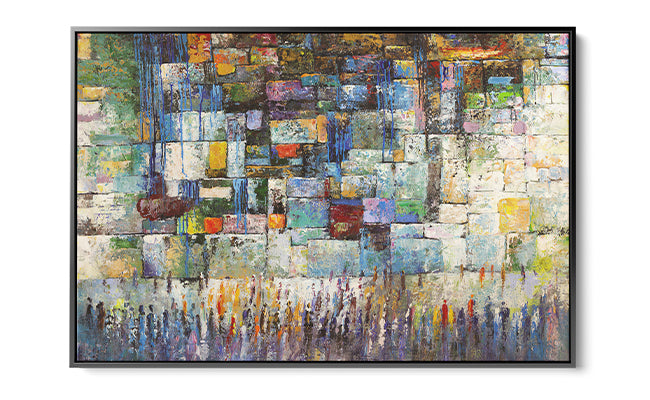
The emotional intensity of the expressionist tradition suited Jewish artists navigating trauma, displacement, and cultural rupture. Color used non-naturalistically, distorted form, and raw surface quality became a way to carry weight that literal imagery could not. This tradition persists in contemporary Jewish art, where a painting of the Kotel might use deep ochres, cobalt, and raw texture rather than photographic accuracy.
Decorative and Calligraphic Traditions
Hebrew letterforms are themselves an art form in the Judaic context. Micrography, the practice of forming images from tiny Hebrew script, produced extraordinary works in medieval manuscripts. Today, calligraphic Hebrew lettering appears in everything from hand-painted ketubot to large-format wall art featuring Psalm verses, often set against washes of gold, blue, or ochre. The letters carry meaning on two levels simultaneously: as text and as visual form.
Contemporary and Abstract Judaica
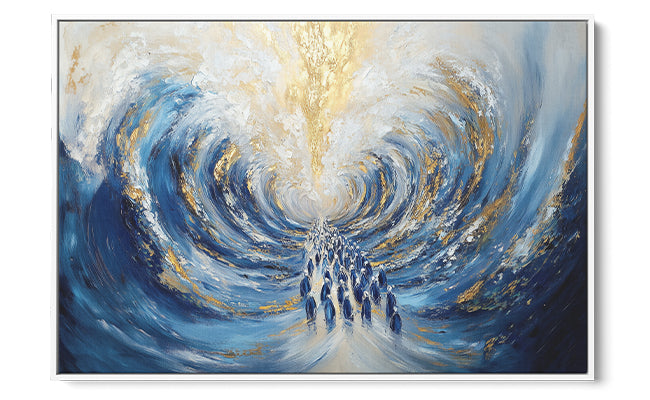
Many contemporary Jewish artists work in abstract or semi-abstract modes while remaining clearly within a Jewish visual vocabulary. Geometric forms derived from Star of David geometry, color palettes drawn from the ancient Temple materials (blue, gold, crimson, white), and compositional structures built around the Hebrew alphabet all signal Jewish cultural grounding without literal depiction. This style pairs naturally with modern, minimalist, and Japandi interiors where figurative religious imagery might feel incongruous but a rich, abstracted blue-and-gold canvas reads as sophisticated wall art.
Artists working in contemporary Jewish wall art often blend these traditions, using calligraphic elements within expressionist color fields or setting figurative rabbi portraits against abstracted golden grounds.

Key Symbols in Jewish Painting and What They Represent
Jewish painting symbolism is dense and layered. The same motif can carry halachic, mystical, and cultural meanings simultaneously. Here are the most common symbols and what they actually signify.
- The Menorah: The seven-branched candelabra is among the oldest Jewish symbols, depicted on the walls of ancient synagogues and the Arch of Titus in Rome. In painting, it represents divine light, the continuity of the Temple tradition, and the presence of God. A Hanukkiah, the nine-branched version, carries more specific seasonal meaning but shares the light symbolism.
- The Star of David (Magen David): Though not an ancient Jewish symbol (it became widespread as a Jewish identifier only in the 19th century), it now functions as a primary marker of Jewish identity in visual art, often combined with other motifs or used as a structural element in geometric compositions.
- The Torah scroll: Painted scrolls appear frequently in scenes of synagogue life and as standalone symbols of learning, covenant, and the transmission of tradition from generation to generation.
- Hebrew text and Psalm verses: Specific verses, particularly from Psalms and the Shema, appear constantly in Judaic painting. Psalm 42's opening verse, "Ke'ayal Ta'arog," expresses the soul's longing for God as a deer thirsts for water. You see this verse rendered as large-format calligraphic art designed to anchor a wall, often in deep blues and golds that reinforce the imagery of flowing water and divine presence.
- Jerusalem and the Western Wall: The city and the Kotel function as symbols of return, continuity, and collective Jewish memory. A painting of Jerusalem's old city rooftops at dusk or the stones of the Western Wall carries this freight regardless of how realistic or abstracted the rendering.
- Shabbat candles and table settings: Domestic ritual objects painted in warm, glowing light represent the sanctity of the home as a space of Jewish practice. These paintings often carry a warmth of palette and intimacy of scale that makes them particularly suited to kitchen or dining room placement.
- Hasidic figures in dance or prayer: The joyful, movement-filled Hasidic figure is a recurring motif, particularly in artists who draw on Eastern European Jewish culture. Silhouetted dancers, bearded scholars bent over books, and circles of prayer convey communal spiritual intensity.
For a deeper look at how specific sacred texts power Jewish visual art, this piece on pasuk-based art explains the tradition in practical terms.

How Judaic Art Reflects Jewish Values, Texts, and Memory
One of the most distinctive things about Jewish visual art, compared to other religious art traditions, is its relationship to text. Christianity produced art primarily as instruction for the illiterate. Islamic art avoided figural representation in religious contexts and emphasized geometric and calligraphic beauty. Jewish art, uniquely, has always existed in close conversation with a literate community of interpreters, which is why so much of it functions on a literary as well as visual level.
The concept of hiddur mitzvah, beautifying a commandment, is foundational. Jewish law requires that ritual objects be beautiful, not merely functional. A Kiddush cup, a Hanukkiah, a Shabbat tablecloth, a Sukkah decoration: each is an expression of the principle that sacred acts deserve the finest materials and craft available. This is where Judaic art and religious practice interweave most directly, and it explains why high-quality handmade or original artworks carry greater cultural weight in Jewish homes than reproductions or factory-printed items.
Memory is another organizing principle. After centuries of exile, destruction, and dispersal, Jewish art became a vehicle for preserving what was lost. Paintings of the shtetlakh of Poland and Russia, of synagogue interiors that no longer exist, of rabbis and community leaders, of the streets of Mandatory Palestine, all function as a form of collective memory. This is not nostalgia in a sentimental sense. It is a serious cultural project of transmission.
Rabbi portraits in particular carry this weight. A painted portrait of the Chofetz Chaim or Rabbi Ovadia Yosef is not simply a decorative choice; it is a statement about intellectual lineage and ethical aspiration. In many traditional Jewish homes, these portraits function the way family photographs do in secular ones: as reminders of who you belong to and what you are accountable to. A well-executed portrait of Rabbi Chaim Kanievsky, for instance, conveys not just likeness but the quality of presence and concentrated attention that defined his scholarship.
Sukkah decoration is a particularly interesting case where all these threads converge: art, memory, text, and hiddur mitzvah all apply to the four walls of a temporary structure built once a year. The Sukkah decorations collection reflects this directly, with works that range from scenic Jerusalem vistas to vibrant rabbi portraits designed to fill a full wall panel.
Curator's note: When choosing a rabbi portrait for a home or study, look for works where the artist has prioritized the character of the eyes and hands. These are the features that distinguish a portrait with genuine presence from a flat reproduction.

How to Recognize Quality Judaic Art and Find Pieces Worth Owning
With the market for Judaic art ranging from mass-printed posters to original oils, it helps to have a clear framework for evaluating what you are looking at. Here is a three-step method: assess the craftsmanship first, then the cultural specificity, then the relationship between the two.
Step 1: Evaluate the Craft Independently of the Subject
A Judaic painting should hold up as a painting before you factor in its subject matter. Look at how the artist handles light, edge quality, and color temperature. A Jerusalem cityscape with muddy, uniform color and mechanical brushwork is a weak painting regardless of its subject. A rabbi portrait where the shadows are warm and the lights are cool, with genuine attention to the texture of skin and cloth, is a strong painting first and a strong piece of Judaic art second.
Step 2: Assess Cultural Specificity
Generic "Jewish" imagery (a star on a blue background, a generic candle) carries less meaning than work that engages with specific texts, figures, traditions, or places. Ask what the artist is actually saying about the subject. Does the work convey something particular about, say, the Chofetz Chaim's emphasis on the ethics of speech? Or is it simply a recognizable face on a colored ground? Specificity is almost always a marker of quality in this genre.
Step 3: Consider Format and Scale for Your Space
Judaic art works across a wide range of formats. Posters on heavyweight archival paper, printed at sizes from roughly 8 by 10 inches to 24 by 36 inches, are a practical and affordable way to bring specific imagery into a space, particularly for Sukkah walls, children's rooms, or study areas where framing can be simple. Original paintings and giclée prints on canvas suit living rooms and dining rooms where scale and surface texture matter more. Acrylic-mounted prints carry a clarity and depth of color that is especially effective for calligraphic or geometrically precise compositions.
A general rule for wall placement: hang the center of a piece at eye level, which is approximately 57 to 60 inches from the floor. For a piece hung above a sofa or credenza, the bottom edge of the frame should sit 6 to 8 inches above the furniture. A single statement piece for a dining room wall should span at least half the width of the dining table to feel anchored rather than lost.
Styling note: In rooms with high ceilings and crown molding, a traditional Judaic painting in a gilded frame reads as deliberate and composed. In a white-walled, open-plan space, the same subject in a clean, thin black frame or a frameless canvas mount will feel more contemporary without losing any of the cultural meaning.
Mistakes to avoid: buying a piece that is too small for the wall (a 5 by 7 inch print on an 8-foot wall reads as an afterthought), choosing a reproduction when the subject demands the intimacy of an original, and selecting imagery based only on religious familiarity without considering whether the execution is actually good. Also, avoid placing paintings of sacred figures in bathrooms or areas of the home where they would be disrespected in traditional Jewish practice.
For perspective on how traditional and modern approaches to Jewish wall art differ practically, this comparison of modern Judaica vs. traditional Jewish decor is worth reading before you decide on a style direction.

Bringing Judaic Art Into Your Home: Placement, Meaning, and Living With It
Transitioning from understanding Jewish art historically to actually living with it requires thinking about how each piece functions in a room's daily life.
Entryway and Hallway
A calligraphic rendering of the Shema or a striking Jerusalem cityscape placed in an entryway sets the tone of the home immediately. The entryway is where guests form their first impression and where you leave and return each day, making it an especially resonant location for art that carries a blessing or a statement of belonging. Keep the scale proportionate: in a narrow hallway, a vertical format piece no wider than 18 inches reads cleanly without crowding the space.
Living Room
The living room can carry your most significant piece, whether that is an original painting or a large-format canvas print. A Western Wall scene in deep ochres and warm grays works beautifully above a stone fireplace in a traditional or transitional interior. An abstract piece built on Hebrew letterforms suits a more modern or minimalist setting. The Western Wall art collection includes works at sizes suited to statement-wall placement.
Dining Room
Shabbat and holiday imagery belongs naturally here. A warm, figurative painting of a Shabbat table setting, rich with candlelight and cloth and the soft focus of memory, creates a resonance with the rituals that actually happen in that room. Scale up: for a standard 8-seat dining table, a piece at least 36 inches wide reads as intentional.
Study or Home Office
Rabbi portraits and Torah-learning scenes are traditionally placed in spaces of work and study. They are understood as reminders of intellectual and ethical standards. A portrait of a rabbi deeply absorbed in text carries a certain productive energy in a room where you read and think. The rabbi portrait collection includes works at poster scale, which makes them easy to frame and hang in a study without a major commitment.
Children's Room
Colorful, joyful imagery, Hasidic dancers, festival scenes, vivid depictions of Jewish holidays, suit children's spaces well. These pieces serve as both decoration and early cultural education. Posters at the standard 11 by 17 inch or 18 by 24 inch range, in bright primary palettes, are an appropriate investment for spaces that change as children grow.
Designer's tip: When combining multiple Judaic pieces in a gallery wall, use consistent frame finishes (all natural wood, or all matte black) but vary the subject matter across the symbolic categories described above: one calligraphic piece, one figurative scene, one portrait. The variety in content prevents the grouping from feeling like a collection of duplicates, while the consistent framing gives the wall visual coherence.
For anyone concerned about preserving these pieces over time, proper lighting and framing choices matter as much as where you hang them. This guide to preserving paintings and Judaica art covers the practical side of long-term care.
Frequently Asked Questions
What makes a painting count as Judaic art?
Intent and referent are the two deciding factors. A painting counts as Judaic art if it was made within a Jewish cultural framework, addresses Jewish identity or practice, uses Jewish symbolic vocabulary, or was created specifically for Jewish ritual use. The artist's background is relevant but not determinative: a non-Jewish artist commissioned to paint a Haggadah scene is producing Judaic art. A Jewish artist painting purely secular landscapes is not, unless that work engages Jewish cultural themes.
What are the most common symbols used in Jewish artwork?
Beyond the symbols described in the body of this article, a few deserve mention as frequently misread. The hamsa (open hand) is widely used across Jewish and wider Middle Eastern cultures and signals protection, but it is not exclusively Jewish. The pomegranate, with its traditional 613 seeds corresponding to the 613 commandments, appears frequently in Rosh Hashanah imagery. The lion of Judah represents the tribe of Judah and, by extension, Jewish sovereignty and strength. The dove with an olive branch appears in Jewish art as a symbol of peace and hope, drawing on the Noah story. Each of these carries cultural weight distinct from its use in general decorative art.
Is there a difference between Judaic art and Israeli art?
Yes, a meaningful one. Israeli art refers to art produced in the State of Israel, which encompasses everything from secular abstract painting to politically engaged documentary photography to Bedouin craft traditions. Much Israeli art has no Jewish religious or cultural content at all. Judaic art is defined by its engagement with Jewish cultural and religious content, and it is produced globally, in New York, London, Paris, Melbourne, and Jerusalem alike. There is significant overlap: many Israeli artists working in Judaic themes are among the most significant figures in the field. But the two terms are not interchangeable.
How has Jewish art changed from ancient times to modern styles?
The trajectory runs from communal and anonymous (synagogue frescoes, manuscript illumination produced by scribal workshops) to individual and signed. The concept of the Jewish artist as a named creative figure with a personal style is largely a modern development, accelerating in the 19th century as Jewish emancipation opened European art academies. The subject matter has shifted too, from exclusively religious and liturgical in earlier periods to a much wider range that includes secular Jewish life, political history, Israeli landscapes, and abstracted cultural identity. The core symbolic vocabulary, however, remains remarkably stable across those changes.
What styles do Jewish artists typically paint in?
There is no single style. Jewish artists have worked in every major Western art movement: realism, impressionism, expressionism, cubism, surrealism, abstract expressionism, and contemporary figurative painting. What distinguishes the work is not the style but what it addresses. Within the Judaic art category specifically, expressionism has had particular staying power because its emphasis on emotional and spiritual interiority maps naturally onto Jewish religious experience. Calligraphic and decorative styles, rooted in manuscript traditions, also remain active and are experiencing renewed interest in contemporary interior design contexts.
Can non-Jewish people collect and display Judaic art?
Absolutely. Judaic art is collected by museums, institutions, and private collectors worldwide regardless of religious affiliation. The more relevant question for a non-Jewish buyer is whether a particular piece involves an object of active religious use, like a Torah scroll or a mezuzah, in which case some traditional sensitivities apply, or whether it is a painting or print that depicts Jewish cultural and religious themes. The latter carries no restrictions on who may own or display it. Many collectors are drawn to Judaic art precisely because of its visual richness, its relationship to a long textual tradition, and the specific gravity that comes from art rooted in memory and meaning.
If you are building a collection or choosing a first piece, the contemporary Jewish wall art collection brings together a range of works, from affordable archival posters in the $11.99 to $29.99 range to larger format pieces, organized by subject and style so you can cross-reference the ideas covered here with specific available works.
Read more
Best Contemporary Jewish Artists You Should Know
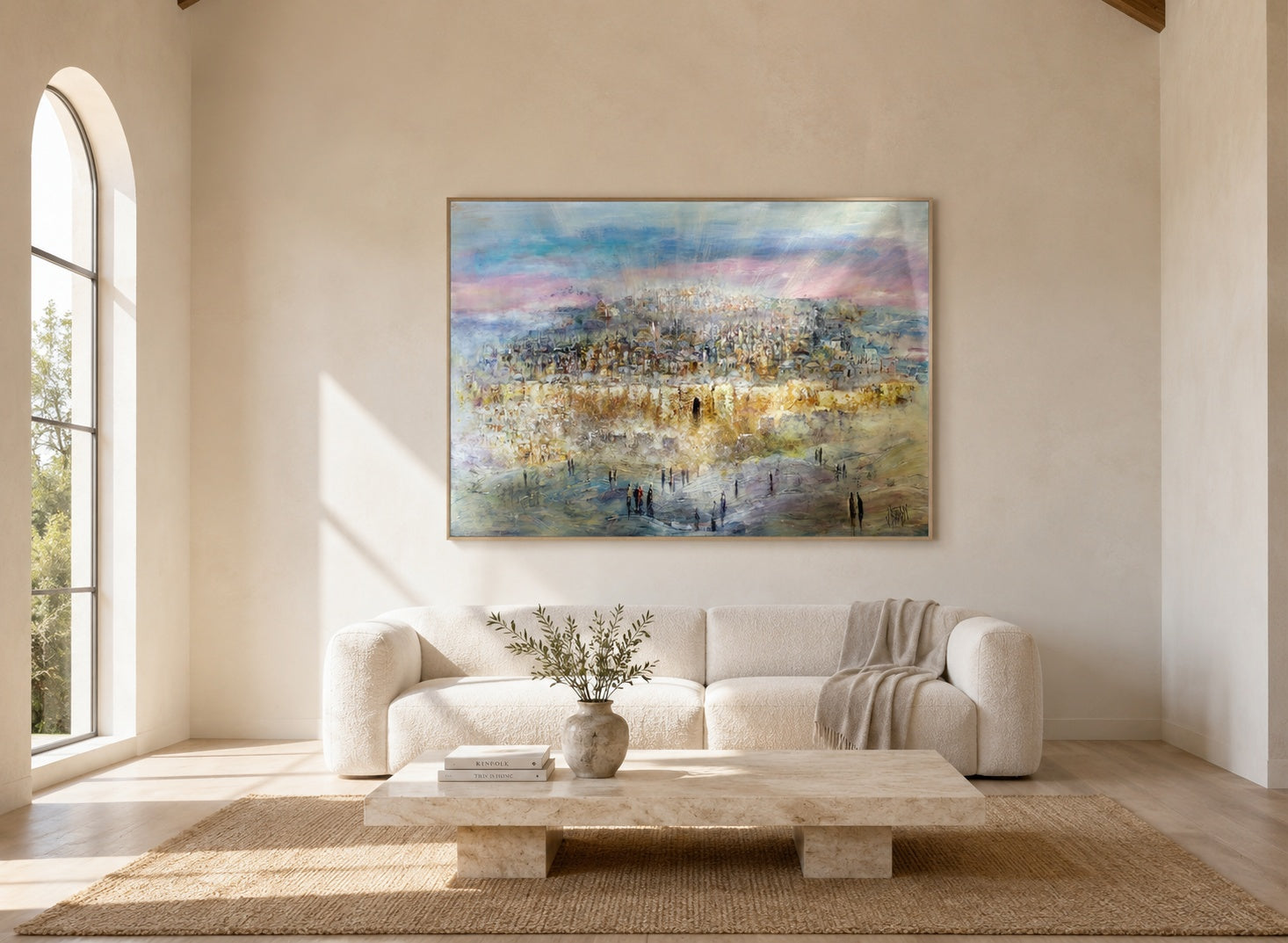
A practical guide to the best contemporary Jewish artists, from Bitton and Ben Ari to Karavan and Rovner, with expert advice on choosing and placing their work in a high-end home.
Read more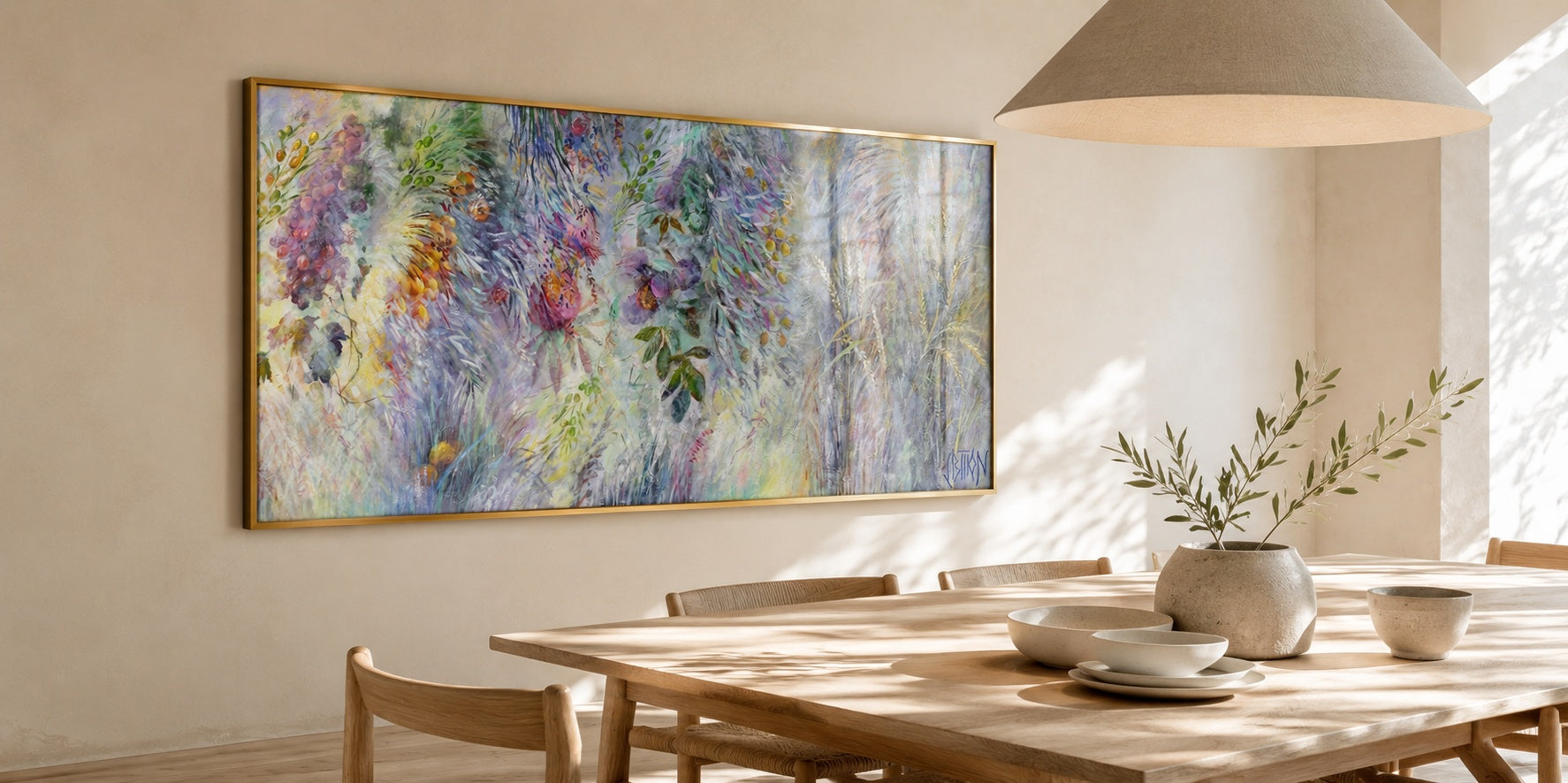
Ancient Jewish Paintings: History, Themes, and Where to Find Them Today
From the 244 CE Dura-Europos frescoes to medieval illuminated manuscripts, this guide traces the full history of ancient Jewish paintings and shows how their symbols, palette, and compositional log...
Read more