

Article: Best Contemporary Jewish Artists You Should Know

Best Contemporary Jewish Artists You Should Know
Best Contemporary Jewish Artists You Should Know
Best Contemporary Jewish Artists: Identity, Memory, and Spiritual Vision
If you're searching for the best contemporary jewish artists, start here: Yossi Bitton, Avigdor Ben Ari, and Menucha Yankelevitch are among the most accomplished working today in the Judaica fine art space. Internationally, the late Dani Karavan (environmental sculpture), Michal Rovner (video installation), and the painter R.B. Kitaj are foundational figures. These artists are not simply making religious objects; they are producing serious fine art that happens to draw from a deeply specific tradition. That specificity is exactly what gives their work its power.
Jewish art has never been a single style or movement. It is a conversation, carried across centuries and continents, about what it means to be part of a people with a long memory and a living faith. In the 21st century, that conversation has moved into abstract painting, mixed media, portraiture, and large-scale installation. The artists shaping it today are working at the intersection of personal biography, collective history, and formal artistic invention.
Understanding who these artists are, and what drives their work, makes you a sharper buyer. When you know the visual language an artist is using, you can choose a piece that actually resonates in your home rather than one that simply fills a wall.
To see how this living tradition looks across a range of styles and formats, see their styles represented in our gallery.

Themes That Define Contemporary Jewish Art: Identity, Memory, and Spirituality
Three forces run through almost all notable Jewish visual artists working today: identity, memory, and spirituality. They rarely appear in isolation. A painting about Jerusalem is almost always also about memory. A portrait of a Torah sage is almost always also about identity and continuity. The richest works hold all three at once.
Identity in contemporary Jewish art is complicated and honest. Artists explore what it means to be Jewish in a post-Holocaust world, in a modern Israeli state, in a diaspora community, or in a secular culture that barely registers the difference. Painter R.B. Kitaj, working into the early 21st century, was one of the first to explicitly call himself a Jewish painter and to theorize what that meant, producing figurative work dense with diasporic anxiety and literary allusion.
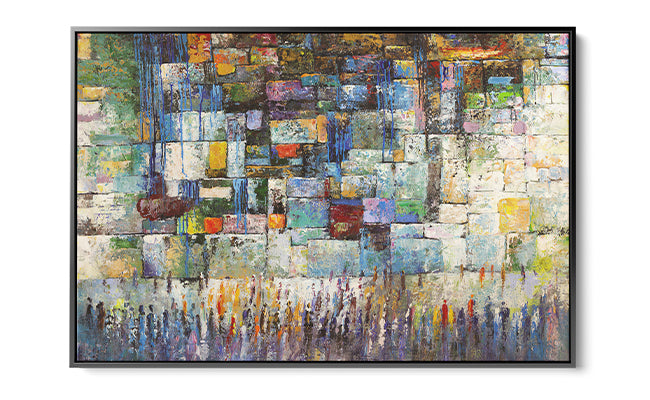
Memory shows up in the recurring imagery: Hebrew text, the Old City of Jerusalem, the Western Wall, the Red Sea crossing, the giving of the Torah at Sinai. These are not decorative motifs. They are visual shorthand for events that Jewish communities have rehearsed for thousands of years. When an abstract painter encodes them in color and texture rather than literal representation, the effect is surprisingly direct. The image bypasses the rational mind.
Spirituality is perhaps the hardest to describe but the easiest to feel. The best works in this tradition carry a quality of concentrated interior stillness, not piety, but the painter's genuine relationship with the material. That stillness is what separates painting that moves you from painting that merely illustrates.
If you want to understand the broader category before buying, the article What Is Modern Judaica Art and Why It Belongs in Every Jewish Home gives a useful grounding in how contemporary work differs from classical Judaica.
Celebrated Jewish Painters Shaping the Contemporary Art Scene
Several painters deserve particular attention from anyone seriously interested in this field.
Yossi Bitton is among the most recognized contemporary Jewish painters working today. Born in Morocco and deeply rooted in Sephardic tradition, Bitton works in rich, layered abstract compositions that treat Jerusalem not as a cityscape but as an emotional and spiritual terrain. His palette runs to warm, earthy tones of brown, olive, and coral, colors that evoke ancient stone and desert light. His series on Jerusalem is arguably the defining body of contemporary Jewish abstract painting of the last two decades. The Yossi Bitton collection shows the full range of how that visual language develops across different works.
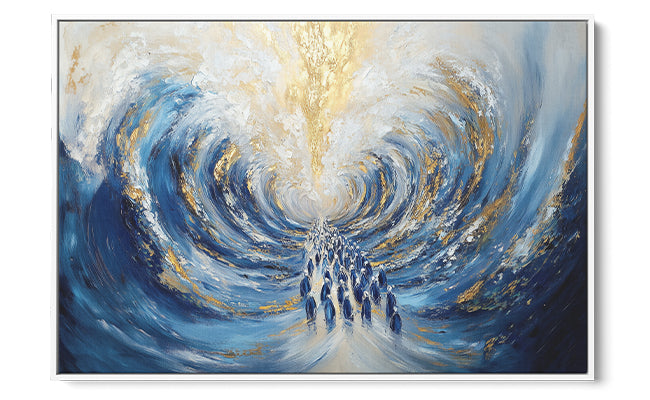
Avigdor Ben Ari brings a different sensibility: his work is more dramatic, more charged with movement and spiritual intensity. His large-format acrylic paintings on biblical themes, including the giving of the Torah at Sinai and the crossing of the Red Sea, use bold color contrasts and sweeping gestural marks to create a sense of cosmic scale. He is one of the few contemporary painters working in this tradition who successfully conveys genuine awe without falling into illustration.
Menucha Yankelevitch works in a more contemplative register. Her portrait-based works honor the great Torah sages of modern times with a restraint that feels genuinely reverential rather than sentimental. The quietly observed Menucha Yankelevitch collection is worth studying simply as an example of how figurative art can carry profound spiritual weight without a single moment of excess.
Beyond these gallery artists, the broader international contemporary art world includes well-known Jewish painters worth knowing. Cecily Brown's large-scale figurative-abstract canvases, particularly her The Fugitive Kind series, with its turbulent, body-charged surfaces, have made her one of the most discussed painters of her generation. And the legacy of Lee Krasner, working well into the 1980s, continues to shape how younger painters think about scale, abstraction, and the body.

Jewish Artists Working in Abstract and Experimental Styles
Abstract art and Jewish visual culture have had a long, productive relationship. Part of the reason is theological: the traditional prohibition on representational images of the divine pushed Jewish artists toward formal and symbolic invention. When Mark Rothko, himself a Jewish painter of Latvian origin, covered enormous canvases with trembling rectangles of color, he was not making Jewish art in any doctrinal sense. But the emotional atmosphere of those paintings, the feeling of standing before something vast and beyond language, is deeply recognizable to anyone familiar with the Jewish liturgical tradition.
Contemporary Jewish abstract artists working today follow several distinct paths.
- Text-based abstraction: Hebrew letters and biblical phrases used as formal elements, not just captions. The letterform becomes shape, rhythm, and meaning simultaneously.
- Landscape abstraction: The land of Israel, and Jerusalem in particular, filtered through painterly gesture. Color and texture carry the geographical and spiritual weight that a photograph cannot.
- Narrative abstraction: Biblical events rendered as pure visual energy, where the drama is felt rather than depicted. Ben Ari's work on the Red Sea crossing is a strong example of this approach.
Curator's note: Abstract works in warm earth tones, particularly the brown-olive-coral range Bitton favors, integrate easily into modern, minimalist, and even Japandi interiors without losing their Jewish specificity. The warmth of the palette does the work of bridging cultural tradition and contemporary design.
When choosing abstract Jewish art for a home, look for work that holds its coherence at a distance. Stand back six feet from any canvas you are considering. If it reads as a unified visual field, with a clear emotional register, it will work in a room. If it only reveals itself up close, it belongs in a smaller, more intimate space.

Sculptors, Mixed Media, and Jewish Artists Beyond the Canvas
The contemporary Jewish art world extends well beyond painting. Sculptors, photographers, installation artists, and ceramicists are all contributing to the conversation.
Dani Karavan, the Israeli sculptor who died in 2021, built large-scale environmental sculptures that encoded Jewish historical memory directly into the landscape. His 1994 memorial at Gurs, the internment camp in the French Pyrenees where thousands of Jews were held before deportation, is one of the most moving public artworks in existence. His coastal installation Passages, in Portbou, Spain, honors the philosopher Walter Benjamin. His legacy continues to shape Israeli and diaspora public art.
Michal Rovner works in video and installation, exploring collective identity, archaeology, and the fragility of human community. Her work has been shown at the Venice Biennale and major museums worldwide. She is one of the most internationally visible Israeli artists of the 21st century.
In the mixed-media space, look for work that uses material choice as meaning. An artist who builds with discarded prayer books, torn maps, or oxidized metal is making a different claim than one who paints on pristine linen. The material is part of the argument.
For homes where a more traditional sacred aesthetic is also valued, the Jewish holy sites art collection bridges that gap, presenting familiar subjects, the Western Wall, Jerusalem, the Temple Mount, through a contemporary formal lens rather than a documentary one.

How to Bring Contemporary Jewish Art Into Your Home
Good art placement requires a few deliberate decisions before you buy anything. Here is a simple three-step framework: start with mood, then color temperature, then scale.
Step one: Decide on the mood you want the room to hold. Contemplative and spiritually grounded? Abstract works in muted warm tones, like Bitton's Jerusalem series. Dramatic and historically charged? Ben Ari's large-format biblical paintings. Quietly reverential? Yankelevitch's portrait tributes to Torah sages.
Step two: Match the color temperature. Warm-toned rooms (walnut furniture, cream walls, warm white light) absorb the brown and coral palettes of the Jerusalem abstract tradition naturally. Cool, pale interiors, those with gray stone, white plaster, or steel accents, need a painting with at least one warm note to avoid a feeling of sterility. A piece that runs warm ochre into deep indigo, for example, will anchor both worlds.
Step three: Get the scale right before you commit. A single large work on a main wall should span roughly two-thirds of the furniture piece below it. For a sofa that is 84 inches wide, that means a canvas or acrylic print at least 56 inches across. Smaller works, say 24 by 24 inches, belong in a cluster or in a more intimate setting like a study or hallway. Never hang a small piece in isolation on a large wall; it will look lost and, strangely, make the room feel smaller.
A few placement principles worth keeping:
- Hang the center of the artwork at eye level, typically 57 to 60 inches from the floor. This is the standard used in most professional galleries.
- In rooms with high ceilings (above 10 feet), you can raise this slightly to 63 inches, but resist the temptation to fill the vertical space by hanging artwork too high. Art that floats above the sight line disconnects from the room.
- In a dining room, the art should relate visually to the seated eye level, not the standing one. Hang it lower than you think.
Styling note: Acrylic-mounted prints have a particular advantage in rooms with strong directional light. The surface picks up ambient light subtly, adding depth and vibrancy to the color without glare, provided the piece is not hung directly opposite a window. An angle of 30 to 45 degrees from the light source is the practical sweet spot.
For more detailed guidance on display choices, the article Jewish Home Decor Ideas With Wall Art: How to Display Sacred Art With Intention covers room-by-room decisions with real specificity.
One mistake to avoid: treating Jewish art as purely ceremonial. A painting of Jerusalem or a biblical scene belongs in a living room, a study, a bedroom, or a hallway just as naturally as any other serious fine art. Restricting it to a synagogue or a dining room sideboard undersells both the work and the room.

Mistakes to Avoid When Buying Contemporary Jewish Art
- Buying by subject alone. "Jerusalem" or "Torah" as a subject does not guarantee quality. Look at the formal choices: composition, color relationships, mark-making. A painting earns its place through how it is made, not only what it depicts.
- Ignoring the format question. Framed prints, acrylic mounts, and canvas wraps each behave differently in a room. Acrylic mounts (like most works in the Ben Ari and Bitton ranges) feel contemporary and clean. Framed works feel more formal. Canvas wraps are warmer and more tactile. Match the format to the room's existing register.
- Underestimating wall color's effect. Deep jewel-toned walls can overwhelm a piece with a quiet internal palette. If your walls are already strong, choose a painting with one dominant bold tone to anchor the relationship, not something delicate and atmospheric.
- Confusing traditional Judaica with contemporary art. A mezuzah or a Seder plate is ritual craft. A painting by Yossi Bitton is fine art. Both belong in a Jewish home, but they serve different purposes and belong in different physical positions in a room.
Where to Find Contemporary Jewish Art That Speaks to You
The challenge with this category is not scarcity. It is navigation. There is a significant volume of work being produced under the banner of Jewish art, and the quality range is wide.
When buying, apply three filters. First, look for artists whose work has a consistent formal identity across multiple pieces, not a collection of stylistic experiments. Bitton's Jerusalem series is recognizable as his regardless of which canvas you are looking at. That consistency signals a developed artistic voice. Second, look for work that holds up at room scale. A small reproduction on a website can flatter almost anything. Ask for scale references, or look for the actual dimensions in the product listing, and visualize it against your wall before buying. Third, consider the medium's longevity. Acrylic-mounted prints produced with archival pigments and UV-protective coatings will maintain color stability for decades; paper prints in standard frames will not.
For the narrative abstraction of Sinai and the Red Sea crossing, the Avigdor Ben Ari collection shows how that visual tradition develops across a full body of work.
For Jerusalem specifically as a subject, the concentrated focus of the Jerusalem modern Jewish art collection allows a useful comparison of how different artists treat the same subject in formally distinct ways. That comparison is one of the best ways to discover which visual language actually speaks to you.
Rabbi portrait works suit different rooms and different buyers. They work particularly well in a study, a library, or a private reading space, where their quiet authority has room to be felt. The rabbi portraits collection brings together several of the strongest examples currently available.
What the artists in this article share, across abstraction, portraiture, and installation, is a commitment to making Jewish cultural experience visible through formal invention rather than decoration. That is the standard worth holding to when you buy.

Frequently Asked Questions
Who are the most famous Jewish artists in the contemporary art world?
Among internationally recognized figures, Michal Rovner (video and installation), the late Dani Karavan (environmental sculpture), and painter R.B. Kitaj are consistently cited as foundational. In the Judaica fine art space specifically, Yossi Bitton and Avigdor Ben Ari have the most sustained critical and collector attention for their abstract treatments of Jewish historical and spiritual themes.
What themes are most common in contemporary Jewish art?
Beyond the identity, memory, and spirituality triad covered above, look for recurring engagements with exile and return, the tension between written law and lived experience, and the visual archaeology of Hebrew text. Holocaust memory remains a significant sub-current, though younger artists increasingly approach it obliquely rather than directly, through abstraction, fragmentation, and material rather than explicit representation.
How is contemporary Jewish art different from traditional Judaica?
Traditional Judaica is ritual craft: objects with a functional role in religious observance (menorahs, mezuzot, Kiddush cups). Contemporary Jewish art is fine art with Jewish content, made for walls, public spaces, and private contemplation. The overlap is in subject matter, but the intent, the making process, and the physical object are entirely different. A painting by Menucha Yankelevitch honoring a Torah sage is a work of fine art, not a ceremonial object, even though it belongs in a deeply Jewish home.
Are there Jewish abstract artists who are well known today?
Yes. The abstract tradition in Jewish art runs from mid-20th century giants through to active contemporary painters. Yossi Bitton works in layered geometric abstraction with a strong color identity. Avigdor Ben Ari uses gestural marks and bold tonal contrasts to convey biblical narrative without literal imagery. In the broader art world, painters like Cecily Brown operate in a Jewish cultural context even when their subjects are not explicitly Jewish.
What should I look for when buying contemporary Jewish art for my home?
Use the mood-color temperature-scale framework described earlier. Beyond that, pay attention to how the artist handles the edges of the canvas. A painting with strong internal composition that resolves neatly at the edges will hold its integrity against any wall color. Also check whether the work is available in multiple sizes, the same composition at 24 by 24 inches and at 48 by 48 inches will feel like entirely different objects in a room. Match the size to the specific wall, not to an abstract preference for "large" or "small."
Which contemporary Jewish artists are best known for their use of symbolism and religious imagery?
Avigdor Ben Ari is among the most deliberate in this regard, encoding the drama of Torah narrative into color, light, and movement rather than literal symbol. Yossi Bitton uses the emotional resonance of Jerusalem's physical landscape as symbolic shorthand for the entire Jewish spiritual inheritance. Menucha Yankelevitch works with the human face as the central symbol, finding in the physiognomy of the great Torah sages a visual language for wisdom, humility, and devotion. Each takes a different approach to the same underlying question: how do you make ancient meaning visible in a contemporary painting?
If this conversation has opened up a direction you want to pursue, the contemporary and modern Jewish masterpieces collection brings together paintings across all of these formal registers, from Ben Ari's charged biblical narratives to Bitton's Jerusalem abstractions and Yankelevitch's contemplative portraiture. It is a useful place to see how the tradition looks as a whole before narrowing to the work that belongs on your wall.
Read more
What Is Judaic Art? A Guide to Jewish Painting Styles and Symbolism
Judaic art spans painting, sculpture, and manuscript illumination united by Jewish cultural intent. This guide covers the major styles, symbols, and placement advice for design-conscious buyers.
Read more