

Article: Jewish Home Decor Ideas Modern: Tradition Meets Design
,%20give%20each%20room%20a...)
Jewish Home Decor Ideas Modern: Tradition Meets Design
Jewish Home Decor Ideas Modern: Tradition Meets Design
To make Jewish home decor feel modern, treat tradition as a design language rather than a theme: pick one or two meaningful pieces (a Kotel painting, a Hebrew word, a clean Hamsa), give each room a restrained palette, and let negative space do the work. The goal is a home that reads as contemporary first and Jewish in its details, where a single abstract Western Wall canvas says more than a wall crowded with symbols. That balance is what most jewish home decor ideas modern searches are really after.
Below is a room-by-room approach grounded in real interior practice: how to choose pieces, what colors and materials hold up over time, where to hang things, and how to keep meaning intact without the space tipping into religious-gift-shop territory. I'll point to specific artworks along the way, but only as examples of principles you can apply anywhere.
Why Modern Jewish Home Decor Is Having a Moment
For a long time the choices felt binary: ornate silver and heavy frames on one side, or no visible Jewish identity at all on the other. Younger families building first homes wanted neither. They wanted spaces that look like the design they actually love, Scandinavian, japandi, warm minimalist, with their heritage present in a way that feels personal instead of inherited.
Artists have caught up. Contemporary Judaica now includes abstract paintings, textural canvases, and Hebrew typography designed by people who understand color theory and scale. A Kotel rendered in soft ochre and stone-gray brushwork sits comfortably above a linen sofa. You can see the range in the gallery's contemporary Judaica home decor, where holy-site imagery is treated as fine art rather than ritual object.
The shift matters because a home tells guests, and your children, who you are. Modern Jewish home decor lets that story coexist with good design instead of fighting it.
The Design Principles That Blend Tradition With Modern Style
Three rules carry most of the work. Use them as a filter before you buy anything.
- One anchor per room. Choose a single dominant Jewish piece, usually art, and let smaller items support it. Two statement pieces in one room compete; a room with one clear focal point reads as designed.
- Abstract over literal. An abstract Western Wall painting carries the same meaning as a photographic one but blends into a modern interior far more easily. Suggestion ages better than illustration.
- Edit the symbols. Star of David, Hamsa, Hebrew text, holiday objects, you don't need all four in one space. Pick the ones that mean the most to your family and retire the rest to drawers and holiday rotation.
This is where many homes go wrong: they treat every meaningful object as something to display permanently. Tradition includes rhythm. Pieces that appear for Sukkot or Shabbat and then go away keep their significance and keep your shelves calm.
Designer's tip: stand in the doorway and name the one thing your eye lands on first. If it isn't your anchor piece, the room is too busy. Subtract until it is.

Choosing a Palette and Materials That Feel Both Sacred and Contemporary
Color does more for the "modern and meaningful" balance than any single object. Jerusalem stone, the literal material of the holy city, gives you the whole palette you need: warm sand, limestone beige, dusty gold, soft gray, with deep blue as an accent. These tones read as both rooted and current, which is why so much modern Western Wall art lives in exactly this range.
Build rooms around two or three of those colors. Pair stone neutrals with one grounding tone, charcoal, navy, or terracotta, and keep metals consistent: brushed brass or matte black, not both.
On materials, mix one warm natural texture with one clean surface. Olive wood, raw linen, and ceramic bring craft and warmth; acrylic, glass, and powder-coated metal bring the modern edge. A textural acrylic painting against a smooth plaster wall is the whole idea in one pairing. For very small accent moments, the gallery's acrylic block pieces deliver Hebrew text or holy-site imagery in a form that sits on a shelf without visual weight.
Styling note: If you already own gold-toned ritual objects (candlesticks, a Kiddush cup), let brass be your accent metal throughout and the whole home will feel intentional rather than accumulated.

Room by Room: Modern Judaica Ideas for the Living Room, Entry, and Dining Space
Different rooms want different things. Here's how to place Jewish identity where it lands naturally.
The Entry: set the tone in the first three feet
The entrance is your home's opening sentence. A single piece of Hebrew typography or a small Kotel canvas, hung at eye level (center around 57 to 60 inches from the floor), greets everyone before they reach the living room. Keep it modest in scale here; a console with one ceramic object and a framed blessing does more than a crowded gallery. A mezuzah in a clean, modern design completes the moment without announcing itself.
The Living Room: lead with one large artwork
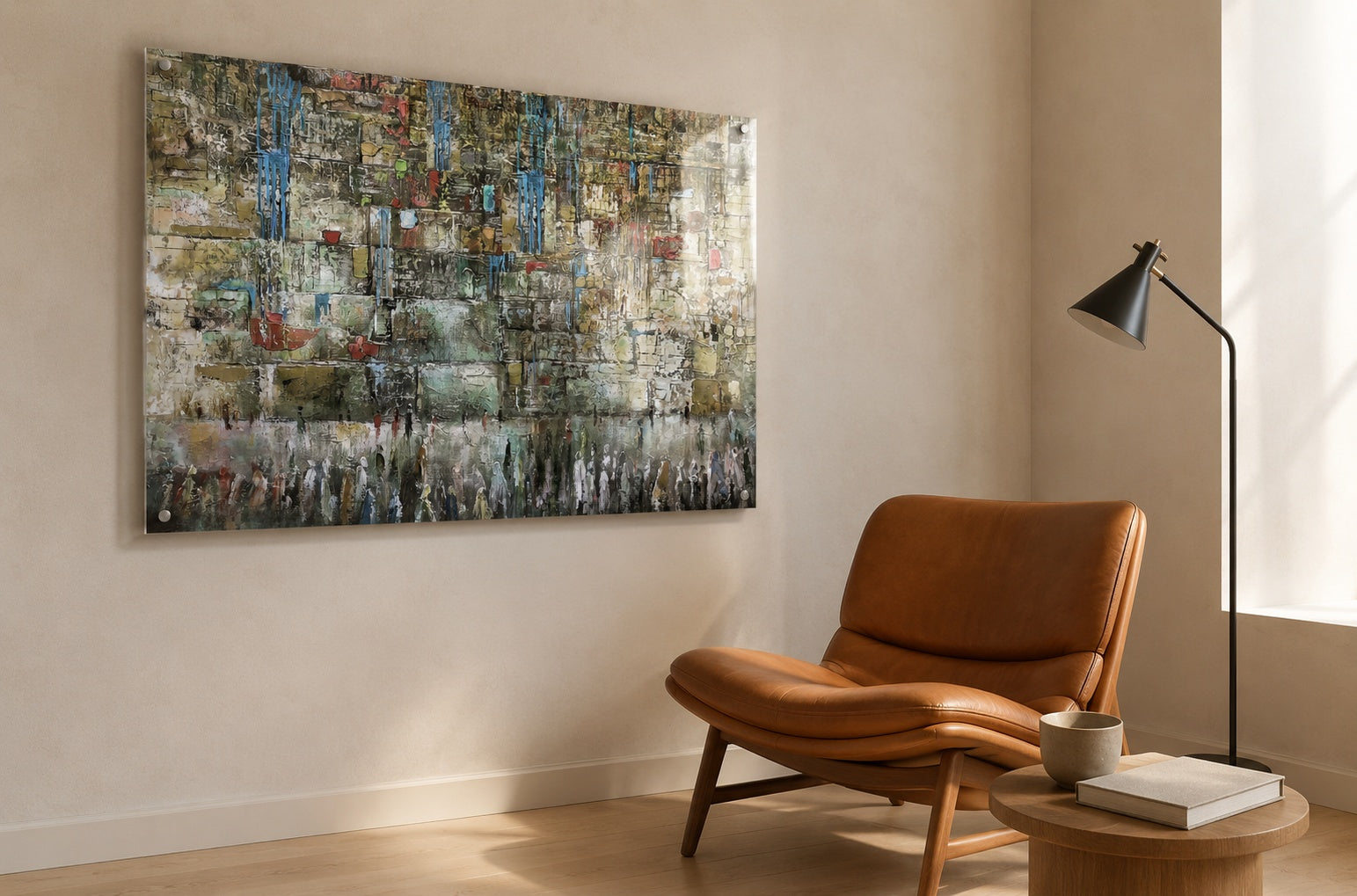
This is where your anchor belongs. Above a sofa, aim for art that spans roughly two-thirds of the furniture width: a 60-inch sofa wants a piece or grouping around 40 inches wide. Abstract Western Wall paintings work beautifully here because their stone palette ties into neutral upholstery. The Western Wall art for the home reads as serious contemporary art from across the room, with the meaning revealing itself up close.
The Dining Space: where ritual already lives
Shabbat and holidays happen at this table, so the room can carry a little more warmth. A larger statement canvas on the main wall, paired with a sideboard that holds candlesticks and a Kiddush cup, lets the everyday and the sacred share one space. During holidays, this is the room that changes; a Sukkot family will recognize how much a season's worth of Sukkot decoration ideas can shift the atmosphere without a permanent footprint.

Using Wall Art to Anchor a Modern Jewish Home
Wall art is the most efficient way to add Jewish identity to a modern home because it carries meaning at scale without occupying surfaces. One well-chosen canvas does what a dozen objects can't.
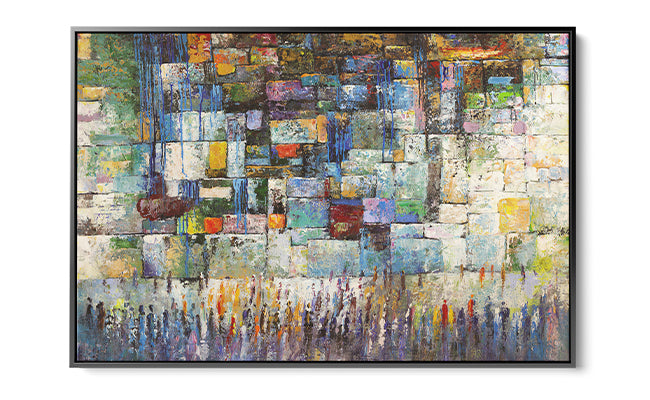
When you're choosing a single piece to anchor a room, look for canvases that hold to two or three tones and one dominant shape. That restraint is what keeps a meaningful image from reading as busy on a large wall. Eternal Stones of the Kotel by Avigdor Ben Ari is a clear example: the abstract treatment of the Western Wall keeps the palette tight and lets the texture do the talking, so it grounds a modern living room instead of decorating it. Across sizes it runs $320 to $1290, which gives you room to scale the piece to the wall rather than the other way around.
For an entry or a narrower wall, the same logic applies in smaller format. The full range of Avigdor Ben Ari's modern Judaica stays within that disciplined stone-and-sky palette, which makes it easy to repeat an artist's hand across two rooms for a cohesive look.
If you want a deeper walkthrough of placement, this guide on displaying Jewish art in a modern home covers hanging height, lighting, and grouping in detail.

Canvas, Framed, or Acrylic: A Quick Comparison
Format changes the mood as much as the image does. Here's how the common options behave in a modern interior.
| Format | Mood it creates | Best room | Maintenance |
|---|---|---|---|
| Gallery canvas | Soft, warm, no glare | Living room, bedroom | Dust only |
| Framed print | Crisp, gallery-formal | Entry, study | Glass needs cleaning |
| Acrylic / glossy | Modern, reflective, depth | Dining, bright walls | Wipe clean |
| Acrylic block | Small, sculptural accent | Shelf, console | Wipe clean |
Best for: rooms with strong daylight, a matte gallery canvas avoids the glare you'll fight with glass or high-gloss acrylic on a sunny wall.
Balancing Hebrew Text, Symbols, and Holiday Pieces Without Clutter
The fastest way to make a home feel dated is to display every Jewish symbol you own at once. Treat them as a small vocabulary, not a checklist.
A method I use with clients, three filters in order: meaning first, then color temperature, then scale.
- Meaning first. Keep the symbols tied to your family's story, a name, a blessing you love, a place you've prayed, and let go of the generic ones.
- Then color temperature. Group warm-toned pieces together and cool-toned pieces together. Mixing them randomly is what creates visual noise.
- Then scale. One large item, one medium, a couple of small. Three sizes in any grouping reads as composed; same-size clusters look like a display case.
Hebrew text deserves special care. A single word, chai, shalom, a child's name in clean lettering, has presence. A wall of competing phrases doesn't. For name-based pieces tied to a verse, the name by pasuk artwork turns a personal detail into a quiet focal point rather than decoration.
Curator's note: Hang Hebrew typography where people pause, beside a reading chair, at the end of a hallway, so there's time to actually read it. Text behind a busy sofa gets lost.

Mistakes to Avoid
- Hanging too high. Art centered above 60 inches floats away from the furniture. Keep the center near eye level and relate it to the piece below it.
- Matching art to the wall paint. A stone-toned canvas on a beige wall disappears. Let the art contrast the wall, not echo it.
- Over-theming. A room where every object is Jewish reads as a museum. Let the identity be a thread, not the entire fabric.
- Ignoring frame and metal consistency. Three different frame finishes on one wall undo the calm you're trying to build.
How to Build a Cohesive Look That Grows With Your Family
The best Jewish homes aren't decorated in a weekend; they accumulate with intention. Start with your living room anchor, live with it, and add the next piece only when a wall genuinely calls for it.
Cohesion comes from repetition, not uniformity. Repeat one artist's palette across two rooms. Repeat brass. Repeat the stone-neutral base. New pieces then slot in without restyling everything. As a family grows, the rotation grows too: a child's name in a verse, a new artist you discover, a Sukkot collection that returns each fall. The difference between modern and traditional Judaica is useful background as your taste settles.
For households drawn to figurative and narrative work rather than abstraction, the Jewish life art collection offers everyday scenes that warm up a minimalist room without crowding it.

Pieces Worth Building Around
A short, editorial shortlist, each tied to a principle above.
For the living room anchor that proves abstract beats literal, Before the Ancient Stones by Avigdor Ben Ari holds its tight palette across a large wall and rewards a closer look. If you want a calmer, more contemplative mood for a bedroom or reading corner, Serene Blessings leans quieter while staying in that same stone register. Spring Light by Menucha Yankelevitch brings the warmer, more luminous end of the palette, useful when your room already runs cool and needs a lift.
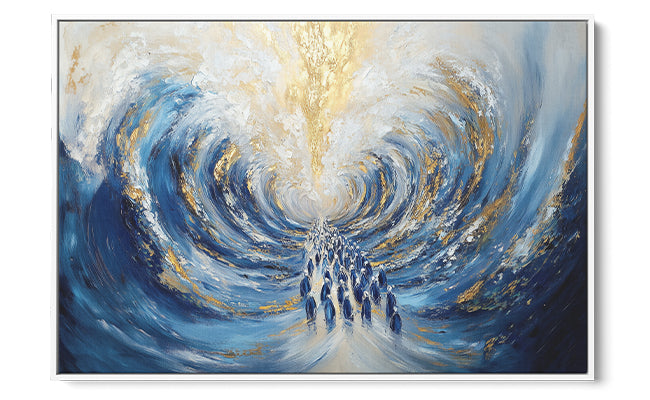
Where you want a piece with more graphic energy for a dining wall, The Gates of Zion and Facing Eternity carry stronger contrast and movement, both suited to rooms that can take a focal point. And Morning Devotions, with its early-light atmosphere, is the kind of quiet, intentional image that suits an entry where you want the first impression to feel settled. To see how these sit together across the modern Judaica range, the gallery's holy-sites art for modern homes shows the full family of palettes side by side.
Frequently Asked Questions
How do I make Jewish home decor feel modern instead of traditional?
Choose abstract or typographic pieces over ornate, illustrative ones, keep each room to two or three colors, and display fewer objects with more space around them. The modern feeling comes from restraint and clean lines, not from avoiding Jewish content. One strong contemporary canvas does the job better than a shelf full of silver.
What are some easy ways to add Jewish identity to a minimalist home?
Start with a single Hebrew word in clean lettering, a modern mezuzah, or one abstract holy-site canvas. In a minimalist room, a sculptural acrylic block on a shelf adds meaning without breaking the calm. The trick is to add one element at a time and resist filling the empty space the minimalist look depends on.
Which rooms are best for displaying Judaica art and symbols?
The entry sets the tone, the living room holds your largest anchor piece, and the dining room carries holiday and Shabbat meaning naturally. Bedrooms suit quieter, more contemplative pieces. I'd avoid bathrooms and high-traffic utility spaces, where sacred imagery feels out of place and humidity can damage canvas and frames.
How do I mix Hebrew text and Jewish symbols without the space feeling cluttered?
Filter by meaning, then group by color temperature, then vary the scale so you have one large, one medium, and a few small items. Keep text where people naturally pause so it can be read. The most common error is treating every meaningful object as permanent; rotate holiday pieces in and out instead.
What colors and materials work best for modern Jewish home decor?
The Jerusalem stone palette, sand, limestone beige, soft gray, and gold with deep blue as an accent, reads as both rooted and current. Pair one warm natural texture (olive wood, linen, ceramic) with one clean surface (acrylic, glass, powder-coated metal), and keep your accent metal consistent throughout the home.
Can modern Judaica decor still feel meaningful and authentic?
Yes, and often more so, because a single intentional piece carries weight that a crowded display dilutes. Authenticity comes from the connection between the object and your family, a place you've prayed, a name, a verse, not from how ornate or traditional it looks. Modern treatment of sacred imagery, like an abstract Western Wall, preserves the meaning while letting it live in the home you actually want.
If you're ready to choose an anchor piece, the gallery's contemporary Judaica and modern home decor brings the holy-site palettes together in one place. You'll find abstract Kotel paintings and Hebrew-inspired work sized for everything from a narrow entry to a wide living-room wall.
Read more
Best Abstract Jewish Art for Home: Living Rooms and Entryways
A designer's guide to choosing the best abstract Jewish art for home, with specific sizing, palette, and placement advice for living rooms and entryways.
Read more