

Article: What Is Sukkah Decoration History and How Has It Evolved

What Is Sukkah Decoration History and How Has It Evolved
What Is Sukkah Decoration History and How Has It Evolved
Sukkah decoration is the practice of adorning the temporary booth built during the Jewish harvest festival of Sukkot with hanging fruits, handmade ornaments, artwork, and fabric coverings. If you've ever asked what is sukkah decoration history, the answer traces a practice that runs from biblical commandment through Talmudic law, across centuries of diaspora ingenuity, and into a contemporary moment where full-wall photographic fabric panels have become a serious design choice. The tradition is far older than most people realize, and its evolution tells you as much about Jewish cultural history as it does about how people have always wanted to make sacred space beautiful.
What Is Sukkah Decoration and Why It Matters in Jewish Life
A sukkah is a temporary structure with an open-slatted roof, built to commemorate the forty years the Israelites dwelled in the wilderness after the Exodus. The walls go up, the schach (organic roofing material) goes on, and then the decorating begins: people hang gourds and pomegranates, drape fabric across bare walls, suspend paper ornaments from the ceiling, and pin artwork at eye level.
This impulse is not incidental. It is doctrinally motivated. The concept is called hiddur mitzvah, loosely translated as "beautification of the commandment." The principle derives from Exodus 15:2, where the word v'anvehu is interpreted by the Talmud to mean: make your religious obligations beautiful. In practice, this means that a plain, structurally compliant sukkah fulfills the legal requirement, but a decorated one fulfills it with intention and devotion. Aesthetics, in Jewish law, are not a luxury add-on. They are a form of worship.
That theological grounding is why sukkah decoration history matters to anyone who wants to understand the holiday. The decorating is not folk custom that grew up around a religious practice. It is woven into the religious practice itself.
For a broader look at how Jewish ritual objects have moved between traditional and contemporary visual languages, this guide to modern versus traditional Judaica wall art provides useful context.

The Biblical and Talmudic Roots of Sukkah Decoration
The biblical source for Sukkot appears in Leviticus 23:40-42, which commands Jews to take the four species (etrog, lulav, hadas, aravah), to rejoice before God for seven days, and to "dwell in booths." The text says nothing explicit about hanging ornaments. But the Talmud, specifically tractate Sukkah, filled that silence with remarkable detail.
The rabbis discussed which decorations could be hung inside a sukkah, how they might affect the sukkah's halachic validity, and whether they could be removed and used during the holiday. That last question generated an entire body of law around muktzeh, the category of objects set aside for Sabbath or holiday use that cannot be handled for other purposes. The fact that decorations generated their own halachic literature tells you something important: by the Talmudic period (roughly 200-500 CE), decorating the sukkah was already an established, complex practice, not an emerging one.
The Talmud also specifically mentions spreading colored sheets on the sukkah walls and hanging nuts, almonds, pomegranates, and grape clusters. These were not suggested; they were described as existing practice. The ancient sukkah, in other words, was already a designed space, not just a functional shelter.

How Sukkah Decoration Evolved Across Jewish Communities and Diaspora
Once Jewish communities scattered across the globe, each region folded its own visual vocabulary into the sukkah. The decorating tradition did not flatten into a single universal style. It diversified, absorbing local materials, craft traditions, and aesthetic sensibilities.
Ashkenazi communities in Central and Eastern Europe developed an elaborate folk art tradition of paper cutting. Families would cut intricate geometric and floral patterns from paper, then hang the chains and medallions from the schach. These were handmade objects, crafted at home rather than purchased, a form of seasonal folk art that made elaborate sukkah interiors accessible to households across the economic spectrum.
Moroccan Jewish families took a different route. Brass lanterns, fragrant jasmine garlands, and richly patterned textiles brought the sukkah into dialogue with North African decorative traditions. The scent of fresh herbs and citrus was as much a part of the sensory design as anything visual. The sukkah was meant to engage all the senses, and Moroccan practice took that seriously.
Italian Jewish communities, particularly in Venice and Livorno, sometimes commissioned oil-on-wood panels depicting Jerusalem, the Temple Mount, or pastoral landscapes for permanent or semi-permanent use in the sukkah. These were not folk crafts. They were genuine works of art, made by skilled hands and passed down through families. The precedent for high-quality representational artwork inside the sukkah is, in some communities, centuries old.
Yemenite, Persian, Iraqi, and Syrian communities each developed their own material traditions, from woven textiles to hand-painted cloth banners. The common thread, across every regional variation, was the same: the walls of a temporary structure were taken seriously as a design problem, and communities invested real creativity in solving it.

Traditional Materials and Motifs Used to Decorate the Sukkah
Before the 20th century, most sukkah decorations were made from whatever was available and seasonal. That meant:
- Hanging produce: Etrogim, pomegranates, grapes, gourds, and corn husks suspended from the schach. These were practical, symbolic (connecting the holiday to the harvest), and visually rich.
- Paper chains and cutouts: The Ashkenazi papercut tradition produced geometric stars, floral medallions, and Hebrew text cutouts. Colors tended toward deep reds, blues, and golds.
- Fabric wall hangings: Woven textiles, embroidered panels, and draped cloth were used to cover rough wooden walls, soften the interior, and add color. In wealthier households, silk and velvet appeared.
- Ushpizin images: Prints or paintings of the seven biblical guests, Abraham, Isaac, Jacob, Joseph, Moses, Aaron, and David, traditionally "invited" into the sukkah each night. These were often placed prominently on a main wall.
- Hebrew text and prayers: Printed blessings, psalms, and holiday greetings were framed or pinned to walls. The Kiddush and Ushpizin prayers appeared in decorative calligraphy.
Motifs across traditions consistently referenced the same symbolic field: the Land of Israel, Jerusalem and the Temple, the harvest, and the divine protection that the sukkah represents. A sukkah wall in Baghdad and one in Warsaw might look nothing alike materially, but both were likely to reference the same theological landscape.
The text-as-decoration tradition has a long history in Jewish homes, and it translates naturally into the sukkah. The prayers and blessings sukkah decor collection continues that lineage in a contemporary format, pairing calligraphic and typographic treatments of holiday prayers with materials suited to outdoor use.

The Role of Jewish Artists and Paintings in Sukkah Aesthetics
The Italian communities mentioned above were not anomalies. Across Jewish history, when resources allowed, families brought genuine artistic quality into the sukkah. Illuminated manuscripts, decorated mizrach plaques, and hand-painted ushpizin panels all reflect a tradition that saw the sukkah as worthy of the same investment as a permanent home interior.
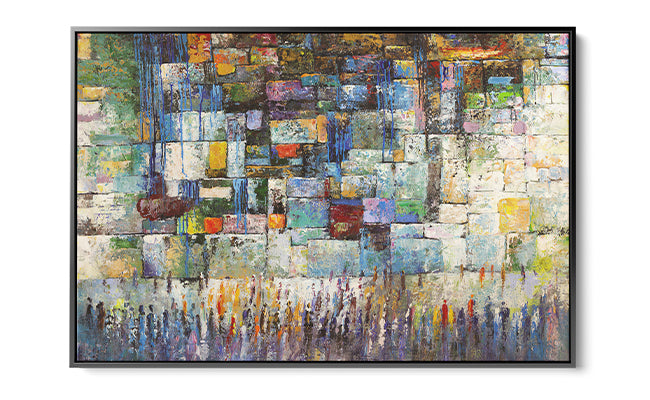
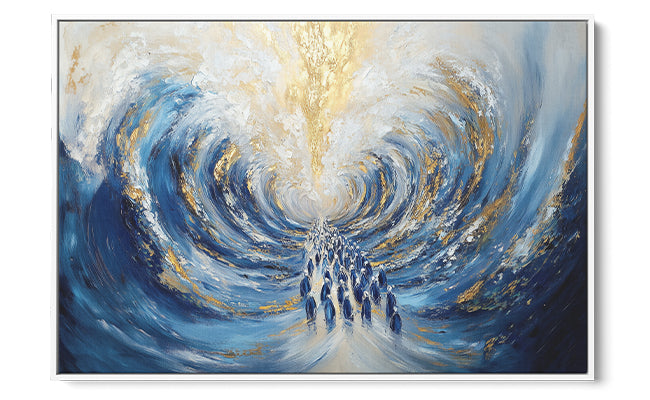
In the 20th century, as Jewish artists engaged with modernism, that impulse found new expression. Painters and printmakers began producing works specifically for Sukkot: Jerusalem landscapes, abstract interpretations of the four species, figurative scenes from the Exodus. These pieces occupied a space between fine art and ritual object, which is exactly the space the hiddur mitzvah principle has always occupied.
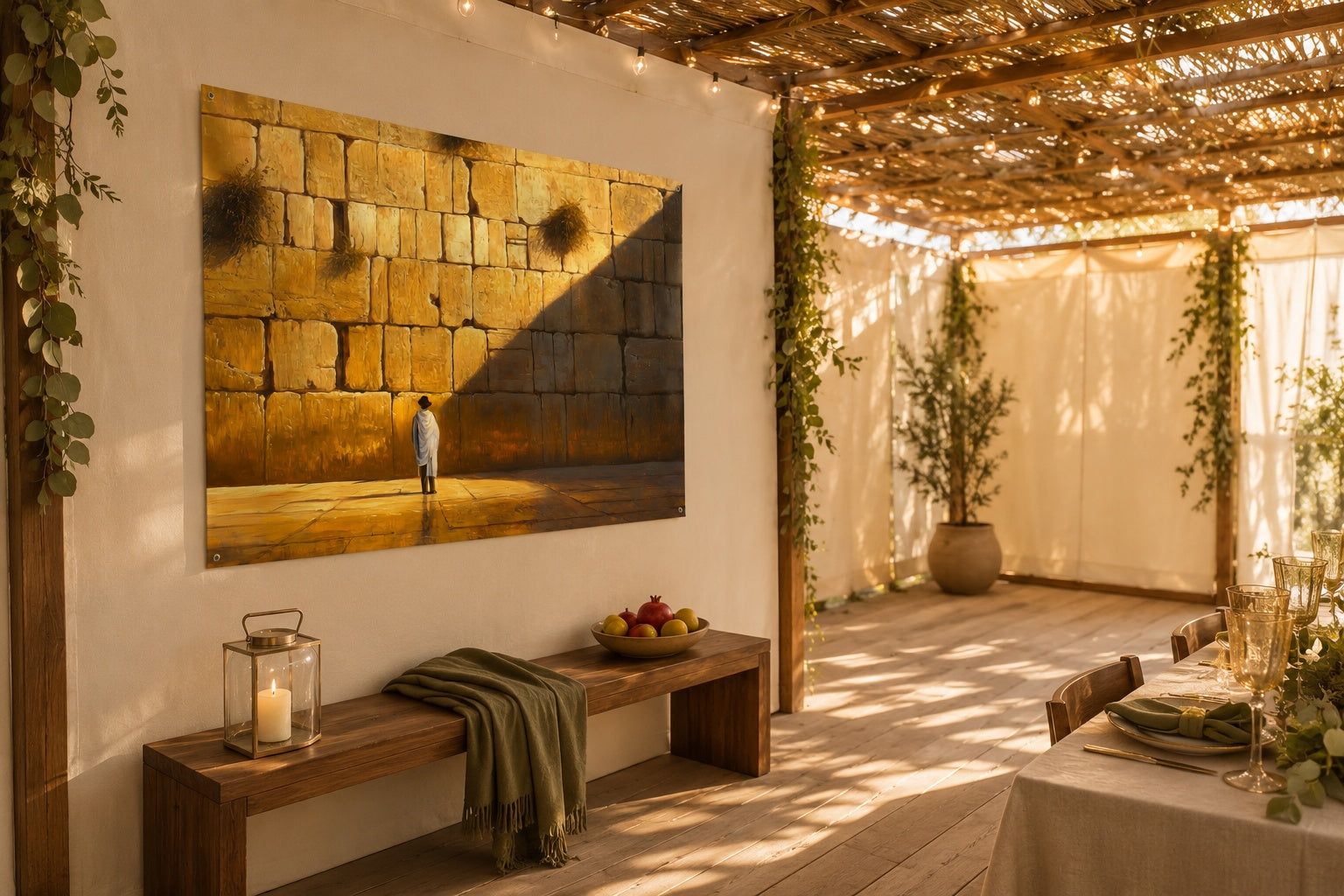
Contemporary artists working in this tradition continue the conversation. Rabbi portraits, scenes of the Western Wall, and impressionistic views of the Old City all carry the same symbolic logic as the ushpizin prints that hung in European sukkahs a hundred years ago: the sukkah wall becomes a window onto a landscape of memory, longing, and faith.
The rabbi portraits and spiritual art collection connects directly to this ushpizin tradition, offering a contemporary version of an ancient practice. For those drawn to Jerusalem's visual power, the Jerusalem modern Jewish art collection draws on a city that has anchored sukkah imagery across centuries and continents.
One practical note on scale: a piece that reads beautifully at 24 by 36 inches on a living room wall may disappear against a 10-foot sukkah panel. Think in terms of panels and wall sections, not individual framed pieces.

Modern Sukkah Decoration: From Paper Chains to Scenic Sukkah Wall Art Fabrics
The shift from handmade paper chains to high-resolution printed fabric panels happened gradually over the second half of the 20th century. Mass-produced plastic decorations, foam cutouts, and vinyl banners entered the market in the 1970s and 1980s, making elaborate sukkah interiors achievable without craft skills. The tradeoff was quality: plastic fruit and printed vinyl do not age gracefully, and they carry none of the tactile richness of traditional materials.
The more meaningful development of the past decade has been the arrival of UV-resistant, weatherproof fabric murals designed to cover entire sukkah walls. These are not posters. The best versions are printed on heavyweight fabric, built to handle outdoor humidity and direct sun, and sized to span standard sukkah wall dimensions (5 by 3 feet up to 10 by 5 feet and larger). They change the fundamental visual experience of being inside a sukkah: instead of a collection of hanging objects, the space becomes a coherent environment.
The scenic sukkah wall art fabrics collection illustrates what this format can do at its best. Panels like the Lake Path Landscape and the Mountain View Stone Balcony designs use perspective and depth to make the sukkah feel spatially open rather than enclosed. That is a specific design choice worth thinking about: an image that leads the eye outward (a path receding toward water, a balcony opening onto a mountain range) changes how a small sukkah feels to sit in. A lush, close-up image like the Cherry Blossom Forest panel, by contrast, wraps the interior in texture and warmth, creating a sense of sheltered abundance rather than expansiveness.
Neither approach is better. The right choice depends on the sukkah's dimensions and how the family uses the space. A narrow 6-by-8-foot sukkah benefits from perspective-based imagery that reads as depth. A larger sukkah used for communal gatherings can handle an immersive, pattern-rich panel without feeling claustrophobic.
One detail that consistently surprises first-time buyers: sukkah fabric panels read very differently under warm versus cool artificial light. Landscape panels with natural greens and blues can look flat and slightly harsh under cool white LEDs. Warm-toned bulbs (around 2700K) bring out the depth of photographic nature imagery in ways that cool lighting simply cannot. Plan your light sources before finalizing art selections.
For those newer to the full scope of sukkah decor options, the overview of how a sukkah is decorated covers the practical decisions alongside the aesthetic ones.

How to Choose Meaningful Sukkah Decorations That Honor the Tradition
Bringing the historical context to bear on a real buying decision is where this history becomes practical. Here is a three-step framework that mirrors how the tradition has always operated: start with intention, then consider the space, then select materials.
Step 1: Clarify your intention. What do you want the sukkah to feel like? A place of joyful harvest abundance? Spiritual contemplation? A space that connects children to Jewish history? Your answer will determine whether you gravitate toward floral and landscape imagery, representational Jewish art, Hebrew text pieces, or a mix. The tradition supports all of these; none is more "authentic" than the others.
Step 2: Assess the space. Measure your walls before buying anything. Standard fabric panels come in sizes ranging from 5 by 3 feet to 10 by 5 feet. For a full three-wall effect, most families need two to three panels. Factor in the doorway, any windows, and the position of the table relative to the walls people will actually look at while seated. The seated sightline is the one that matters most.
Step 3: Choose materials that match your priorities. Paper decorations and fresh produce offer seasonal authenticity and biodegradability. Framed prints or canvas panels bring permanence and visual weight. Full-wall fabric murals (UV-rated and waterproof) solve the weather problem for outdoor sukkahs and can be rolled and stored for multiple years. The best sukkah interiors usually combine all three layers: a wall-scale base, mid-level artwork or text pieces, and hanging ceiling decorations that connect the schach to the walls visually.
Common mistakes to avoid:
- Hanging too many small pieces on different walls with no unifying palette. Pick two or three colors and let them recur across the space.
- Buying decorations scaled for indoor walls without accounting for outdoor exposure. Uncoated paper and untreated wood degrade quickly in humid conditions.
- Ignoring lighting. The wrong color temperature can undermine even excellent imagery. Plan your light sources before finalizing art selections.
- Forgetting the ceiling plane. The schach is the roof, but the visual space between the hanging decorations and the walls either coheres or fragments. A few long hanging garlands or pendant lanterns bridge that gap.
- Prioritizing novelty over longevity. A decoration that looks clever the first year and dated the second is exactly what hiddur mitzvah asks you to avoid. Invest in pieces that deepen in meaning over repeated use.
The practical guide to decorating a sukkah with art goes deeper on placement specifics and hanging methods for different wall materials.
The table below compares the main decoration formats across the criteria that matter most for outdoor sukkah use, weather resistance, reusability, and best application.
| Decoration Type | Best For | Weather Resistance | Reusability |
|---|---|---|---|
| Fresh produce and botanicals | Seasonal authenticity, sensory richness | None (single use) | None |
| Paper cutouts and chains | Family craft tradition, ceiling fill | Low (humidity damages quickly) | One season |
| Framed prints and canvas | Focal wall, ushpizin tradition | Moderate (covered sukkah only) | Many years |
| UV-rated fabric wall murals | Full-wall coverage, outdoor sukkahs | High (designed for outdoor use) | Many years |
For those who want a single cohesive starting point for this year's sukkah, the complete Sukkot decorations collection organizes options across formats and styles.
Frequently Asked Questions
What is the purpose of decorating a sukkah in Jewish tradition?
The purpose is hiddur mitzvah, beautifying the commandment. Jewish law requires dwelling in the sukkah but does not mandate decoration. The decoration fulfills a separate, aspirational obligation: performing religious acts with beauty and intention, not merely technical compliance.
What decorations are traditionally hung inside a sukkah?
The Talmud specifically mentions hanging fruits (pomegranates, grapes, almonds, and gourds) from the schach, alongside colored cloths on the walls. Over time, regional traditions added paper cutouts, brass lanterns, embroidered textiles, ushpizin prints, and Hebrew text panels. The throughline is always a combination of produce (connecting to the harvest), imagery (connecting to the Land of Israel and Jewish history), and text (connecting to prayer and blessing).
How has sukkah decoration changed from ancient times to today?
The shift has been from exclusively natural, locally sourced materials toward manufactured and then digitally produced ones, while the underlying symbolic vocabulary has remained largely constant. What changed most dramatically is scale: contemporary fabric murals can cover an entire wall with a single image, something that required commissioned oil paintings in earlier centuries and was available only to the wealthy. The democratic availability of high-quality visual material is genuinely new.
Is there a religious requirement to decorate the sukkah or is it optional?
Structurally, decoration is optional: a bare, valid sukkah fulfills the biblical commandment. But the hiddur mitzvah principle means that "optional" undersells it. Rabbinic tradition consistently encourages beautification as a positive religious act. The Talmud's detailed discussion of decoration halacha confirms that the practice was treated seriously enough to generate legal analysis, not merely cultural habit. Most halachic authorities consider some degree of beautification to be praiseworthy, if not strictly obligatory.
What is the difference between traditional and modern sukkah wall coverings?
Traditional wall coverings were primarily fabric (silk, linen, embroidered cloth) or painted wood panels, handmade and often passed down through families. Modern options range from vinyl banners (inexpensive, low durability) to high-resolution fabric murals printed on weatherproof material and sized to cover full walls. The practical difference is weather performance and reusability: quality fabric murals rated for UV and moisture can last a decade or more with proper storage, while traditional cloth hangings required protection from the elements and regular maintenance.
Can Jewish artwork and prints be used as sukkah decorations?
Absolutely, and the precedent is centuries old. Italian Jewish communities commissioned oil paintings for their sukkahs; Eastern European families hung printed ushpizin portraits of Abraham, Isaac, Jacob, Joseph, Moses, Aaron, and David. The main practical consideration for outdoor or semi-outdoor sukkahs is the framing and substrate: canvas or fabric-backed prints handle humidity better than paper prints in standard frames, which can warp and delaminate after a single damp night. For permanent sukkah art that also functions in the home during the rest of the year, canvas or acrylic-mounted prints are the most durable and versatile format.
To see the full range of large-format sukkah wall fabric options, the full-wall sukkah fabric mural collection brings together landscape, nature, and architectural designs built specifically for outdoor sukkah conditions.
Read more
Best Sukkot Decorating Ideas for a Beautiful and Festive Holiday
Practical, visually specific ideas for decorating your sukkah with meaning, from Hebrew blessing prints and Ushpizin posters to natural elements, lighting, and family-made crafts.
Read more